Verse 11816aahai
G13
1
the dew on the tulip-flower is not devoid of charm/coquetry
2
the wound/scar of a heart without pain/compassion is a viewing-place of modesty/shame
'A rose; a flower; a red patch (on anything); ... speck or pearl (in the eye)'.
'Grace, beauty; elegance; graceful manner on carriage; charm, fascination; blandishment; amorous signs and gestures, coquetry'.
' A mark burnt in, a brand, cautery; mark, spot, speck; stain; stigma; blemish; iron-mould; freckle; pock; scar, cicatrix; wound, sore; grief, sorrow; misfortune, calamity; loss, injury, damage'.
'Pain, ache; affliction; pity, compassion, sympathy; affection'.
zar-gaah>> : 'The place where anything is kept for view or inspection; a place where any spectacle is exhibited, a theatre, ampitheatre'.
'Shame, sense of shame, modesty; pudency; shyness, bashfulness'.
| References | |
|---|---|
| Arshi, Imtiyaz Ali | Ghazal# 179 |
| Raza, Kalidas Gupta | 268-69 |
| Nuskhah-e-Hamidiyah | 275-276 |
| Gyan Chand | 395 |
| Hamid Ali Khan | Open Image |
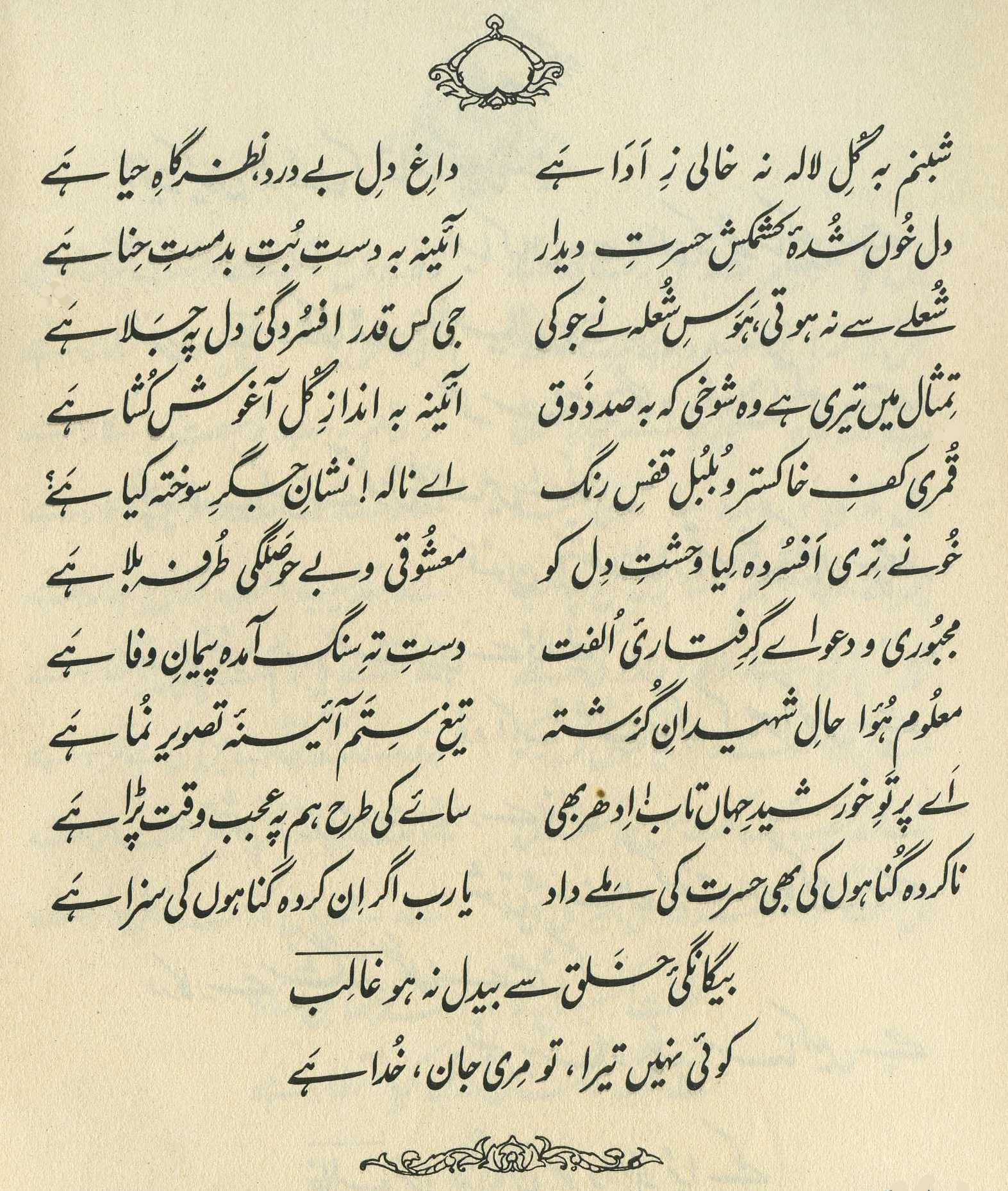
On the tulip-flower the dewdrops are fulfilling a purpose. It is this: in the heart in which there would be no pain, and there would come to be a wound/scar, it is an occasion for shame. That is, the tulip has a wound, but is devoid of the pain of passion, and this fact is for it a cause of shame. And out of embarrasment, it reveals the 'sweat of shame' []. In the first line, for to be with is contrary to the idiom. Instead of one ought to say . (259)
== Nazm page 259

He says, the dewdrops that are visible on the tulip-flower are not devoid of airs and graces. It's as if they are gesturing toward the fact that there is a wound in the heart, but there's no pain and burning. Thus the dewdrops are acting as the 'sweat of shame' []. As if the 'rose' of the tulip had burst into sweat because of this shame. (315)
[Disagreeing with Nazm:] Oh Protector [God]-- that there would be a wound, and no pain! What meaning can this verse be considered to have, if this is considered to be its interpretation? It might be considered that when the poet has seen a wound in the tulip, and has also seen dewdrops, then the question arose, why is such the case? Then his lofty temperament of its own accord gave that answer that is mentioned in Janab [Nazm] Tabataba'i's solution. But about it this can be said: why didn't the viewer consider that if in the heart there would be a wound, then what's the meaning of not weeping? That is, the one who is wounded will certainly weep. If the reply be given that the poet leaves the beaten track, then for there to be no pain in the heart remains a mere prayer, although it's true that poetic prayers are not forbidden. But as long as a determinate and enjoyable meaning would emerge without elaboration, then what's the need for elaboration? (474)
This verse has always nagged at my mind, because it's such a classic, unresolvable case of enigmatic 'A,B' structure. The two lines are grammatically and semantically quite independent. So how are we to decide on the connection between them? Do both lines basically describe the same situation? Is one to be considered a cause, and one a reaction or result-- and if so, which way around? Or are the situations in the two lines meant to be contrasted?
One reason that these relationships are hard to resolve is the complexity and abstractness of the information we're given. Even in the first line, can be either a passive, even involuntary quality ('grace, beauty, elegance') or a very active one ('blandishment, amorous signs and gestures, coquetry'). So we don't know whether the dewdrops are flaunting their beauty and preening themselves flirtatiously, or are merely innocent bystanders who have no idea of their own attractions. This dual possibility means we're hopelessly unable to pin down the further multivalences in the second line.
For in the second line, the ambiguities are piled on top of each other. A is either a 'wound' or a 'scar', so it might be either something recent or something experienced long ago. In any case, it's clearly established in the ghazal world that the tulip has exactly such a ; on this, see 33,1 .
A heart that is is without 'pain, ache'-- or else without 'pity, compassion'-- or even without 'affection' (see the definition above). And the somewhat elusive might refer to the kind of 'shame' that is a sign of innocence and virtue ('modesty, shyness'); or else to the kind of embarrassment or sense of shame that results from an awareness of improper behavior.
There's also the enjoyably paradoxical , a 'viewing-place' or 'theater' of the very quality that would make one unwilling to be publically viewed.
In short, the dewy tulip might be full of innocent loveliness, or else shameless flirtation. And the wound or scar in a heart that is without pain, or else without pity or sympathy, may be that of the tulip, or that of a lover, or just a general abstraction; and its moral status may be as a display or theatrical spectacle either of becoming and suitable modesty, or else of embarrassment and real shame (at wrongdoing or impropriety?). We can mix them and match them as we like, and take our pick.
graphics/dewdrop.jpg