Verse 11816aa;Gkaa
G3
1
not a single grain of the earth of the garden is useless
2
here even/also the path is the wick/bandage of the tulip's wound/brand
'A wick; a match; a fuse'.
'A tulip; (in India, also) the red poppy'.
'A mark burnt in, a brand, cautery; ... scar, cicatrix; wound, sore; grief, sorrow; misfortune, calamity'.
| References | |
|---|---|
| Arshi, Imtiyaz Ali | Ghazal# 22 |
| Raza, Kalidas Gupta | 147 |
| Nuskhah-e-Hamidiyah | 67-68 |
| Gyan Chand | 105-106 |
| Hamid Ali Khan | Open Image |
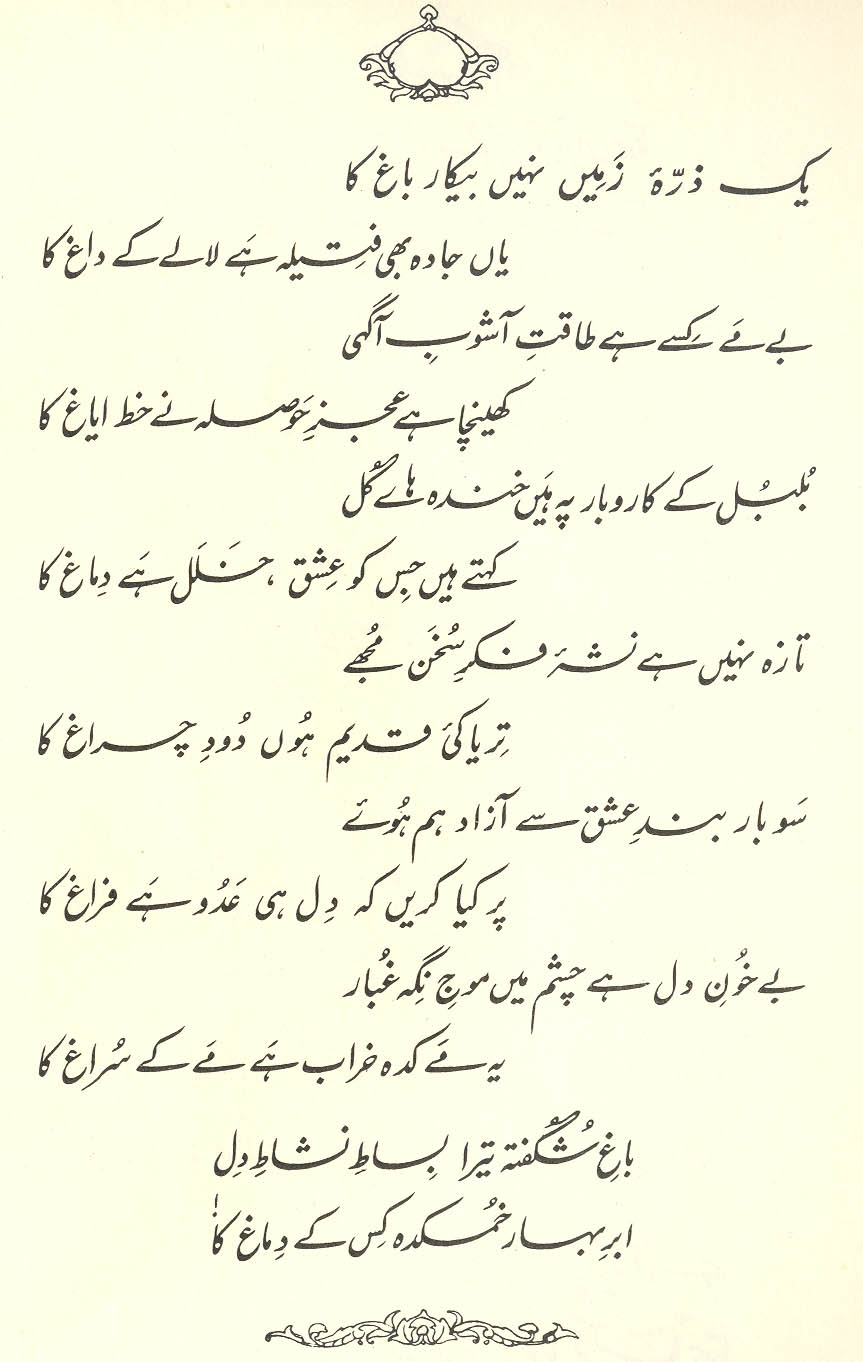
If we take to mean 'wound', then is that rolled-up bandage that they put in a wound, and if we take it to mean [a burning] 'lamp', then [as 'wick'] is the cause of its radiance. In the first case, the lush growth of greenery has caused the path to grow so thin that it's become like the vein of the tulip. And the 'wound' is the special feature of the tulip because it would prove the claim of excess against the numerousness of the colorful roses and the intensity of the greenness of the greenery. And in the second case, it means that the path has the same affinity with a tulip that a wick does with a flame. (31-32)
== Nazm page 31 ; Nazm page 32


Urdu text: Vajid 1902 {33}
He says that this time spring has come to the garden so riotously that not a grain of earth has remained useless: the garden paths have become covered with greenery, and it's as if they have become ointment-covered rolled-up bandages for the tulip's wound. (62)
Even the path, which separates the gardens, has doubled the beauty of the tulips. As if it were a wick, through which the lamp of the tulips was lit.
[Also,] in this verse is the theme of the insubstantiality of the world.... The path is illumining the fact that the world of luxury and joy has no stability; rather, the fruit of seeking worldly enjoyment is a wound-- and that too a wound like the tulip's, which remains forever. (78)
Nazm explains the wordplay of and . You might think that in a gorgeous, voluptuous garden the path through it would be 'useless' in contributing to the visual effects. But far from it. The long, narrow path can serve as a certain kind of rolled-up bandage used for deep wounds and called metaphorically a 'wick'. And since the tulip's wound is a flaming one contained inside a deep cup, it resembles an oil lamp, and the path can act as a a 'wick' for it.
Thus in one sense, the as a wick makes possible the flame of the tulip; in another sense, the as a bandage soothes the fiery wound of the tulip. It thus plays two contradictory roles at once, both of them crucial. And the path itself, the particular word , seems to be a part of Ghalib's regular tool kit of highly abstract images; for other examples, see 9,4 .
The word , 'here', may mean 'in the garden', thus suggesting what an unusually complex microcosm the garden really is. Or it may mean 'in this world', thus suggesting that the world is full of signs that have meaning for the mystically perceptive (consider 13,1 ). What is here a single grain of dirt, , is normally conceived of by Ghalib as more like a sand-grain, and in that role too it is is full of mystical possibilities (see 16,4 ).
We don't get to know any of this until the second line, of course. The first is a general statement; the second provides an instance or proof of it.
ABOUT THE AND ITS : By convention the has a 'wound' or 'scar' in its heart, indicated by its dark, scorched-looking center; thus its heart resembles that of the lover, which has at its center the black (on this see 3,2 ), and is flaming with passion, and finally burns itself out (and which also melts into bright red blood the color of the flowers). In the real world, there are lots of species of tulips; they have all kinds of different-looking centers. Moreover, in India the can also become a red poppy (see the definition above); for more on such stylization, see 60,8 . The important thing is that in the ghazal world, the is always inwardly dark or blackened, to show that the flower's heart is scorched or burnt-out, with a 'wound/scar' of (mystical?) suffering. Other verses that invokes the tulip's 'wound' or 'brand': 146,4x ; 155,1 ; 230,1 .
Different kinds of formations: a tulip, and a red poppy:
graphics/tulip.jpg
http://www.flickr.com/photos/22612111@N05/2396712744/ graphics/tulip.jpg
http://www.flickr.com/photos/deerwooduk/3629203179/ http://www.flickr.com/photos/kmorrisonimages/2461128554/ http://www.flickr.com/photos/deerwooduk/3629203179/ graphics/redpoppy.jpg
