Verse 51816aa;Gkaa
G3
1
a hundred times, from the bondage of passion we became free
2
but what can/would we do? --for only/emphatically the heart is an enemy of freedom/disengagement
'Freedom (from business, &c.), disengagement, &c.'
| References | |
|---|---|
| Arshi, Imtiyaz Ali | Ghazal# 22 |
| Raza, Kalidas Gupta | 147 |
| Nuskhah-e-Hamidiyah | 67-68 |
| Gyan Chand | 105-106 |
| Hamid Ali Khan | Open Image |
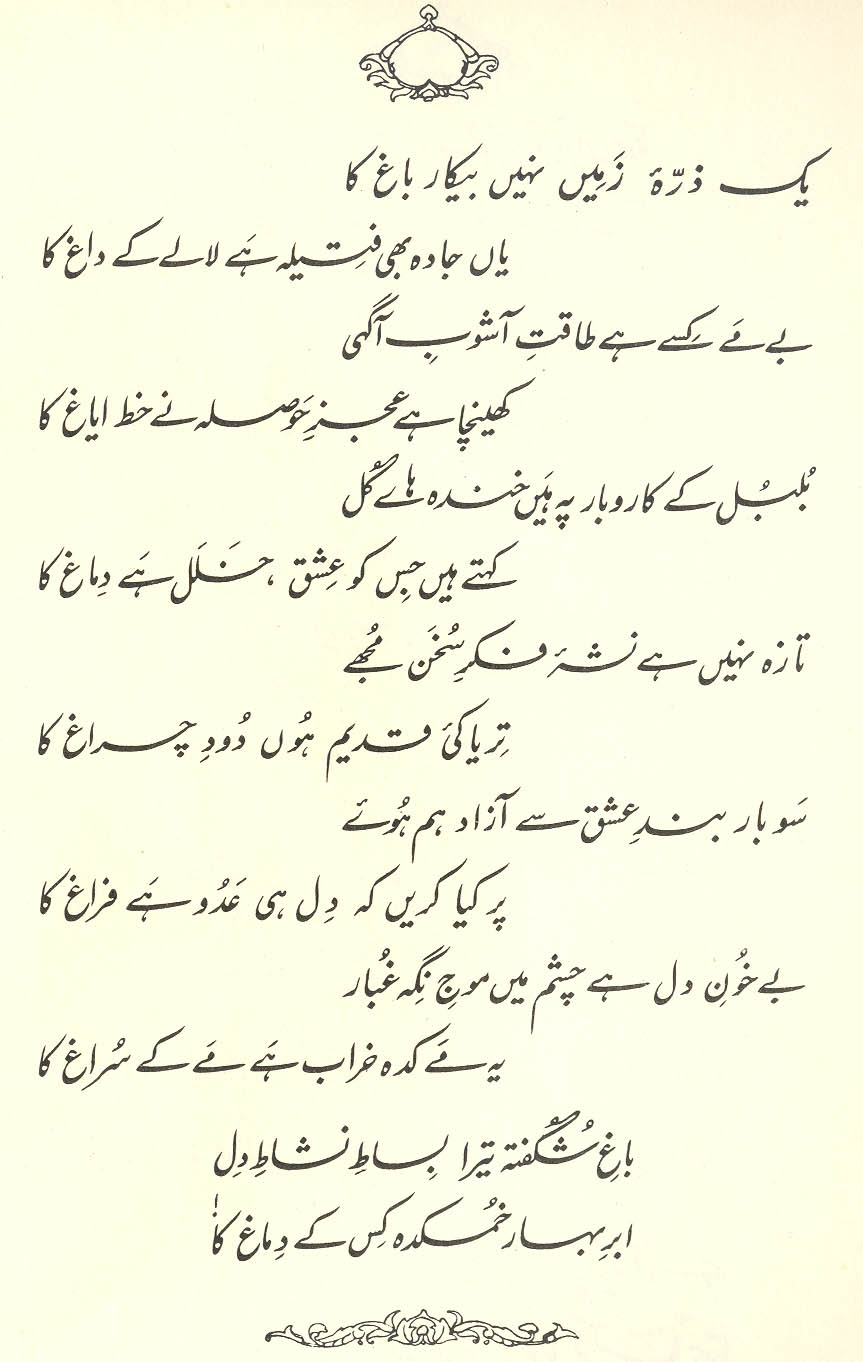
That is, when we are free, the heart again gets itself captured. (32)
== Nazm page 32

In this verse Mirza Sahib has made emotions wear the garb of an allegory . Here by passion is meant love of the world, and by the bonds of passion is meant entrapment in that love.... That is, while living in the world a man can never be without involvement and care. (63-64)
Our heart itself doesn't like to be at rest. Here we escaped from the prison of passion, and there it entrapped us again. That is, we are compelled by our temperament. This wretched temperament won't listen. (79)
The lover depicts himself as free-- and yet not free. In fact he's really kind of a 'lifer'. After all, if he'd such a recidivist that he's voluntarily returned to bondage 'a hundred times', how voluntary is his choice? If his heart itself refuses to be at peace outside the 'bondage of passion', how real is his chance to escape? In this seemingly simple verse, with no obvious pyrotechnics, Ghalib nevertheless makes us wonder about the nature of 'freedom'.
Even this somewhat dubious claim to 'freedom' is unusual, since normally the lover depicts himself as utterly trapped, unable to escape from his passion, like someone with his 'hand under a stone' 230,7 .
Compare 42,4 , an even more severe reproach to the treacherous heart.
graphics/captiveheart.jpg