Verse 61816aa;Gkaa
G3
1
without heart's blood, in the eye the wave of the gaze is dust
2
this wine-house is ruined for [want of] a trace of wine
'Look, glance, sight, view, regard; consideration'.
'Ruins, desolate places; --A tavern; --a brothel (such being usually kept in ruins)'.
'Dust; clouds of dust; a dust-storn; vapour, fog, mist, mistiness; impurity, foulness; (met.) vexation, soreness, ill-feeling; rancour, spite; affliction, grief; perplexity'.
| References | |
|---|---|
| Arshi, Imtiyaz Ali | Ghazal# 22 |
| Raza, Kalidas Gupta | 147 |
| Nuskhah-e-Hamidiyah | 67-68 |
| Gyan Chand | 105-106 |
| Hamid Ali Khan | Open Image |
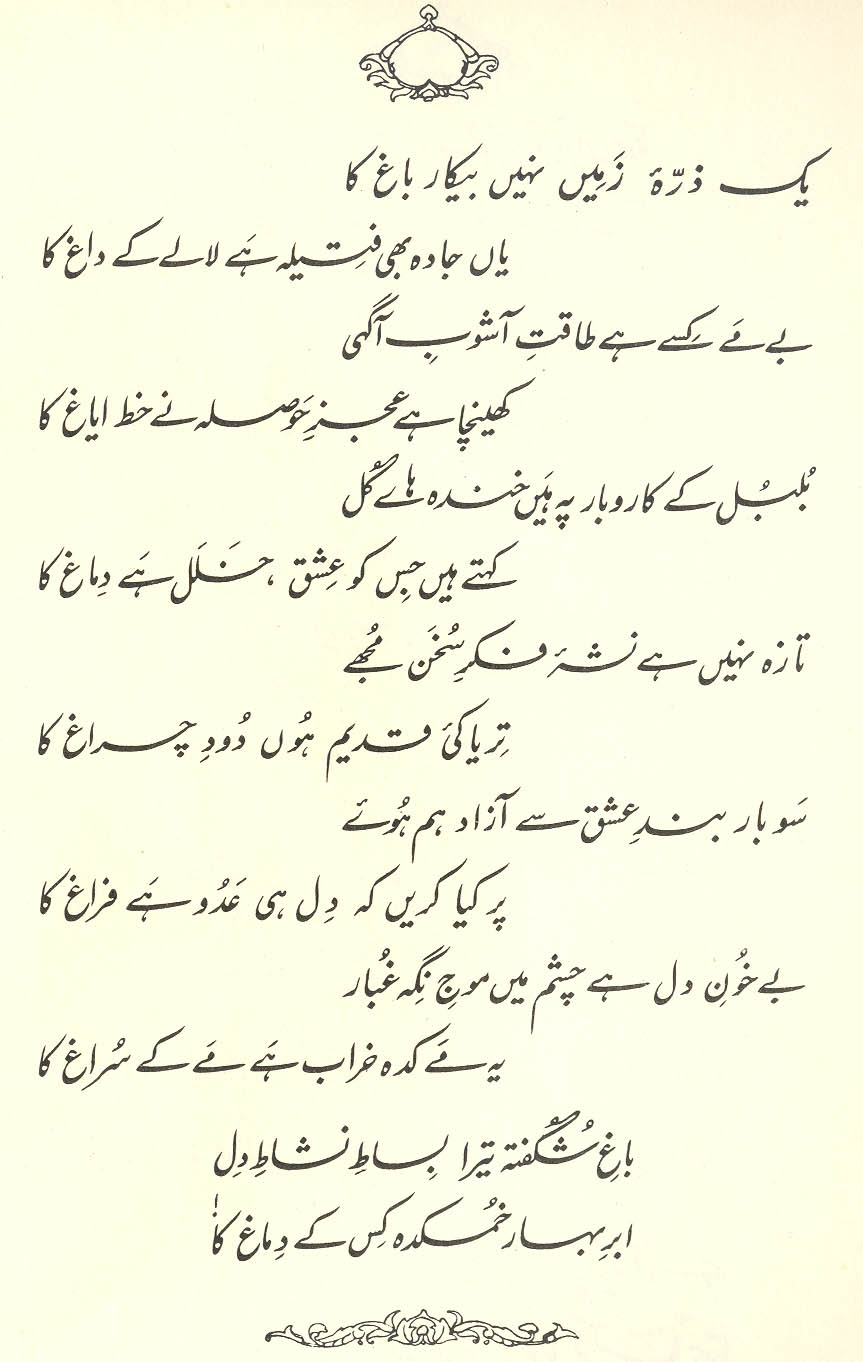
The eye is the wine-house and wine, the blood of the heart. And if the blood of the heart is not in the eye, the wave of the glance has become dust, as if a wine-house is becoming ruined and dust-covered in the search for wine. (32)
== Nazm page 32

Urdu text: Vajid 1902 {33}
To use dust as a simile for the wave of a glance is very suitable, and the word for a wine-house too is not devoid of a [special] mood . (32)
He says, man's eye has been created so that it would always keep on shedding tears of blood. If heart's blood doesn't flow from the eye, then instead of a wave of a glance dust begins to fly around within the eye. That is, the eye's adornment and glory has bitten the dust. This wine-house-- that is, the human eye-- becomes ruined without wine. The affinity of the words-- what an achievement! (64)
The gist of the meaning is that the glory of the eyes is to continue to shed blood through remembering the beloved. (79)
[The use of] for a wine-house is very enjoyable. (109)
The truth is that there is affinity of words no doubt, but by way of meaning, the word 'wave' is useless. And perhaps calling the glance 'dust' can be considered as comparing the scatteredness of the glance with the scatteredness of dust. (168)
The commentators point to the enjoyable wordplay, especially that of calling a wine-house or ruined, and thus invoking , a word for ruins that can mean wine-house as well.
This verse recalls 7,4 , with its blood, dust, and a sea (full of waves of course). But in this case it's a little easier to put together its imagery.
As so often, Ghalib leaves us to connect the two lines for ourselves. But he gives us a little more of a hint than he often does: in the second line 'this' wine-house implies that the winehouse is something mentioned in the first line. And surely, of the available nouns (heart, blood, wave, gaze, dust, eye) the most probable candidates are the heart and the eye; or the reference could conceivably be to the body itself, home to both heart and eye.
Whether the wine-house is heart, eye, or body, the obvious sense is that without the blood of the heart it is ruined, a mere shadow of its real (former?) self. The sign of its ruin is that 'the wave of the gaze is dust in the eye', Clearly has both the literal meaning of 'dust', which is appropriate since a formerly wet riverbed would turn to dust when it dried, and the metaphorical meaning of 'vexation, grief' (see the definition above), which is appropriate since the drying up of the wellspring of passion would reduce former delights to mere aggravations.
It used to be believed that sight happened when the eye sent out beams onto the objects of vision. Speaking of the 'wave of the gaze' is thus beautifully appropriate here-- the gaze that was formerly a flowing wave of blood is now reduced to a blowing wave of dust.
With thanks to Rafiq Kathwari (Sept. 2016), this unforgettable image:
graphics/wine.jpg