Verse 71816aa;Gkaa
G3
1
your garden in bloom-- a carpet/spread of the joy/fruitfulness of the heart
2
a spring raincloud-- the {cask/distillery}-house of whose mind?
t>>: 'Anything that is spread out; surface, expanse, expansion; carpet; bedding; chess-cloth of chess-board, dice-board; --goods, wares, &c'.
t>> : 'Growing; being produced; springing up, appearing; —anything growing, or produced; —a product; a creation; —a creature'.
t>> : 'Liveliness, sprightliness, cheerfulness, gladness, glee, joy, pleasure, exultation, triumph'.
'A large vessel or jar; an alembic, a still'.
| References | |
|---|---|
| Arshi, Imtiyaz Ali | Ghazal# 22 |
| Raza, Kalidas Gupta | 147 |
| Nuskhah-e-Hamidiyah | 67-68 |
| Gyan Chand | 105-106 |
| Hamid Ali Khan | Open Image |
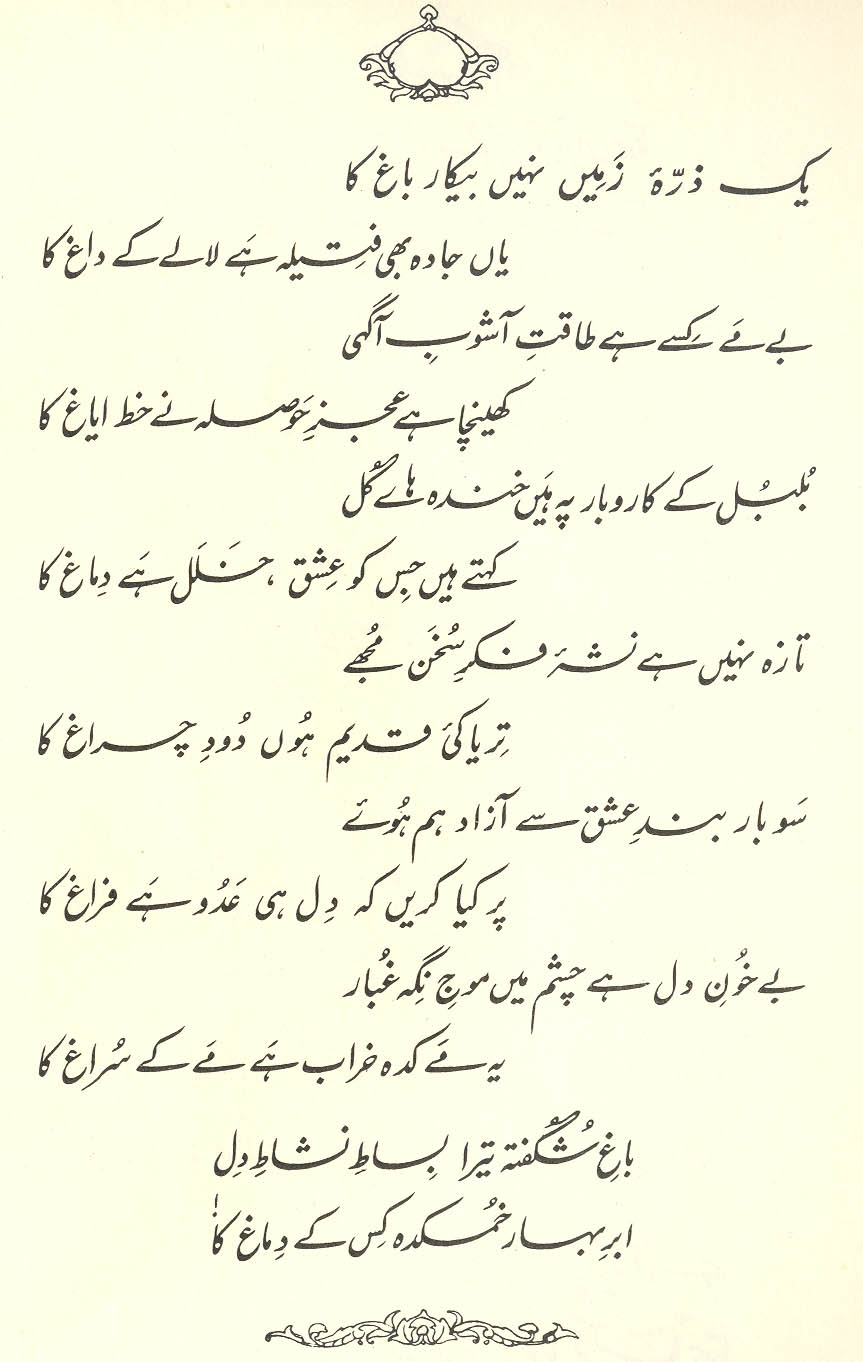
In the first line 'is' is omitted . The meaning is that when sometimes the garden creates joy, then I reflect-- the spring raincloud, which has filled the glass brimful with the wine of color and scent, of whose mind is it the wine-house? (32)
== Nazm page 32

Urdu text: Vajid 1902 {33}
He says, what makes the bud of my temperament bloom is the springtime of your garden of beauty, and this garden is always in bloom and forever flourishing. The cause of my existence can't be the spring raincloud. This wine-house-- that is, the spring raincloud-- has been created in order to intoxicate and render unconscious no telling whom.
The meaning is that ordinary wine-drinkers can take pleasure in spring, and their minds can find pleasure and rest in strolling through the blooming roses and the garden. In order to make me bloom, there is your beauty and the springtime of your beauty. (64)
A blooming garden is a source of enjoyment for you. Then, for whose mind is the wine-house of the spring raincloud a source of joy and intoxication? That is, everything in the world has been made for you. This verse has been composed for mankind: every adornment in the world has been made only for him. (79)
The affinity of the words is manifest, and there will be scarcely any verse of Mirza Ghalib's that will be devoid of this affinity. Here, he has brought in 'wine-house' through its affinity with 'spring raincloud', and the affinity of 'mind' and 'intoxication' also needs no commentary. (130)
Unusually, the divan version of this ghazal has no closing-verse ; it originally had one, but Ghalib chose to omit 33,8x from the published divan.
This is what I call a 'list' verse (for more on these, see 4,4 ), since it entirely dispenses with verbs, and gives us simply three entities A, B, C, and a brief question D that is not grammatically connected to any of the earlier three. Of course we may well feel that A and B in the first line are equated, while C is referred to in D; this seems to be the most obvious reading. But there could certainly be other ways of putting all the elements together, and some of the commentators seem to play with them rather freely.
The word works excellently here, since it's usually used for casks of wine or whiskey. The large dark thick shape of the raincloud is well suited to evoke such a cask, with its sense of bulk storage, and even of the secondary meaning of 'alembic' or 'still' (see the definition above). In whose mind would we find the cask-house, or distillery-chamber, where vessels like the spring raincloud were stored?
The construction being what it is, the carpet 'of' the joy of the heart might be one that 'is' the joy of the heart; or one that 'pertains to' the joy of the heart; or one that somehow creates or generates it, or is created or generated by it. Then these protean effects are echoed even more complexly by those of and in the second line. Is the distillery-house 'of' the mind one that 'is' the mind; or one that 'pertains to' the mind; or one that creates or somehow 'distills' the mind; or one that the mind somehow creates or distills?
The question also arises, who are the two entities being discussed? One of them is addressed, and in the most intimate way. (The possessive has to apply to the garden, because is feminine.) But this is not the person inquired about in the second line. The speaker is well aware of the creative prowess of the 'you'-- the 'you' is the creator or essence of the garden in bloom, and thus is linked to the joyous expansion of the heart that apparently in some sense 'is' the garden.
But the speaker seems to feel that the spring raincloud that waters the garden has another source-- one who has a mind, but whom he doesn't know, and whom the 'you' may or may not know. This second creator might be a higher power: the garden needs the raincloud, but the raincloud doesn't need the garden. (For more on spring and the rainy season, see 48,7 .)
We might identify the 'you' as the beloved, leaving the second, unknown, entity to be God. But what if we identify the 'you' as God? Then the verse becomes a remarkable meditation indeed. Look at the parallel structures of the two lines: in the first line, the garden is the carpet of somebody's (the speaker's? the addressee's?) joy of heart; in the second line, the raincloud is the wine-house of somebody's (whose?) mind. The garden may be to the (metaphorical?) carpet of joy, as the cloud is to the (metaphorical?) wine-cask of the mind.
What kinds of equation are intended here? We really don't have enough information to give any one reply. Is there a pantheistic presence behind the universe, for whom the raincloud actually acts as a wine-cask or wine-storage chamber? Or is there a creator so protean that he uses the image of the raincloud for inspiration, so that it becomes source of intoxication and fertility for his mind?
There are also fine effects based on the Urdu script-- and differ from each other only in the placement and number of their dots. Thus they not only rhyme, but have a strong visual echo as well; this can hardly have been accidental. As a bonus, the word has two separately-derived meanings (see the definitions above), both of them completely apposite.
Compare Mir 's use of this kind of suggestive, haunting question in M 239,1 .
graphics/raincloud.jpg