Verse 4after 1821ardthaa
G3
1
from heart to liver, which is the shore of a sea of blood now--
2 a
in that roadway, the glory/appearance of the rose was formerly the dust
2 b
in that passage, the glory/appearance of the rose was formerly trivial/useless
'Manifestation, publicity, conspicuousness; splendour, lustre, effulgence'.
'To be or become dust: --to be worthless or good-for-nothing; to be as dust, to be easily removed or overcome, to be practicable or easy'.
| References | |
|---|---|
| Arshi, Imtiyaz Ali | Ghazal# 33 |
| Raza, Kalidas Gupta | 354 |
| Hamid Ali Khan | Open Image |
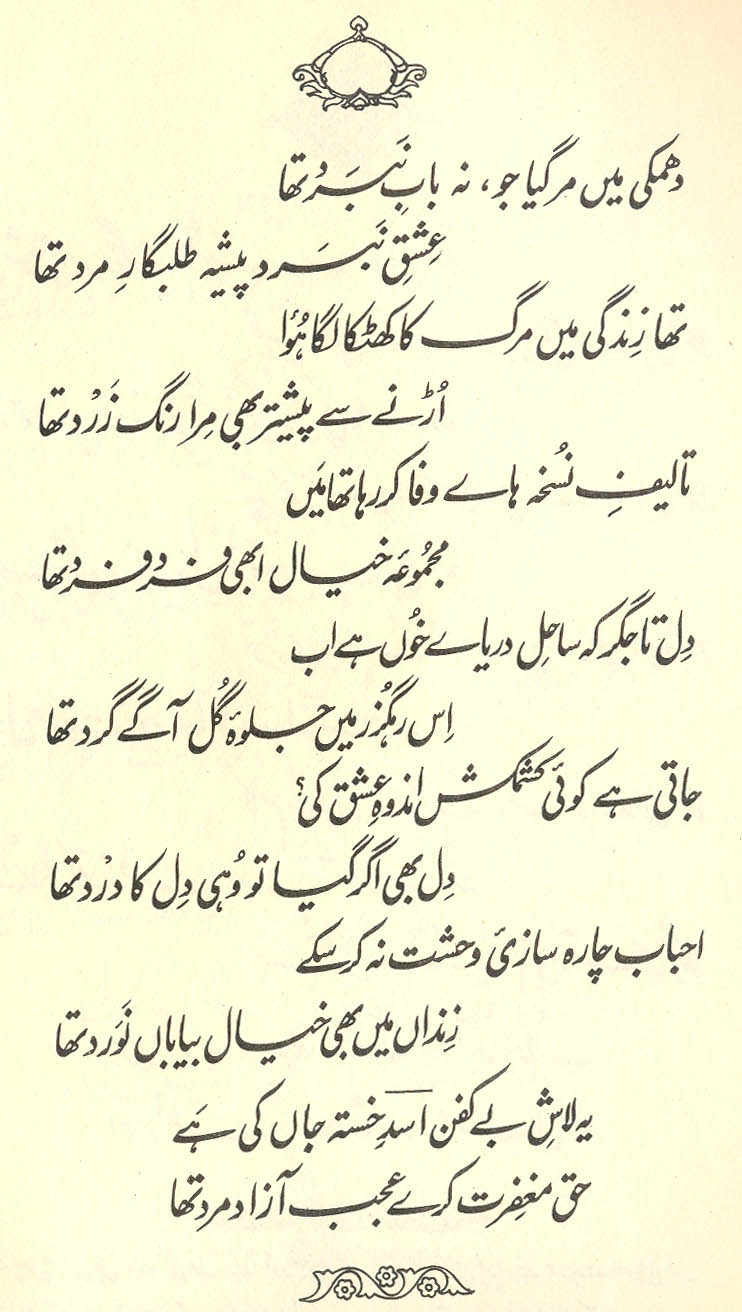
That is, from heart to liver there's now a river of blood; formerly, on that very road there was such flourishing that the glory/appearance of the rose became dust when compared to it. That is, once upon a time I too had a flourishing and colorful heart. (8)
== Nazm page 8

Urdu text: Vajid 1902 {7}
The meaning of the verse is that we too used to have, in the time of happiness and carefreeness, a joyous heart and a colorful temperament; constantly those springtimes remain before our eyes, compared to which the glory/appearance of the rose is dust. But such a revolution of the times has taken place that now from the heart to the liver is the shore of a sea of blood, and nothing else. (18-19)
Now, from the heart to the liver dust is flying-- that is, there's not even a trace of blood left. At one time, nothing but turbulent blood could be seen, which created such a flourishing in the heart that compared to it even the glory/appearance of the rose was dust. (13-14)
Bekhud Mohani puts the sea of blood in the past, so that now only its dried-out shore remains; the heavy flow of blood from liver to heart once provided resources for the radiant flourishing of love. (For more on the liver versus the heart, see 30,2 .) The difficulty is that the 'shore of a sea of blood' seems to make both ocean and sea equally present.
Most commentators go with Nazm, making the sea of blood a present sign of the breakdown of both liver and heart, which have melted away into blood. This view requires a previous state in which the liver-heart highway once had as its dust 'the glory/appearance of the rose'. Because the lover saw the beloved's beauty in every grain of 'dust' on the road, as in (2a)? Because the lover disdained the mere garden rose and considered it worthless, as in (2b), by comparison to the beloved's beaury?
How impossible it is to detect any tone in this matter-of-fact reportage! Is the lover sorry, or glad, or indifferent, about the change? The tone shifts with the reading, and vice versa.
Ghalib is very partial to 'dust' vs. 'glory/appearance' oppositions. For more examples, see 6,8x ; 68,4 ; 87,7 ; 114,3 ; 114,5 . (I also want to put 61,7 alongside these, as further material for thought.)
graphics/rosepathlahore.jpg