Verse 31826arme;N ;xaak nahii;N
G9
In this meter the next-to-last long syllable may be replaced by two shorts.
1
of which paradise-{qualities/winds} [-possessor] is this the imminent-arrival?
2 a
that other than the glory/appearance of the rose, in the roadway -- {nothing at all / not 'dust'}
2 b
that other than the glory/appearance of the rose, in the roadway there's no dust
'Excellences, virtues, talents, abilities; dispositions; qualities; customs; --northerly winds'.
'Manifestation, publicity, conspicuousness; splendour, lustre, effulgence'.
| References | |
|---|---|
| Arshi, Imtiyaz Ali | Ghazal# 101 |
| Raza, Kalidas Gupta | 365 |
| Hamid Ali Khan | Open Image |
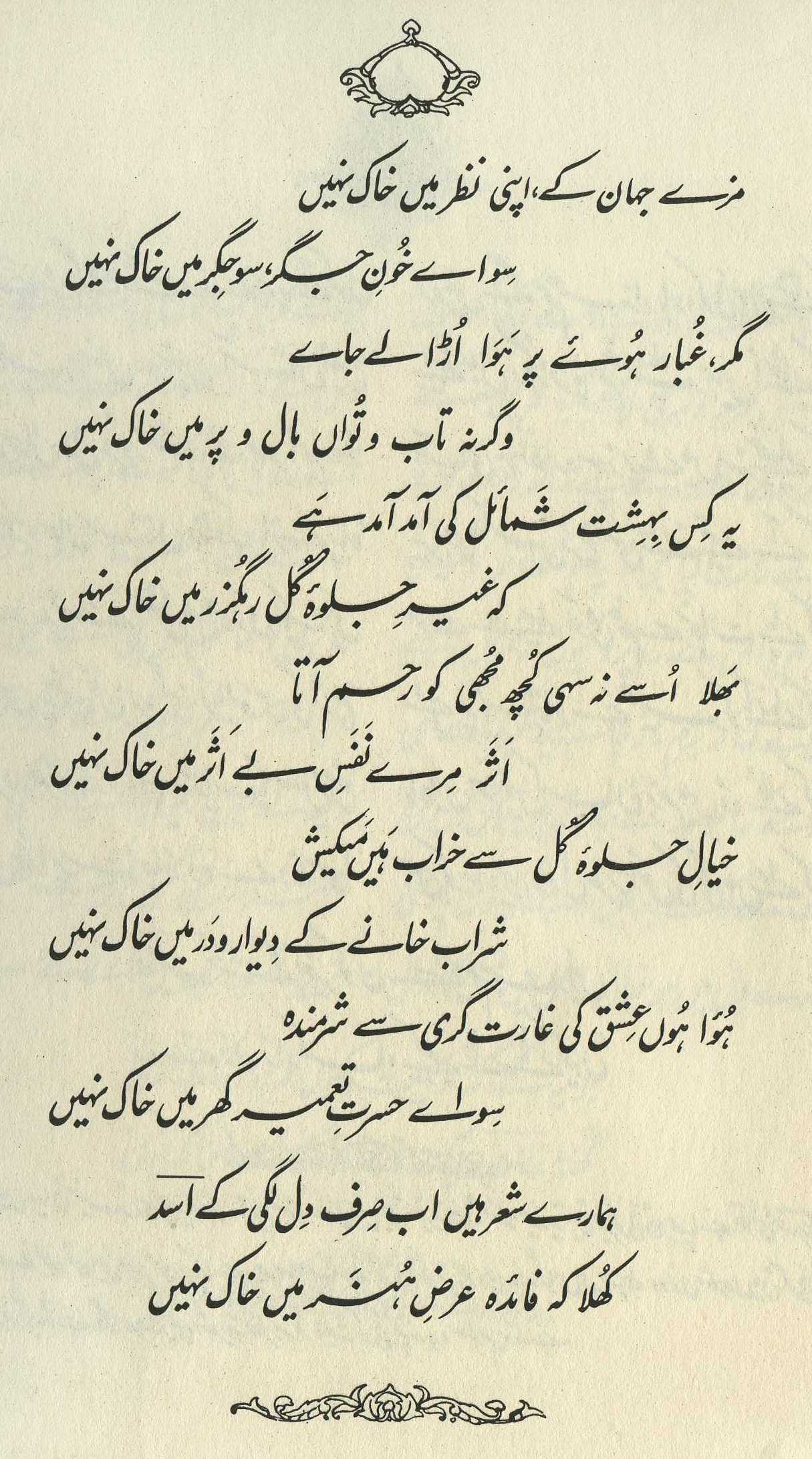
That is, in the roadway there is no dust, there is the glory/appearance of the rose. (123)
== Nazm page 123

He says, which possessor of paradise-qualities is on the way, such that except for the glory/appearance of the rose, there's no dust in the roadway? The meaning is that in paradise there will not be dust. From the wordplay of 'paradise-qualities', for there to be no dust in the world either except the glory/appearance of the rose, is not devoid of pleasure. (173)
The Lord knows which possessor of paradise-qualities is coming, such that in the road flowers have been strewn.
[Or:] To the one ardent for sight, in imagining the paradise-qualities-possessor the whole road seems to be dressed in roses. (231)
This verse, in Ghalib's favorite interrogative style, cleverly asks a question-- which it then even more cleverly doesn't answer, but leaves us to wonder and speculate about. On the idiom , see 114,1 .
The speaker notices that the roadway is, most unusually, free of dust; instead, it's full of the of the rose. Is this the same as being full of roses? Surely not. Rather than a stretch of roadway physically piled with flowers (and thus perhaps even impassible), other possibilities are easier to imagine. The 'glory' of the rose could be an 'appearance' or public display of-- well, of something overpoweringly roselike. A radiance resembling that of roses? An appearance like that of roses? A roseate mood, or scent, or shimmer in the air, or vibration in the atmosphere? Scattered petals on the ground, where dust would normally be?
Whatever its exact nature, this rose-glory either replaces the usual dust (2a), or itself is the dust (2b), thus doubly emphasizing the 'red-carpet' treatment being prepared. And the presence of the glory/appearance of the rose, and the absence of (other) dust, cause the speaker to conclude that some possessor of 'paradise-qualities' [] is arriving, and to wonder who it might be.
The operative word here is surely the unusual, arresting ; this is its only occurrence in the divan , and it surely deserves ' fresh word ' credit. In its more obvious sense, it helps generate the implication that in paradise there's no dust, only roses, so when we notice that condition on earth we can guess that an emissary is arriving. But in its secondary meaning of 'northerly winds' (see the definition above), it could be a flow of 'paradise-winds', which would be exactly suited to blow all the dust away and replace it with rose-glory, so that the speaker would be noticing the arrival of (something compared to) an unusual, divinely delightful wind, and not necessarily a literal heavenly being.
My favorite possibility, though, is that the rose-glory itself is the arriver. After all, what is the essence of the (human or even divine) beloved except the glory/appearance of an ultimate Rose? This radiance fills up the roadway completely, as it fills up heaven and earth, as it fills the lover's heart and mind. In its presence nothing at all [] can exist-- not even dust. Is this radiance all we can see, so that we have to wonder at the rest of its identity?
Ghalib has a number of 'dust' vs. 'glory/appearance' oppositions: on these see 7,4 .
graphics/roseroad.jpg