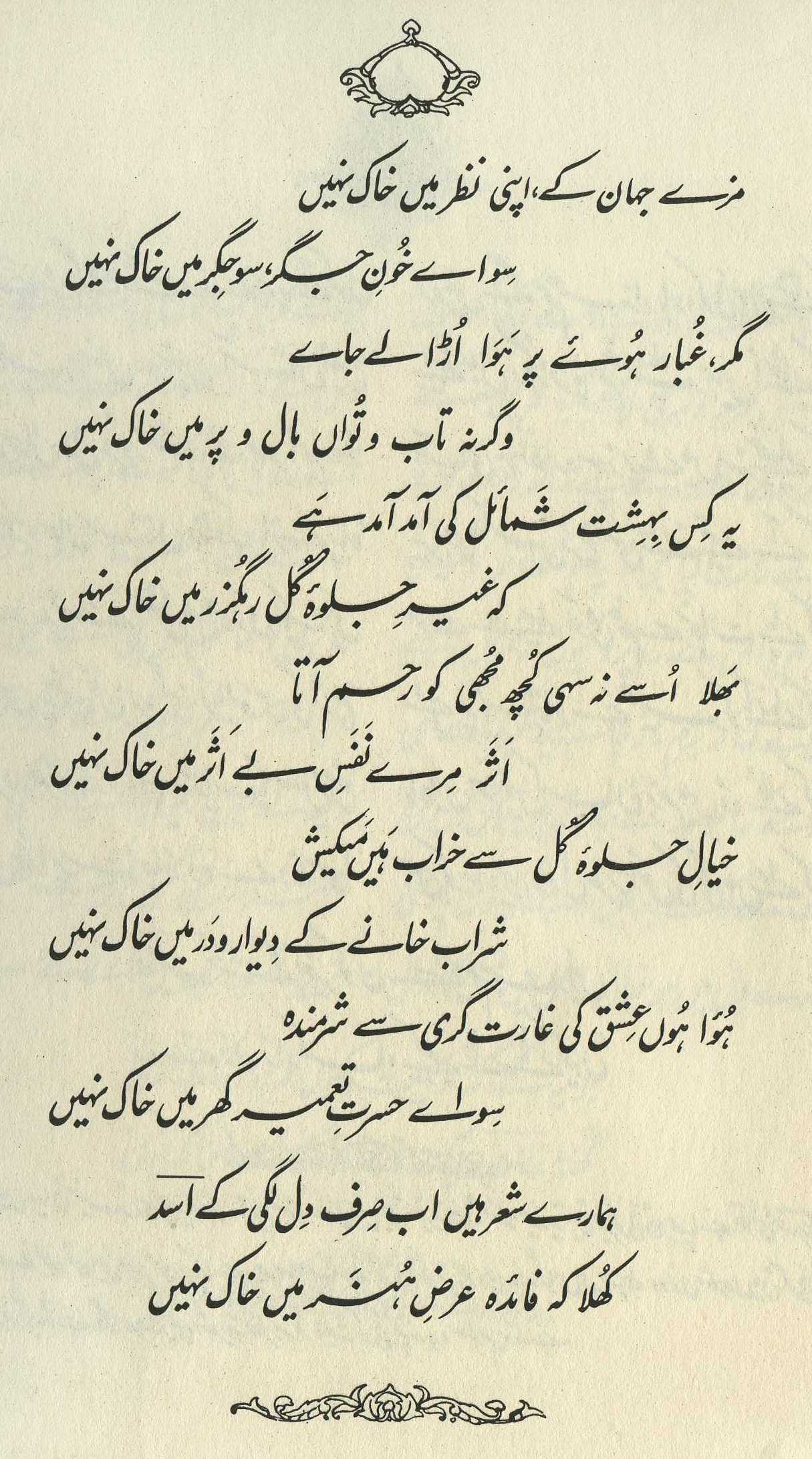
Verse 21826arme;N ;xaak nahii;N
G9
In this meter the next-to-last long syllable may be replaced by two shorts.
1
perhaps upon [their/our] having turned into dirt/dust, wind/desire might carry [them/us] away
2
otherwise, strength and power in wing and feather-- {nothing at all / not 'dust'}!
is an archaic variant of ( GRAMMAR )
| References | |
|---|---|
| Arshi, Imtiyaz Ali | Ghazal# 101 |
| Raza, Kalidas Gupta | 365 |
| Hamid Ali Khan | Open Image |
means 'perhaps'. The affinity of and is providing beauty. (123)
== Nazm page 123

In our wing and feathers no strength at all has remained. Now if we would arrive at the garden, or the nest, then it would be perhaps after dying and turning to dust, if the breeze had pity on us. This is the limit of ardor for arriving in the garden-- that when in life no hope remains, then to comfort his heart he says, 'It won't be strange if after dying, my dust would reach the garden'. The word 'perhaps' [] tells us that he's not confident even of that. (231)
First of all, please consider the verbal wordplay []. There is a .zil((a and an affinity . In the first line, there is the connection of between and . Among , , , and there is the connection of affinity. Now let's come to the meaning. The apparent interpretation is absolutely clear....
But the question is, why such a longing for flight? It can be assumed that the speaker of the verse is the traditional bird of Urdu poetry who is pining in a cage, but in the verse there's no hint of a cage, only the mention of there being no strength in wing and feather. Thus we can say that the speaker is a bird, and the bird is a metaphor for man. For a bird, flight is a metaphor for freedom and perfection. For man, flight is a metaphor for being free of the bonds of creation and the narrowness of life. So then, what is meant by there being no strength in wing and feather? It's clear that what's meant are those coercions and subjections that are man's fate. If this is so, then in flight (that is, being free of those coercions), what thing can be of help? It's clear that this freedom can only be obtained through death. Thus the matter arrives again at the same place: when I die and become dust, that is when I am free of the prison of existence, only then will the perfection of life be possible.
Now here the verse adopts an absolutely new metaphorical style. What is the goal of life? To fly like dust. Not simply to fly, but rather to fly the way grains of dust scatter and spread in every direction. This because there's no other aspect of freedom. The goal of perfection of life is possible only when life would not remain. Thus now to turn to dust and fly is the perfection of madness-- that is, a symbol for the perfection of life. To turn to dust or dirt and fly, is the final state of the perfection of indivuality. Because dust is completely free, and is spread everywhere. Having become nonexistent, the 'handful of dust' becomes present everywhere, because it spreads in the world through all the four directions. But in becoming dust and being carried away by the breeze is an expression of this paradox and this creative melancholy: that I was not able to fly like this, nor to reach the beloved's street, nor to become free of the restrictions of time and place. The only thing possible is that when I die, the wind might carry me away, and perfect me. To live in the true sense is certainly to die.
== (1989: 194-95) 2006: 216-27
[See also his comments on Mir's M 553,4 .]
Faruqi has done a lovely job on this one, enhancing the mystery and depth of a verse that's already remarkable for its truly exceptional wordplay. Faruqi mentions some of it, but I'd like to add a bit more. In the first line we have and (which is written exactly like ). In the first line we have as 'upon', and in the second line as 'wing'. Notice too that the verb , which I've had to translate as 'to carry away', literally means 'having caused to fly, to bear away', thus echoing the wing and feather imagery perfectly. And as Faruqi notes, and both mean 'dust', though the latter here very prominently its idiomatic meaning (on this see 114,1 ).
In its hauntingness and strange vision of dust-flight this verse reminds me of 61,7 . But that one is much brighter and less melancholy. Another good verse for comparison is 158,4 .
This verse belongs to the 'lover is a bird' set; for more examples, see 126,5 .
graphics/wingfeathers.jpg