Verse 41833arga))ii
G3
1
flying, my dust wanders around in the street of the beloved
2
finally now, oh wind/desire, the desire/lust for/of wing and feather has gone
is an archaic form of, here, ( GRAMMAR )
'Air, wind, gentle gale;.... affection, favour, love, mind, desire, passionate fondness; lust, carnal desire, concupiscence'.
| References | |
|---|---|
| Arshi, Imtiyaz Ali | Ghazal# 205 |
| Raza, Kalidas Gupta | 382-83 |
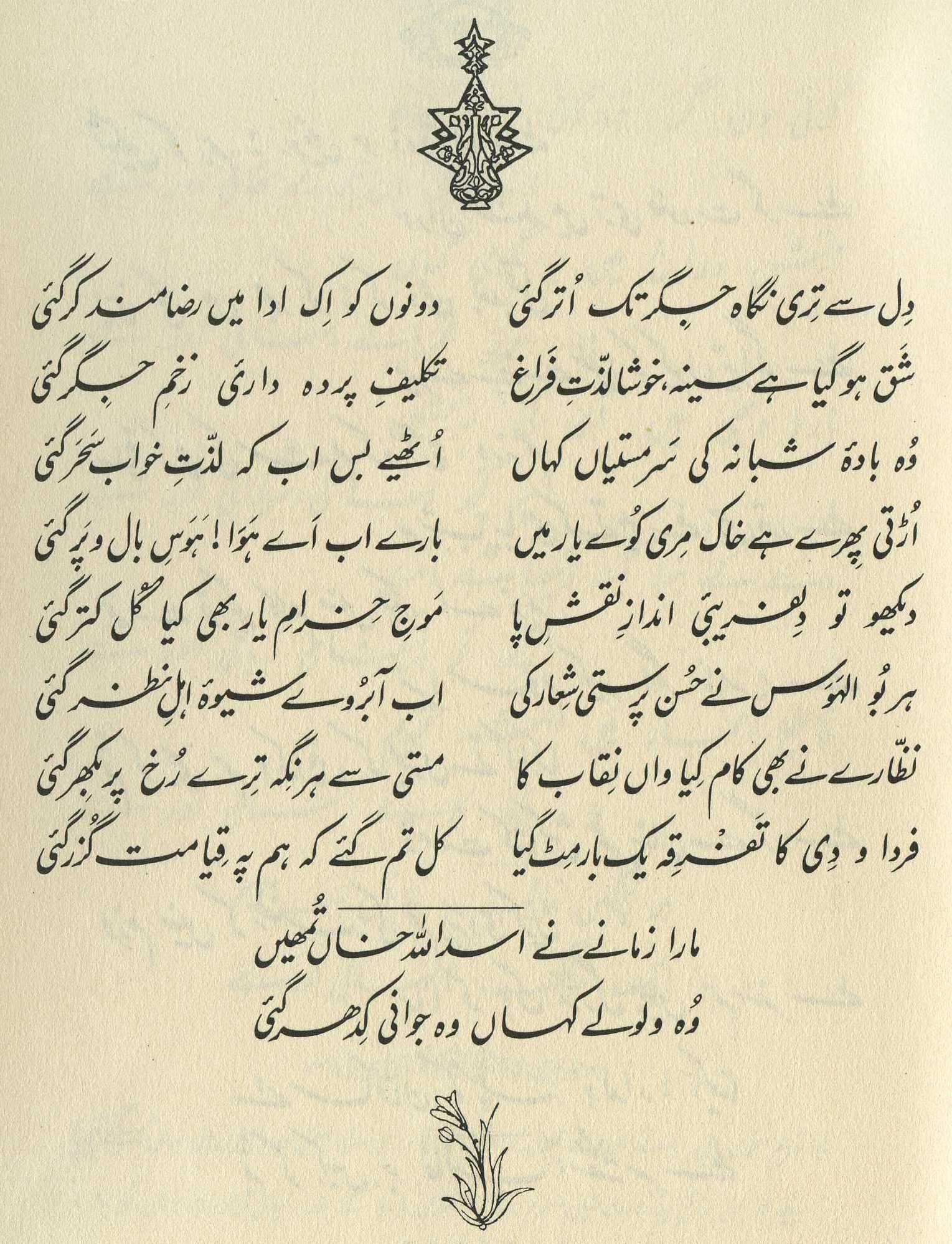
| Hamid Ali Khan | Open Image |
It's clear that to address the wind is devoid of pleasure, but because of the affinity with the author has preferred it over 'spring breeze' []. In the same way, the affinity with 'wing and feather' requires that in place of 'street of the beloved' the dust should have flown in 'the courtyard of the garden of the beloved' []. In addition, this theme has been used so often that it's become hackneyed. The point is that this verse falls very much below the level of Ghalib's poetry. (170)
== Nazm page 170

He says, 'For years I longed to grow wings and feathers, and use them to fly to the beloved's street. During life, this longing of mine was not fulfilled. But after death, my dust flies around enjoying the street of the beloved, just as I had longed to do in life.' (226)
[In response to Nazm's criticisms:] To address a lifeless thing as a living thing is common. In addition, the author has used not merely instead of 'spring breeze', but because it means 'longing' and 'desire'. Indeed, in this word there is certainly an . And when that is so, there's no need to speak of the 'courtyard of the garden'. Only this much of the theme , that our dust is flying around in the street of the beloved, is hackneyed. If he had said this only this much, then it would have been hackneyed; but with 'now the longing for wing and feather no longer remains', it is not hackneyed. (304)
SETS == WORDPLAY
ROAD: 10,12
SOUND EFFECTS: 26,7
The second line has such excellent sound effects that they almost evoke the soughing of wind-- all those and sounds that permeate the whole line, and above all the sequence. The juxtaposition of and is brilliant, since they share not only sound but also one meaning ('desire'). We can't help but strongly experience that nexus at the heart of the line.
But then, is the vocative addressed to the speaker's own desire, or to the wind? The commentators are sure it's to the wind, but why would Ghalib ever limit himself to one addressee when he could have two? Either one is an appropriate addressee, and the first line works beautifully with either one. If the addressee is the speaker's own desire, then the distinction between the more general , with its wide range of meaning, and the more specific , with its particular sense of 'lust' or carnal desire, are also elegantly invoked.
Compare 114,2 for another treatment of the wing-and-feather theme . And 58,1 too is a good study in the ambiguities of wings and feathers.
It seems very probable that in the present verse the lover is speaking as a dead bird who in life was kept in a cage, perhaps with his wings clipped; for discussion of 'lover is a bird' verses, see 126,5 . He might, however, simply be a lover who has longed for the power of flight.
This verse belongs to the 'dead lover speaks' group; for more examples, see 57,1 .
On the translation of as 'has gone', see 158,2 .
graphics/roaddust.jpg