Verse 21833arga))ii
G3
1
the breast has become split open-- congratulations, pleasure of freedom/ease!
2
the trouble/suffering/formality of the concealment of the wound in the liver has gone
'Freedom (from business, &c.), cessation (from work, &c.), finishing and ceasing (from), disengagedness, leisure, rest, repose; freedom from care or anxiety, ease, convenience, comfort, tranquillity, happiness; easy circumstances, competency, affluence, abundance'.
'Ceremony; the imposition of a burthen (upon); burden, difficulty, trouble, distress, inconvenience; molestation, injury, hardship, grievance; suffering, ailment, affliction'.
'Concealing (a blemish), conniving at (a fault or offence); keeping one' s secret; preserving confidence'.
| References | |
|---|---|
| Arshi, Imtiyaz Ali | Ghazal# 205 |
| Raza, Kalidas Gupta | 382-83 |
| Hamid Ali Khan | Open Image |
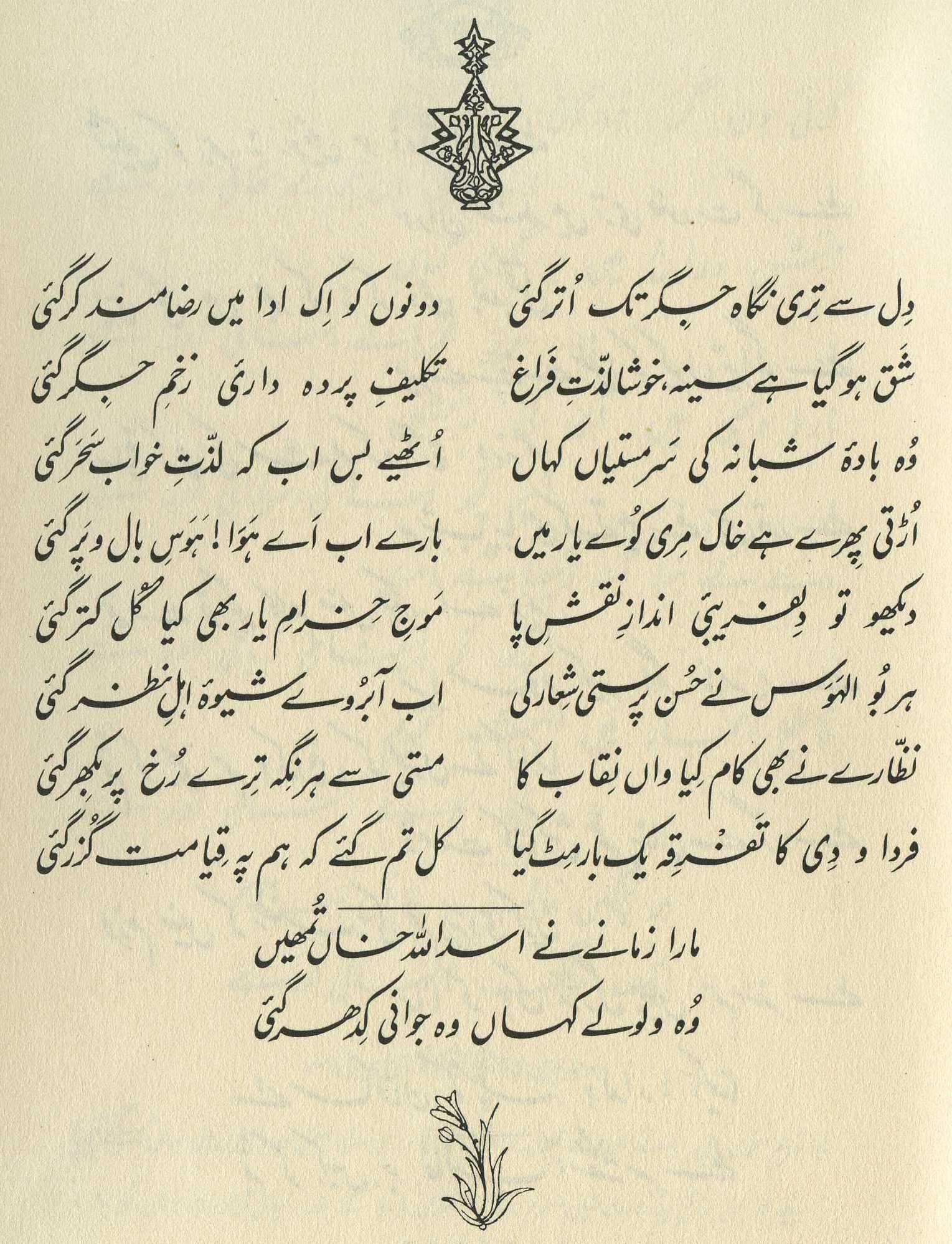
First he has reported this event: that the breast has become split open. Then, expressing joy, he has mentioned the advantage of the breast's bursting open. That is, he has become free of the need to keep the wound in the liver concealed. (169)
== Nazm page 169

He says, listen, my breast has become split open, and from its splitting open, the pleasure of separation has obtained an extraordinary happiness. To hide the wound in the liver was a great trouble. Now that that has been erased, the uninhibited pleasure of separation has been vouchsafed. (226)
From it is clear that there was so much trouble/suffering in hiding the wound of the liver that the lover considers the splitting open of his breast to be not a difficulty, but a comfort. (303)
SETS == EXCLAMATION; STRESS-SHIFTING
JIGAR: 2,1
VEIL: 6,1
It's clear in the second line that something has gone, and we are celebrating its departure-- but what exactly, and why? Among all these constructions, where does the real semantic emphasis fall? Is what we are celebrating the end of the 'trouble' or 'suffering' (or even 'formality' or 'ceremony') [] of hiding a liver-wound, since concealment is no longer an option? Or is it the end of the trouble of the 'veiling' [], since once the whole chest has split open, no further cover-up is possible? Or is it the end of the trouble of veiling the 'wound' [], since the wound has now been split completely open and thus no longer exists? Or is it the end of the trouble of veiling the wound in the liver [], since the whole liver itself has now been ripped apart and destroyed? Any or all of these possibilities can work, not to our surprise; for want of a better name, I call this effect 'stress-shifting'.
Congratulations are in order-- but they aren't addressed to the lover himself, who would seem to be the natural recipient. Rather, they go to a semi-personified 'Pleasure of Freedom/Ease'. Do we conclude that the lover himself has died when his breast split open, and all that's leftof him is a kind of lingering, ghostly, disembodied satisfaction? Or has he taken his sense of 'freedom/ease' with him to another sphere, and cries of congratulation are being launched after him encouragingly, the way people wave to a departing traveler? Or is he himself ruefully contemplating the sight of his own innards, and wryly trying to put a good face on things? Three guesses-- or more, if you care for more. Congratulations, oh Pleasure of Freedom! Ghalib is going to allow you as many choices as he can possibly contrive.
Note for grammar fans: in this and several later verses of this ghazal, I translate as 'has gone' instead of 'went'. Here, that's obviously the appropriate English counterpart, because the first line actually does contain the present perfect, and the second line logically postdates the first one. In 158,3 , 158,4 (which has present perfect in the first line), and 158,6 (which requires the same change in the first line too), the 'now' points us firmly toward the present perfect. In general, it's also true that Urdu tends to be, in colloquial usage, one step further in the past than English. But here, the poet himself is providing the temporal cues; we can thus tell that he really in a sense 'means' the (English) present perfect. For more discussion of this kind of temporal mismatch, see 38,1 .
graphics/wound.jpg