Verse 11821aa;Nniklaa
G5
In this meter the first long syllable may be replaced by a short; and the next-to-last long syllable may be replaced by two shorts.
1
ardor [in] every mode/'color' turned out to be an enemy/ Rival of possessions/property
2
Qais , even/also in the veil of a picture, turned out to be naked
'Colour, tint, hue, complexion; ... appearance, aspect; fashion, style; character, nature; mood, mode, manner, method'.
'Apparatus, necessaries, requisites, effects, goods and chattels'.
'Picture; drawing; sketch; painting; portrait; an image'.
'A curtain, screen, cover, veil ... ; secrecy, privacy, modesty; seclusion, concealment; ... pretext, pretences'.
| References | |
|---|---|
| Arshi, Imtiyaz Ali | Ghazal# 6 |
| Raza, Kalidas Gupta | 320-322 |
| Nuskhah-e-Hamidiyah | 33-34,36-37 |
| Asi, Abdul Bari | 54-55 |
| Gyan Chand | 70-72 |
| Hamid Ali Khan | Open Image |
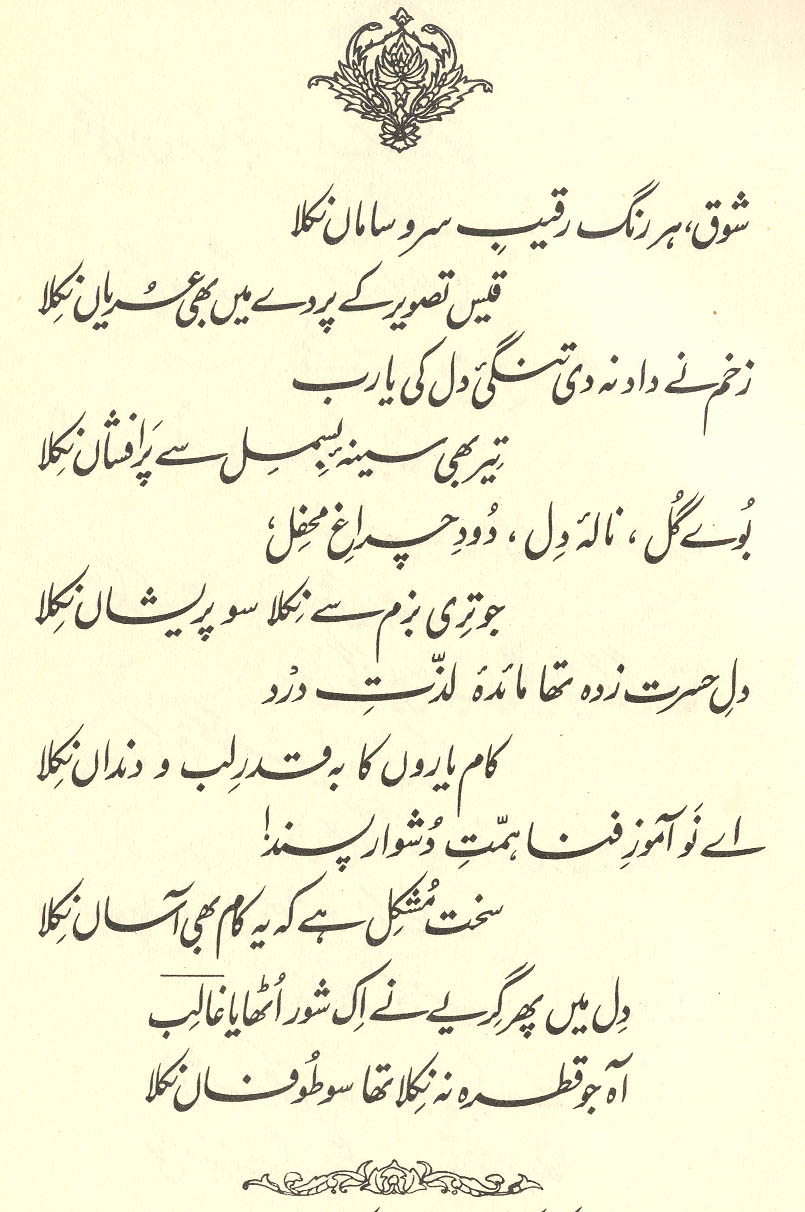
[1865, to Shakir:] has the meaning of 'opponent'. That is to say, ardor is the enemy of possessions. The proof is that Qais, who in life wandered around naked, remained naked even within the veil of a picture. The pleasure of it is that Majnun is always pictured with his body naked, wherever he is pictured.
==Urdu text: Khaliq Anjum vol. 2, p. 837
==another trans.: Daud Rahbar , pp. 281-82.
That is, even when Majnun's picture is made, it's always made naked. Even in this condition, passion is the enemy of possessions.... Realizing the affinity of with, he said [rather than other metrically equivalent words]. But to abandon an idiom for the sake of affinity is not good. The meaning of 'rival' [] has been [inappropriately] made to be 'enemy'. (6)
== Nazm page 6

Urdu text: Vajid 1902 {6}
[Nazm is wrong to object to .] Where, because of a word with affinity , the verse would begin to resemble a garden, it is not suitable [] to to reject it. Where because of affinity the meaning in the verse would not become flawed, but rather it would become an ornament to the verse, to reject it is distorted. In this place, only that individual can accept the phrase who is not only a poet, but also a person of literary sensibility []. And if is read with an [after ], then its meaning will be 'no matter how much any would become an enemy of possessions'. (11)
ABOUT : Every single time in the divan (and in most unpublished verses too) that Ghalib uses the word 'naked' [], it appears in just the same position as it does in this verse: as the rhyme -word. In that closural position its dramatic impact and slight shock value are maximized, especially in mushairah verses. Compare its other occurrences: 6,7x ; 6,11x ; 17,5 ; 111,3 ; 226,2 ; 226,6x // 332x,8 ; 377x,5 . The noun form 'nakedness' [] is often (though not always: see 192,1 ) used similarly, as in 64,1 ; 202,1 ; in 378x,3 , it comes at the end of the first line; in 3,5 , comes at the end of the first line. See also the closural positioning of 'bare' [] in 322x,8 .
ABOUT DRAWING/PAINTING: Very rarely does Ghalib in his ghazals make any reference to drawing or painting. The present verse is the most conspicuous example in the divan , but there are a few others. One additional example, itself tongue-in-cheek: 131,4 . Another example, concerning an 'under-coat': 145,10x . A third example, about the power of 'drawing': 153,9 . Then among the unpublished verses there's the ambiguous 320x,6 , the extravagant 326x,2 , the clever 396x,3 , and 399x,5 with its praise of Mani; there's also 433x,3 , in which the poet calls himself a 'Nightingale in a picture'; 440x,2 with its invocation of Bihzad, and 441x,5 , in which the image is a kind of intruder. For verses with references to music, see 10,3 .
In the present verse, the excellently chosen phrase basically refers to property and possessions (see the definition above); thus it has overtones of dignity and propriety (including 'self-possession'). As a madman Qais is out of his head [], as a naked wanderer in the desert he has renounced all possessions and all possible forms of 'equipment' []. So he's as hostile to as it's possible to be.
Of course the verse is full of semantic affinities: color and picture, veil and nakedness. The versatility of is particularly appropriate: its literal meaning of 'color' goes well with the idea of a painting, while its numerous related and more abstract meanings give the verse a wider range of applicability. Nazm's objection, based as it is on an absurdly restricted notion of the meaning of , is unpersuasive. For further discussion of the possibilities of -- in the context of a very similar objection by Nazm-- see 119,2 .
This is the second of the three ' meaningless verses ' that Ghalib explained in a letter in 1865. In the first one, 1,1 , the people in a picture [] were imagined as dressed in paper robes as a complaint against injustice; here, a picture is imagined as a veil or screen between human nakedness, rawness, wildness, and the 'proper possession' of dignity and self-control. In both cases, the picture apparently fails to achieve its object: God (?) continues to show 'mischievousness', and Qais continues to be seen in the wild nakedness of his passion.
As is the case so often in Ghalib's ghazals, this is a verse in which each line makes an independent statement, and the reader is obliged to figure out how the two are to be connected. Is the first line the main point, and the second a mere example? Or is the verse really about Qais, with the first line just a bit of extra reflection on his plight? Or do both lines refer, through different imagery, to the same situation?
For another meditation on the power of being , see 320x,6 . And for the lover as a 'naked picture', see 332x,8 .
Compare Mir's meditation on 'disgrace' and 'propertylessness': M 1896,9 .
AN APOCRYPHAL VERSE: Many people nowadays apparently attach to this ghazal another, apocryphal verse:
[some pictures of idols, some letters of beautiful ones
after dying, from my house this equipment/material emerged]
Please note that this verse is NOT by Ghalib. (I will refrain from going into a long tirade about how it doesn't even sound like him.) For a detailed discussion of the issues surrounding such apocryphal verses, see 219,1 . I'm grateful to Shah Jemal Alam for pointing out this verse and examining its wide circulation. And I'm particularly grateful to Irfan Khan, who posted this very helpful information to the Urdulist:
This verse has been discussed by Hanif Naqvi in (1990). The key points:
= Except for the 1922 edition of Ghalib's divan published by the Nizami Press, this verse has never appeared in any divan. And even there, it appeared in a special section of verses not from the traditional divan.
= Bazm Akbarabadi composed, sometime before 1910, the following similar verse:
[one picture of some mischievous one, and some letters
from the lover's house, after death, this equipment/material emerged]
Naqvi is of the opinion that the verse attributed to Ghalib is a modified form of this verse of Bazm's.
It's such a pleasure and honor to have the help of other researchers on this huge project.
graphics/qais.jpg
