Verse 31821aa;Nniklaa
G5
In this meter the first long syllable may be replaced by a short; and the next-to-last long syllable may be replaced by two shorts.
1
scent of the rose, lament of the heart, smoke of the lamp of the gathering
2
whatever/whoever emerged from your gathering, emerged disordered/dispersed
'Dispersed, scattered; disordered, confused; dishevelled, tossed (as hair); amazed, distracted, perplexed, bewildered, deranged; troubled, distressed, wretched; ruined'.
| References | |
|---|---|
| Arshi, Imtiyaz Ali | Ghazal# 6 |
| Raza, Kalidas Gupta | 320-322 |
| Nuskhah-e-Hamidiyah | 33-34,36-37 |
| Asi, Abdul Bari | 54-55 |
| Gyan Chand | 70-72 |
| Hamid Ali Khan | Open Image |
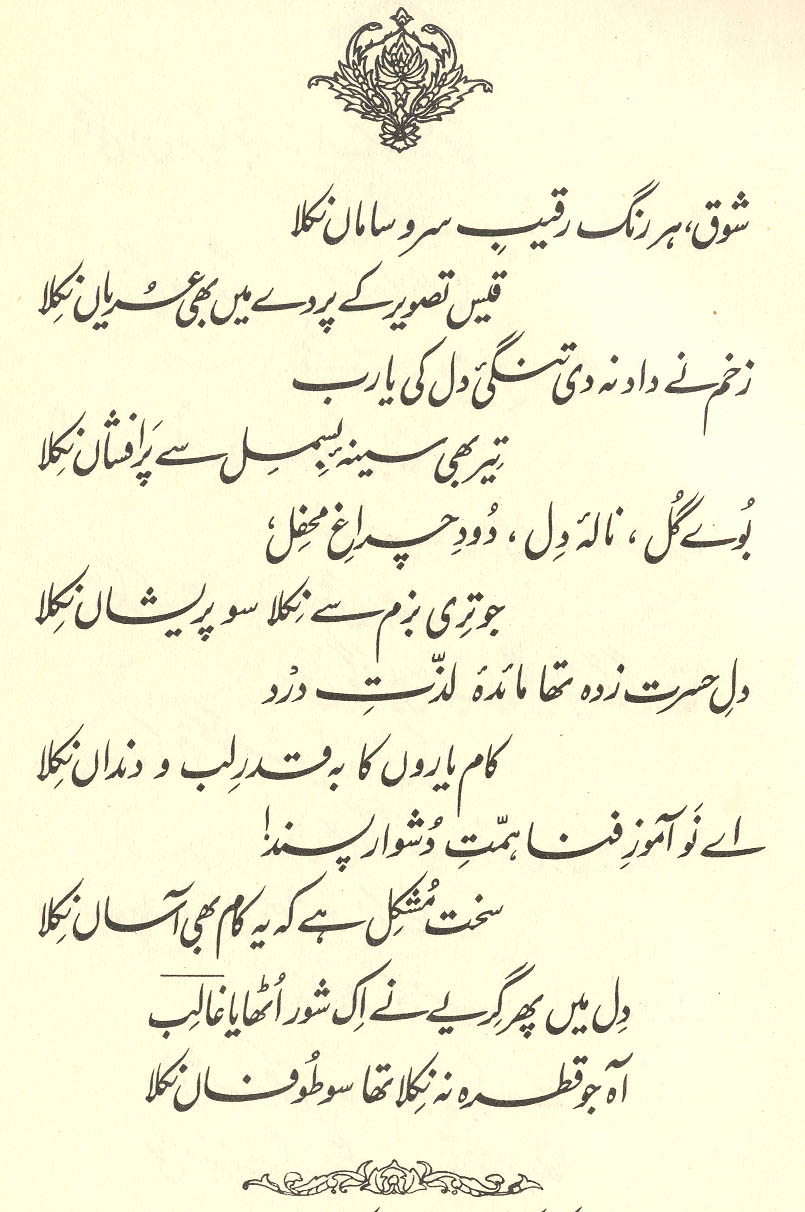
That is, to emerge from your gathering is itself a cause for disarray. (7)
== Nazm page 7

This verse is incomparable. It is founded on ' elegance in assigning a cause '. (12)
Three items are listed in the first line as evidence in support of the general statement made in the second line. The three items have reference to three important senses, of small, hearing, and sight, respectively. The world expresses a similarity of experience in all three. The fragrance of the flowers rises and gets scattered with the breeze. The smoke from the lamp burning in the midst of the joyous gathering rises twisting and turning, a picture of anguish. The lament rises from the poet's heart, a similar expression of anguish.
Question: In the case of the fragrance of the smoke one can say that natural phenomena have been given poetic reasons. They were present--in the most natural way--in the beloved's [gathering] and 'naturally' showed despair at having to leave the company. But why the heart's lament? If the poet was present in the beloved's , why did he cry out in anguish? These questions can be answered, perhaps, in the following ways.
1.) The poet remained in anguish even in the presence of the beloved because his rivals were also present there in that and they received all the favours.
2.) The poet was not physically present in that . But his heart was there. (Didn't he lose his heart to his beloved?) He cries out in the anguish of separation. This cry rises out from his heart and leaves the beloved's to dissipate in the same way as the lamp's smoke.
3.) The poet is not in the . His heart (the token and symbol of his love) has been made to stay away from the beloved. He was close to her at one time but now he has been forced out of the . The cry rising from his heart is just as is anything else that has been made to leave the beloved's .
== Naim 1970, pp. 19-20
As so often, the first line leaves us with a puzzle, for it is nothing but a list of three things, from three different sensory domains: smell, hearing, sight . (On such 'list' verses see 4,4 .) What do the three things have in common, where is the verse going? In the oral performance conditions of the mushairah , the audience hears the first line, and then is made to wait a bit, eagerly and curiously, for whatever resolution will be provided in the second line.
Then when the second line finally comes, in this case it does the job with flair. The second line is elegantly grounded in the multiple meanings of , an adjective with enough range to aptly describe in its literal sense both scent and smoke diffusing in complexly tangled patterns in the air, and in its metaphorically extended sense, laments troubling and agitating the lover's heart-- for the lover too has obviously emerged from the gathering in a condition.
Moreover, this key word is the rhyme -word, so that it's withheld as long as it possibly can be-- another strategy that's far more effective in the authoritarian time-boundness of oral presentation. Then when we do hear it, the verse delivers its whole interpretive and closural punch at once: there's nothing more for us to get on a second reading, or a third. All these qualities make for a brilliant example of what I call a 'mushairah verse'; for more on these, see 14,9 .
I thank Hassaan Hashmi for pointing out (Sept. 2010) that the first line is a direct quotation of a Persian line by Bedil . Since the line has no grammar except for constructions, it can easily be read as Persian or Urdu, depending on the context.
graphics/lampsmoke.jpg