Verse 51821aa;Nniklaa
G5
In this meter the first long syllable may be replaced by a short; and the next-to-last long syllable may be replaced by two shorts.
1
it was a novice/learner in oblivion/annihilation, difficulty-loving Courage
2
it is a severe difficulty that even/also this task turned out [to be] easy
'A learner, noviciate; inexperienced; a young falcon learning to hunt; one fond of new things; one who learns anything new, or from the beginning'. (Steingass p.1430)
'Mortality, frailty, corruption, decay, perdition, destruction, death'.
'Vanishing, passing away, being ended and finished; being old, frail; annihilation, mortality; frailty, transientness, fleetingness'. (Steingass p.939)
| References | |
|---|---|
| Arshi, Imtiyaz Ali | Ghazal# 6 |
| Raza, Kalidas Gupta | 320-322 |
| Nuskhah-e-Hamidiyah | 33-34,36-37 |
| Asi, Abdul Bari | 54-55 |
| Gyan Chand | 70-72 |
| Hamid Ali Khan | Open Image |
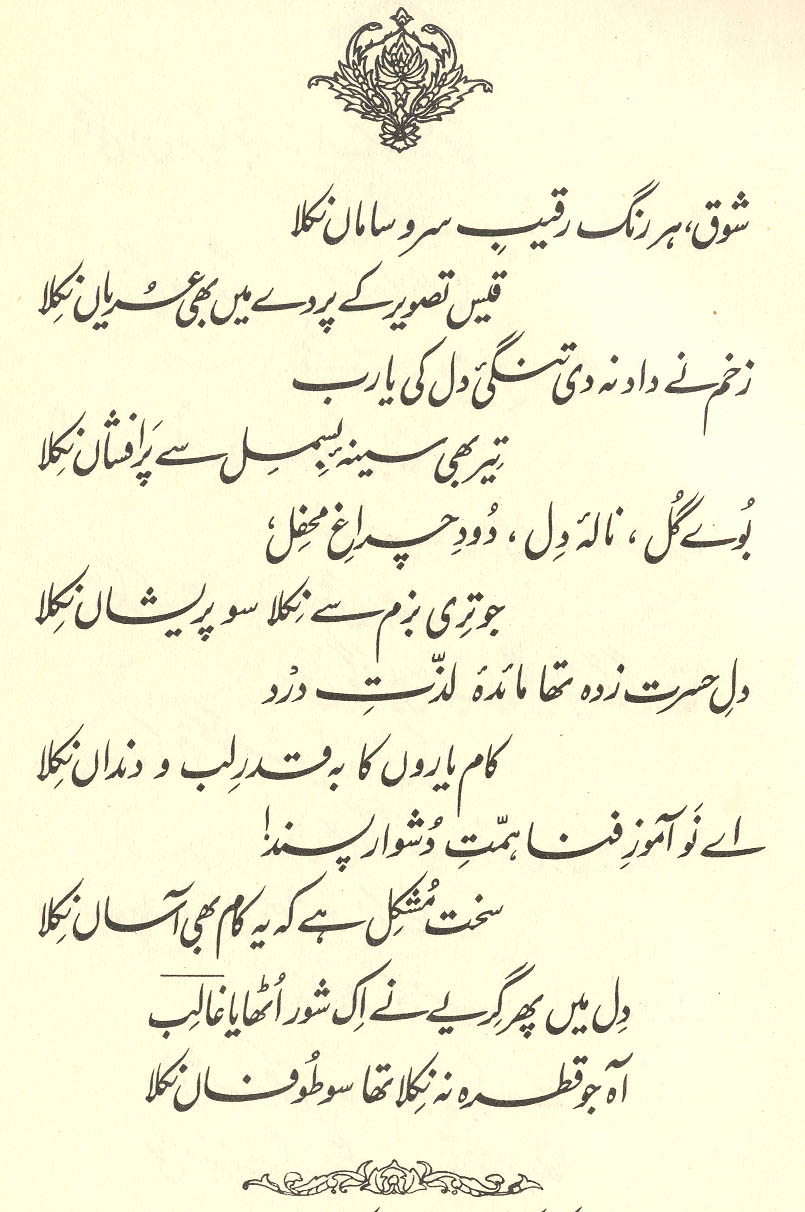
My courage considers it a pleasure to be enmeshed in fear and danger. This work is a sign sent by oblivion; that is, we knew life and the world to be a very difficult task. But alas-- that too turned out to be easy! (7)
== Nazm page 7

Urdu text: Vajid 1902 {6}
The meaning is that my difficulty-loving courage needs some rank higher than oblivion, because oblivion proved to be an easy stage for it. (7)
He says, my courage and my enthusiasm have become difficulty-loving to such an extent that education in oblivion ought to be considered a commonplace task for them.... At one other place too Mirza Sahib has expressed this theme : there he says 61,3 . (17)
There are some manuscript variations in this verse. For the first word of the verse Hamid adopts a reading of ; Nazm and others adopt . As always, I follow Arshi's reading, which in this case is .
The commentators are sure that the Courage belongs to the speaker, although the verse doesn't say so (the verse might be personifying the abstract quality itself). They emphasize the implication that Courage wanted something even beyond oblivion to aspire to, or some kind of task even more difficult, just to have a proper challenge. But did Courage find the task easy because Courage is so able and dauntless, or because oblivion really in fact is an easy lesson to master?
This latter possibility points to the exclusivity angle, which emerges clearly in 60,3 -- 'What honor or prestige can passion obtain, where cruelty is widely available?'. Perhaps what difficulty-loving Courage really wanted was a chance specifically to do something so difficult that nobody else could achieve it. In that case, what a let-down to find that learning oblivion is within the capacity of every Tom, Dick, and Harry!
The use of adds to the possibilities here. Does Courage find that all tasks have always been easy, and learning oblivion was 'also' easy, just like the rest? Or does Courage find that 'even' learning oblivion-- a task set apart, one that's in a class by itself-- was unexpectedly easy?
The verse remains cryptic and ultimately undecipherable-- for what does 'this task' of 'learning oblivion' actually refer to? Dying? Encountering God? Learning something unspecified within, or about, a realm called Oblivion? The proper question to ask is always whether the verse sufficiently rewards us for our struggles with it. There's the difficult/easy wordplay, and the inexhaustibly paradoxical quality of 'learning' 'nothingness'. Is that enough? It's certainly not bad for a poem less than twenty words long.
graphics/void.jpg