Verse 9x1821aa;Nniklaa
G5
In this meter the first long syllable may be replaced by a short; and the next-to-last long syllable may be replaced by two shorts.
1
something used to prick/throb/rankle in my breast, but finally
2
what we/they used to call a 'heart'-- it {turned out to be / emerged as} the head of an arrow
'To beat, go pit-a-pat; to feel doubt or misgiving; to excite doubt or misgiving (in, -); to feel hesitation, to hesitate, to waver; to feel anxiety or apprehension; — to prick, to rankle'.
| References | |
|---|---|
| Arshi, Imtiyaz Ali | Ghazal# 6 |
| Raza, Kalidas Gupta | 320-322 |
| Nuskhah-e-Hamidiyah | 33-34,36-37 |
| Asi, Abdul Bari | 54-55 |
| Gyan Chand | 70-72 |
| Hamid Ali Khan | Open Image |
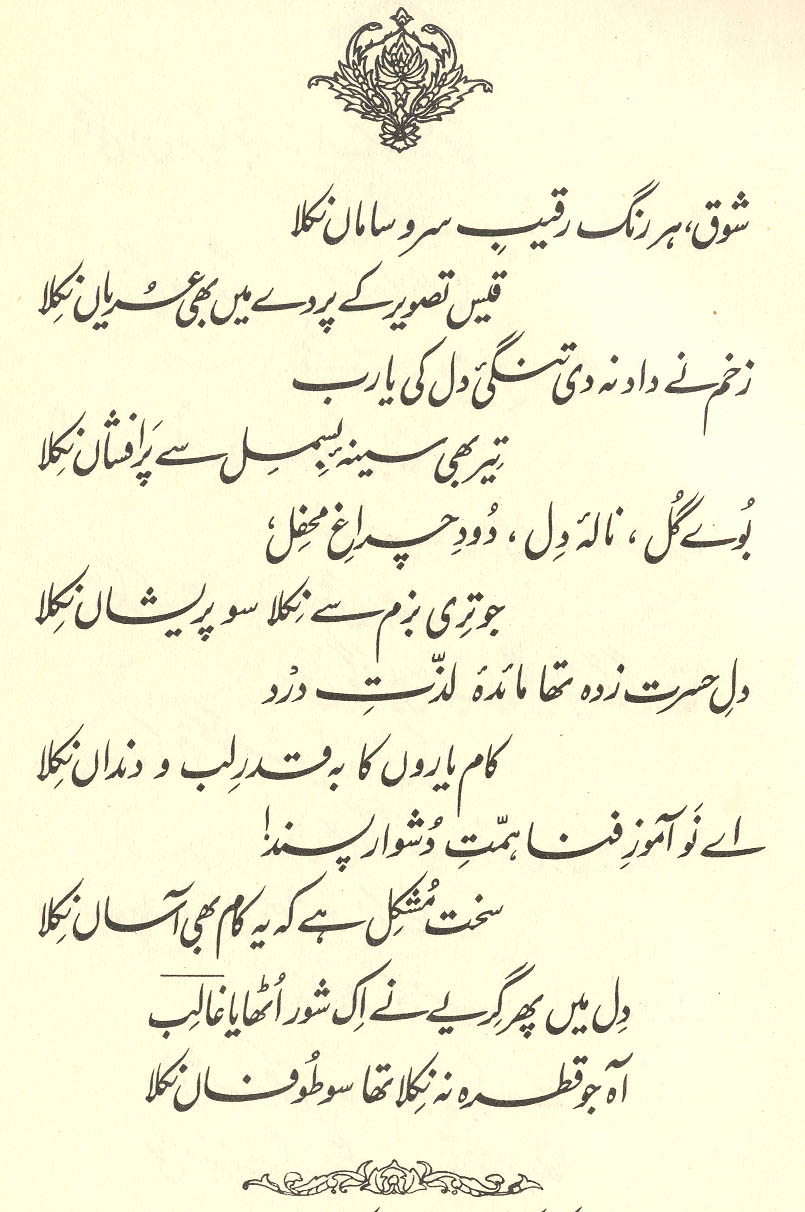
I knew that something was pricking/throbbing in my breast, but I considered that perhaps it was the heart. Now I have come to know that it is not the heart, but the head of an arrow.
== Asi, p. 54
It was not the heart, it was the head of an arrow. That is, the difficulties and troubles that befell us were all caused by the heart.
== Zamin, p. 35
The heart used always to create a pricking/throbbing in my breast. Finally, it became apparent that this 'heart' is in reality the head of the beloved's arrow, that has broken off and lodged itself here. The arrowhead is a cause of pain. Between the heart and the arrowhead, to me there's no difference.
== Gyan Chand, p. 71
[See his discussion in M 302,2 .]
For background see S. R. Faruqi's choices . This verse is NOT one of his choices; I thought it was interesting and have added it myself. For more on Ghalib's unpublished verses, see the discussion in 4,8x .
The colloquial possibilities of are wonderfully relevant here. For a full discussion of these possibilities, see 219,1 . Here two of them are particularly apposite.
If we take to mean 'turned out to be', then we have a report of a new diagnosis. There was something pricking or throbbing in the speaker's chest, and everybody thought that what he was feeling was a soreness in his heart. But now the doctors have learned something new-- it wasn't a 'heart' at all, but an arrowhead.
If we take more literally to mean 'emerged', then this seems to be a discovery made through some kind of dire surgery, or else when the lover is on the point of death. The arrowhead is literally drawn out of the chest, or perhaps works its way out-- and only then is its real identity recognized.
In either case, the question is inescapably suggested: what happened to the heart? Did the lover give it away so long ago that not a trace remains? Did it turn itself into blood through its suffering, and flow away in the form of bloody tears? Did the invading arrowhead pulverize it? Or was the lover's heart itself never other than (by definition?) an arrowhead in the first place?
In any case, apparently the arrowhead then became so precious and beloved that it acted as a heart, keeping the lover alive (albeit in pain). So the earlier (mis)identification of it as a 'heart' perhaps wasn't so wrong after all. Compare the preciousness of the arrowhead in 70,2 .
graphics/arrowhead.jpg