Verse 12x1821aa;Nniklaa
G5
In this meter the first long syllable may be replaced by a short; and the next-to-last long syllable may be replaced by two shorts.
1
the mischievousness of the color of henna, from the blood/murder of faithfulness-- how long?
2
finally, oh promise-breaker, even/also you turned out to be penitent/regretful
'Playfulness, fun, mischief; pertness, sauciness; coquetry, wantonness; forwardness, boldness, insolence'.
'Penitent, sorry, repentant, remorseful, filled with regret; abashed, ashamed; disgraced'.
| References | |
|---|---|
| Arshi, Imtiyaz Ali | Ghazal# 6 |
| Raza, Kalidas Gupta | 320-322 |
| Nuskhah-e-Hamidiyah | 33-34,36-37 |
| Asi, Abdul Bari | 54-55 |
| Gyan Chand | 70-72 |
| Hamid Ali Khan | Open Image |
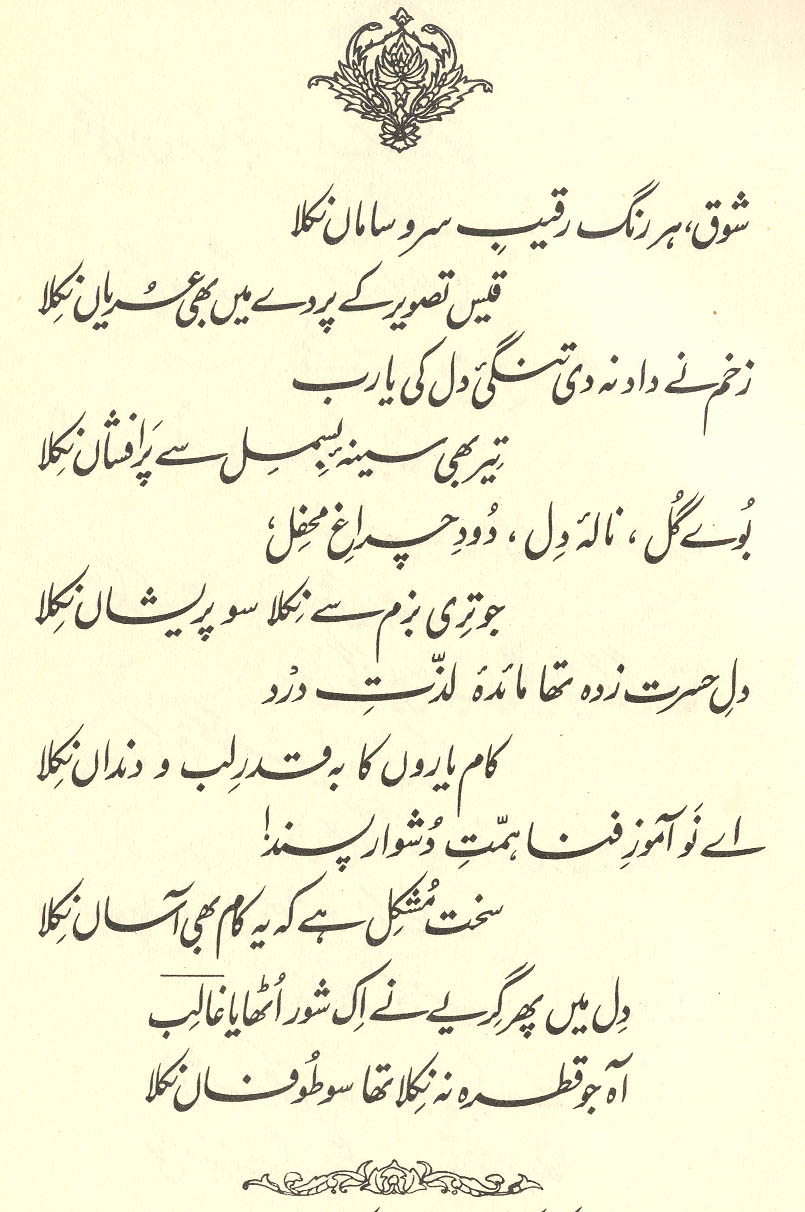
The mischievousness of the color of henna from the blood/murder of faithfulness-- how long would it remain established? Finally, oh promise-breaker, you too will be compelled to repent.
== Asi, p. 55
That is, by continually applying henna to your hands, you did mischievousnesses toward the blood of faithfulness. But finally the color of faithfulness appeared clearly, and you were compelled to repent. He has said not that 'you did mischievousness'; rather, he's said that 'the color of henna did mischievousness'. This is a courteous/respectful introduction.
== Zamin, p. 36
The radiance of the red color of your henna is, in reality, the blood of faithfulness. That is, you didn't show faithfulness to us. But how long could this state of affairs have continued? Finally, the color of the henna faded-- from which it's clear that, oh promise-breaker, you've become penitent for shedding the blood of faithfulness.
== Gyan Chand, p. 71
For background see S. R. Faruqi's choices . This verse is NOT one of his choices; I thought it was interesting and have added it myself. For more on Ghalib's unpublished verses, see the discussion in 4,8x .
The beloved gets the 'mischievousness'-- a word that emphasizes her playfulness and frivolity-- of her brilliant red henna from the blood of her 'murder of faithfulness'. But how long can it last? Just as henna fades from the hands, her decorative bloodstains fade over time. This fading also reflects the final death of faithfulness, so that no more such 'henna' is available (on the nature of henna, see 18,4 ).
The playful, frivolous murderer and 'promise-breaker' then no longer has those fetching, bloody-red hands-- which the speaker loyally interprets as a sign of penitence or regret on her part. But is is the 'murder of faithfulness' that she regrets, or the loss of her special supply of henna?
Compare the most famous 'repentance' verse, the irresistible 17,8 .
graphics/henna.jpg