Verse 81821aa;Nhonaa
G5
In this meter the first long syllable may be replaced by a short; and the next-to-last long syllable may be replaced by two shorts.
1
after my murder, she {swore off / renounced} cruelty/tyranny
2
alas-- the repenting of that quick-repenter!
'Oppression, violence, cruelty, injury, injustice, hardship'. (Platta p.382)
'Penitent, sorry, repentant, remorseful, filled with regret; abashed, ashamed; disgraced'.
| References | |
|---|---|
| Arshi, Imtiyaz Ali | Ghazal# 23 |
| Raza, Kalidas Gupta | 327-328 |
| Nuskhah-e-Hamidiyah | 69-70 |
| Hamid Ali Khan | Open Image |
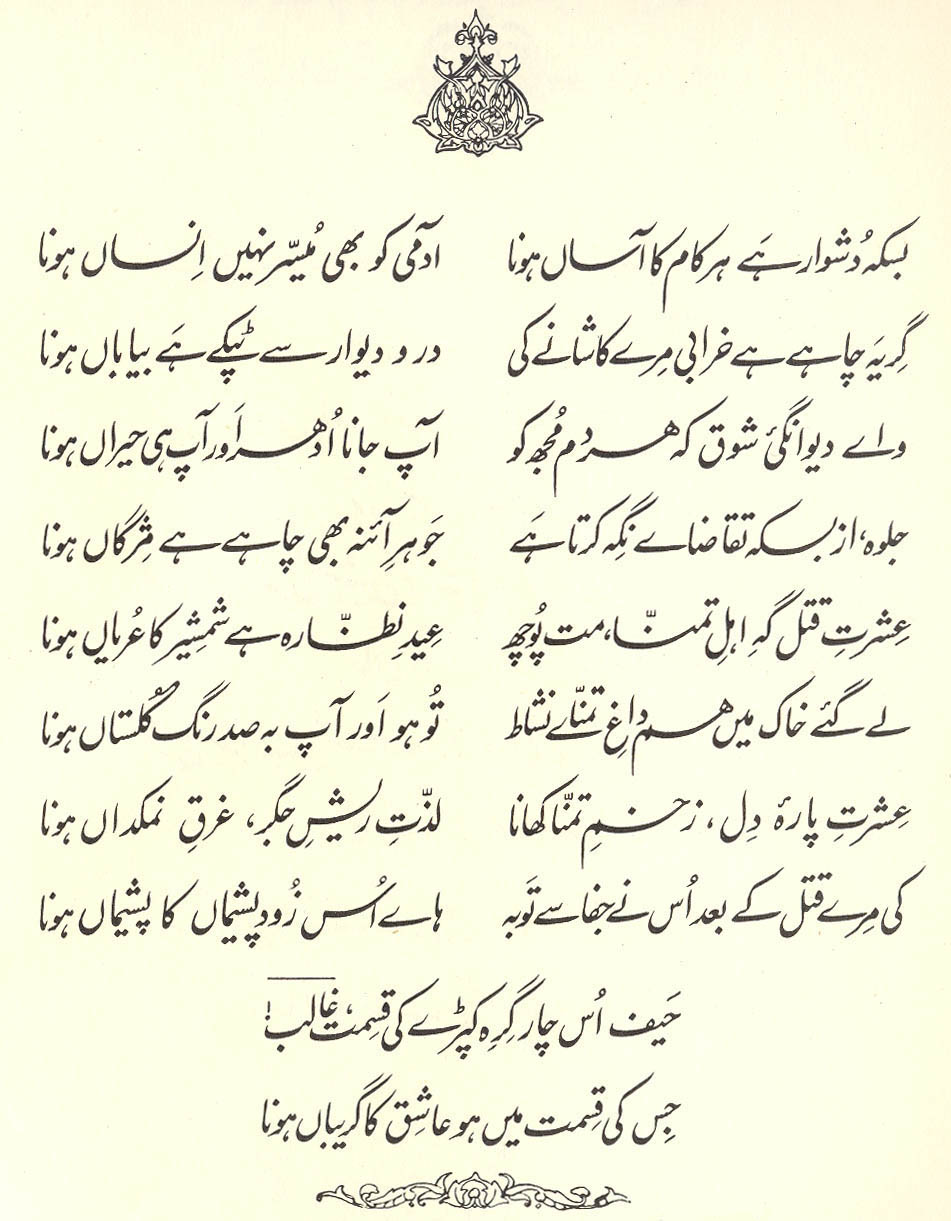
That is, the moment she saw the blood, she felt mercy: 'What have I done?'. There was neither any delay in becoming angry, nor any delay in repenting. And it's possible that he might have called her a 'quick-repenter' as a taunt or insult-- that is, when the deed has been irrevocably done, to feel mercy then, is that to repent quickly? (18)
== Nazm page 18

The pleasure of the words 'that quick-repenter' can't be described. This is a special mood of ecstasy, it can't be written down. Only people with taste can experience something of its pleasure. (38)
Two aspects emerge from 'alas': 1) I love her coquettish temperament. 2) I can't bear to think of her repentance. (43)
What a study in the extraordinary power of speech! This is another very famous, much-loved verse.
Is the beloved's repentance being exclaimed at because it is so quick (since it occurs as soon as she has killed her lover), or so slow (since it occurs only after she has killed him)? As Nazm points out, there's no way to tell: it's both at once. For a classic example of the fickleness of the beloved, see 46,1 .
Is the 'alas!' ironic, or straightforwardly melancholy?
Is the exclamation rueful, or amused, or regretful, or bitter, or detached?
And is the exclamation evoked by the murder itself, or the repentance, or the quickness, or the general nature of 'that quick-repenter'? Shifting the stress will affect how we interpret the verse.
The un-analyzability of this verse (since we have only a few bits of information and a vague, un-pin-down-able exclamation about them) causes Bekhud Dihlavi to consider it a verse of mood . I agree-- the pleasure of it is the intricate texture of all those kinds of available at once, and flickering in and out of the reader's mind. Doesn't it make you want to recite it, and to linger expressively on the ?
This verse belongs to the 'dead lover speaks' set; for discussion and more examples, see 57,1 .
graphics/repentance.jpg