Verse 21821aa;Nhonaa
G5
In this meter the first long syllable may be replaced by a short; and the next-to-last long syllable may be replaced by two shorts.
1
weeping wants the ruin of my house
2
from doors and walls there drips 'being a desert'
is an archaic form of , and is an archaic form of ( GRAMMAR )
| References | |
|---|---|
| Arshi, Imtiyaz Ali | Ghazal# 23 |
| Raza, Kalidas Gupta | 327-328 |
| Nuskhah-e-Hamidiyah | 69-70 |
| Hamid Ali Khan | Open Image |
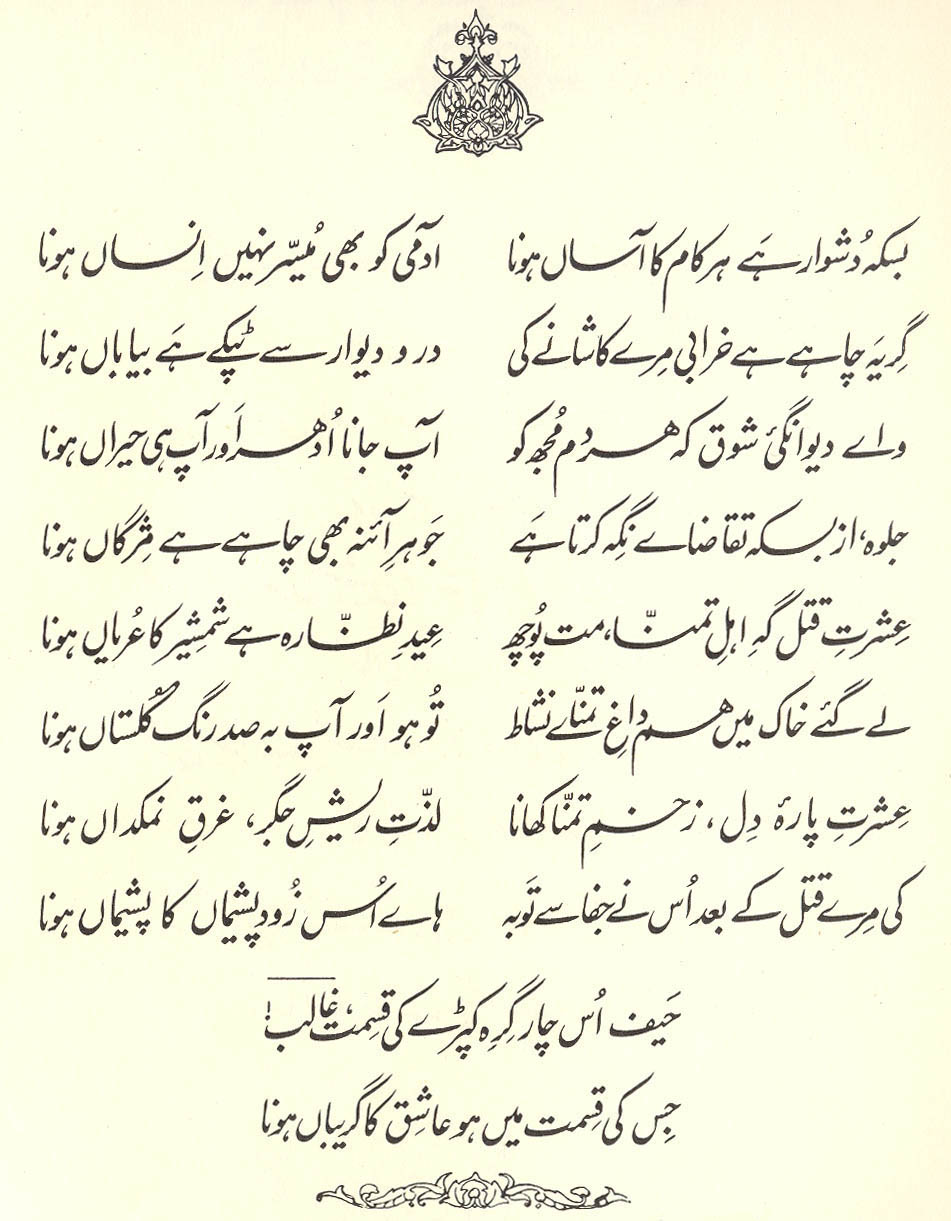
The word 'to drip' has a great deal of affinity for a house, and with weeping as well. 'A word that is fresh is equal to a theme .' (18)
== Nazm page 18

'Drips'-- it's clear that the justice [] that Janab [Nazm] Tabataba'i has done to that word is worthy of praise []. He says, 'A word that is fresh is equal to a theme '. (40)
That is, it's clear that now my house will fall down from the excess of the water of tears, and will become a desert. (36)
[See his commentary on Mir's M 1283,3 .]
ABOUT THE 'FRESH WORD': The words that Nazm cites without attribution, and that so delight Bekhud Mohani, are those of Jahangir's Persian poet laureate, Talib Amuli , who famously said, 'A fresh word is equal to a theme ' [laf:ze kih taazah ast bah ma.zmuun baraabar ast]. I've discussed this passage and the concept of 'theme' in the ghazal tradition in Nets of Awareness , Chapter 7, p. 103. Nazm quotes Talib Amuli 's words again in his fine commentary on 177,8 . Faruqi also cites it when discussing Mir, in M 694,3 and M 1101,1 (and discusses it elsewhere in his work as well). On the Mughal-period 'fresh speech' [] movement in Indo-Persian poetry, see 'Make it fresh: time, tradition, and Indo-Persian literary modernity' by Rajeev Kinra, in Time, History and the Religious Imaginary in South Asia, ed. by Anne Murphy (Routledge, 2011, pp. 12-39). The young Ghalib's favorite culture hero Bedil was a conspicuous part of this movement; see the discussion in 8,5 x .
The grammar of the second line has never ceased to astonish me. What is it that drips from the doors and walls? Literally, it is 'to be a desert' []. How can something as abstract as 'desertification' or 'desertness' do something as concrete (and utterly, paradoxically unlikely) as 'dripping'? It's one of those images like 'Brightness falls from the air'-- it doesn't really have a visual effect as much as an imaginative one, and great sound effects when you say it. I think it has the quality of or 'mood', an elusive but powerful attribute of some ghazal verses that I've tried to describe in Nets of Awareness , Chapter 8, pp. 119-122.
In 8,4x , there seems to be a kind of information that drips. For a verse in which 'affirmation/proof oozes', see 101,8 . And in 190,10 , it's 'fire' itself that drips.
Compare 31,1 : 'even if we did not weep, our house would be desolate...'
How can one really clarify the second line? And yet it works, doesn't it? Another fine case in point is 91,9 . And another example of strange watery behavior is 421x,2 .
Compare Mir's vision of wretchedness as 'raining down' on the lover's grave: M 1480,2 .
This verse always reminds me of one stanza full of similarly ominous, coldly evocative impossibilities from Auden's ' As I Walked Out One Evening ':
The glacier knocks in the cupboard,
The desert sighs in the bed,
And the crack in the teacup opens
A lane to the land of the dead.
graphics/tughluqabad.jpg