Verse 91847aa;Nnahii;N
G3
1
there's no loss/harm in madness-- so what if the house would be wrecked!
2
in exchange for a hundred yards of ground, is the desert not [more] valuable/grievous?
'Heavy, weighty, ponderous; great, important, momentous; difficult; burdensome, grievous; -- precious, valuable'.
| References | |
|---|---|
| Arshi, Imtiyaz Ali | Ghazal# 108 |
| Raza, Kalidas Gupta | 204 |
| Hamid Ali Khan | Open Image |
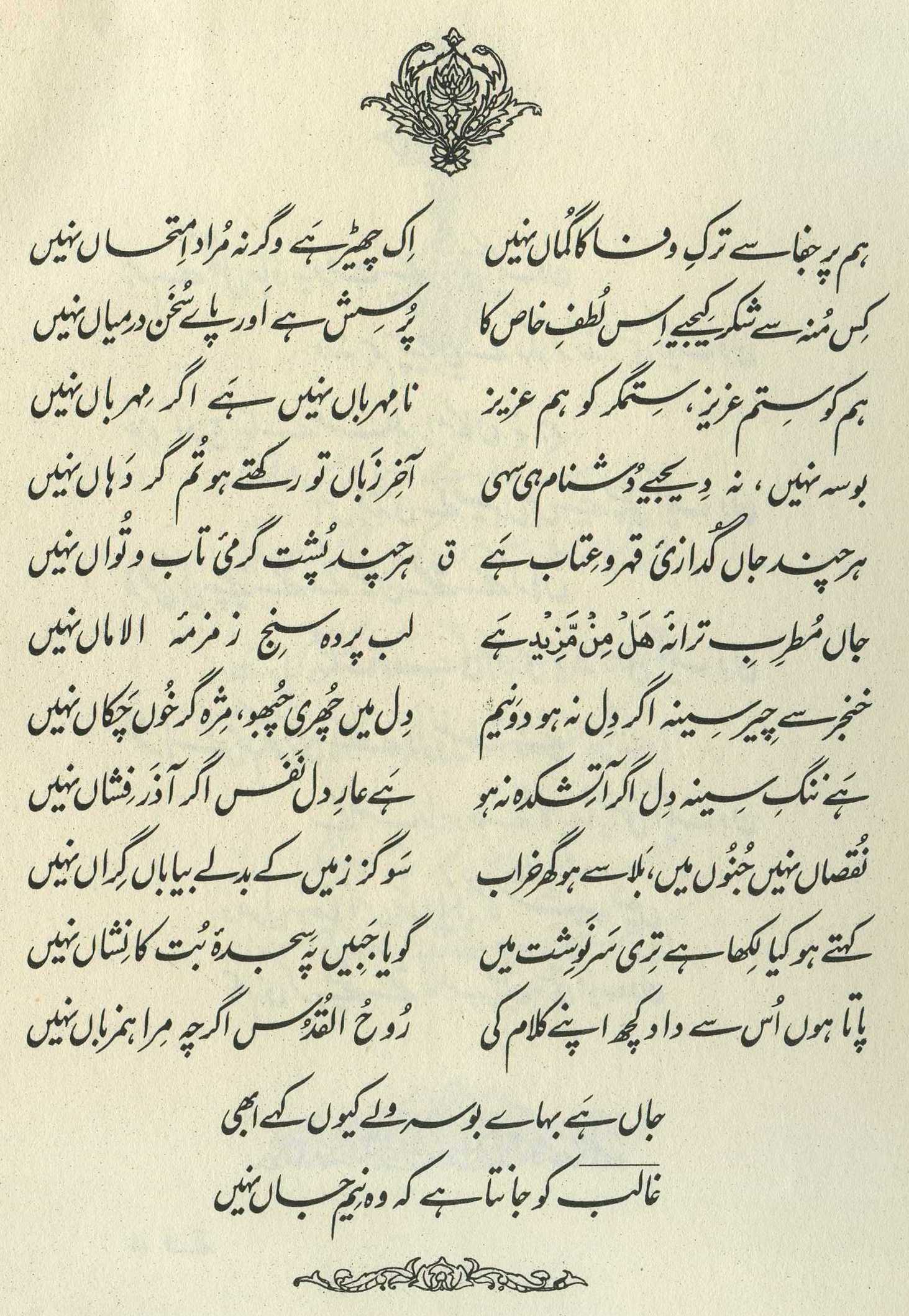
That is, if in madness the house would be destroyed, then so be it. In the house there won't be more than a hundred yards of ground. In exchange for it, we get such a wide desert! How can there be any harm in that? If there isn't a house, we'll set our face toward the desert. (90)
== Nazm page 90

He says, madness is not a thing productive of harm; if after one leaves the house the house becomes ruined, then what the hell, let it be ruined! In the house is, at most, a hundred yards of ground-- in exchange for it, such a big wilderness [] comes to hand. Who could call that expensive? (142)
Answering his own heart, or some Advisor , he jestingly says that if in madness the house will be destroyed, then there's no harm. In exchange for a hundred yards of ground, such a big desert is obtained. (186)
Compare 214,8 . (277)
: sublime madness; a state of total devotion to, or submersion in, some cause, some object of desire, some state of mind.... for the poet-lover, the most heightened state of love. In this state, he seeks the wide open spaces of wilderness, away from the narrowness of the city.... In this state he abhors rational thought, the logical of cause and effect, and discovers the powers and profundities of intuitive knowledge.... But he prefers to give for the benefit of his reader a more mundane reason as to why the adoption of is worth-while. One's home may be destroyed but one would also get possession of something vaster than the narrow confines of home. (44-45)
For more on the expression , see 58,1 .
See what a beautiful high-wire act-- is deftly exploited without its even being there! Literally, the second line says 'in exchange for a hundred yards of ground, the desert is not more valuable/grievous'. Yet the commentators rightly prefer to read it as though it had a (colloquially omitted) in front of it-- for only that could turn it into an enjoyably complex rhetorical question, 'Is the desert not more valuable/grievous?' To which they at once answer, 'Yes, of course it is'. A similar example from Mir : M 490,2 .
The secondary meaning of as 'grievous' or 'difficult' (see the definition above) also works well here-- and can even be made to work (though less multivalently) without the . The house is such a burden to the mad lover anyway-- even the vast desert itself is not more grievous, when compared to the little space of his house. His house is thus as grievous, yard for yard, as the desert. Because his house reminds him of the past? Because it constricts his freedom? Because people come to call on him there and expect things from him?
It's also a subtle and suggestive touch that the house is thought of only as , 'a hundred yards of ground'. Apparently nothing in the house differentiates it from the desert, except its smaller size. Who wouldn't trade a smaller plot of land for a larger one? There's no 'madness' in that! The house isn't spoken of in any of the terms we'd expect-- as holding comforts or souvenirs or loved ones, as providing shelter from the weather, etc.
This verse can't fail to evoke a word it doesn't use: the word , with its two meanings of 'madness' (from the Arabic side) and 'commerce' (from the Persian side); for more on this, see 58,5 .
An especially apt verse for comparison is 101,3 .
Compare Mir's M 1620,7 , which explores the relationship between the enclosure of a house and the open space of a 'house-less field'.
graphics/desert.jpg