Verse 121847aa;Nnahii;N
G3
1
a life is the price of a kiss-- but why would she say it right now?
2
she knows Ghalib-- that he is not {half-dead / half-alive}!
'Half-dead (with fright, &c.)'.
| References | |
|---|---|
| Arshi, Imtiyaz Ali | Ghazal# 108 |
| Raza, Kalidas Gupta | 204 |
| Hamid Ali Khan | Open Image |
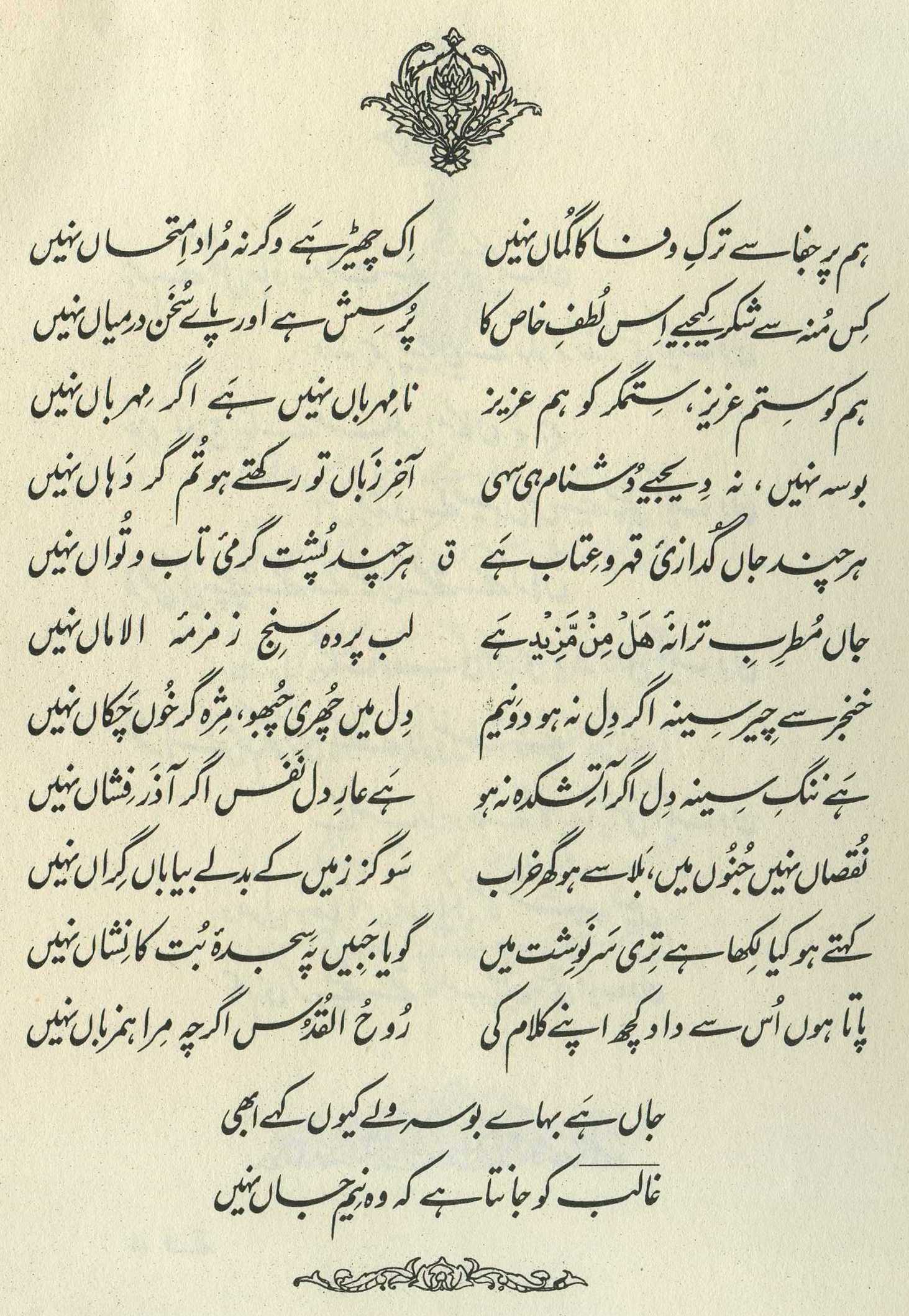
That is, why has she now begun to say, 'Give your life, take a kiss'? There's still life left in me. When I'll no longer have any life left, at that time she'll say 'Give your life, take a kiss'. (91)
== Nazm page 91

He says, 'It's agreed that the price of a kiss is a life. But why will she make this fact known now? She still knows that Ghalib is not half-alive.' The meaning is that when she thinks that Ghalib has become half-alive, then she'll seek a life as the price of a kiss, so that Ghalib won't be able to give his life and buy a kiss. (143)
A kiss from the beloved can be obtained at the cost of one's life; this fact is known to the beloved and she is quite likely to make it known publicly in order to derive pleasure from seeing people lay down their lives for the sake of one kiss. But she also loves to torment Ghalib. That's why she is not making the price of her kiss known publicly yet. Ghalib, despite all his sufferings, is still not half-dead, and if he were to learn of the price of a kiss, he might be able to take advantage of this bargain. (9)
[See his comments on Mir's M 1786,6 .]
The commentators agree on a perfectly defensible reading. But in a cleverly organized verse like this, how could we think that Ghalib would settle for only one possible interpretation? So naturally I want to add another.
Consider the second line. 'You know Ghalib-- that he's not !' To me that sounds like a boast, a vaunt, a claim. The commentators can't make any use of this fact. All they want is a resigned, hangdog report: 'You know that Ghalib isn't half-dead yet' (and that's why you wouldn't be expected to proclaim the price of a kiss yet). Their usage indeed accords with Platts's definition. But I think they are working against the tone, the rhetorical flavor of the line.
If we take the second line as a boast or vaunt, then we can easily imagine a different context for the first line. Let's say the lover demands a kiss. The beloved says, 'Oh, but a life is the price of a kiss'. The lover replies, 'Why would you say this right now []? You seem to think that knowing the price would deter me! Don't you know whom you're speaking to? You know me-- you know I'm not ! I'm not a coward, not a weakling, not half-dead, not half-alive, not a lover who fears to pay the final price for his passion!' In short, it's almost insulting that she should insist on telling him the price before giving him the kiss. Much more worthy of her, and of him, would be to give him the kiss and then tell him the price afterwards, very casually even. (Think about super-luxury goods: 'if you have to ask what it costs, you can't afford it'.)
It's also possible to read the verse vocatively, as addressed to the beloved with the intimate .
To encourage us to perceive the complexity of the verse, Ghalib has elegantly fitted into it an evocative triple wordplay: . Surely when we notice it, we are encouraged to reread the verse, and meditate about being alive (versus half-alive), and the implications of knowing (versus saying).
graphics/kiss.jpg