Verse 111847aa;Nnahii;N
G3
1
I find from him some praise/justice for my speech/poetry
2
although the Pure Soul [the Angel Gabriel] is not my {language-sharer / fellow-speaker}
'Liberality, beneficence, bounty, munificence; a present'.
'Equity, justice'.
'Word, speech, discourse; a complete sentence or proposition; composition, work'.
'Of the same language or tongue; conversing together; expressing the same opinion; unanimous'.
| References | |
|---|---|
| Arshi, Imtiyaz Ali | Ghazal# 108 |
| Raza, Kalidas Gupta | 204 |
| Hamid Ali Khan | Open Image |
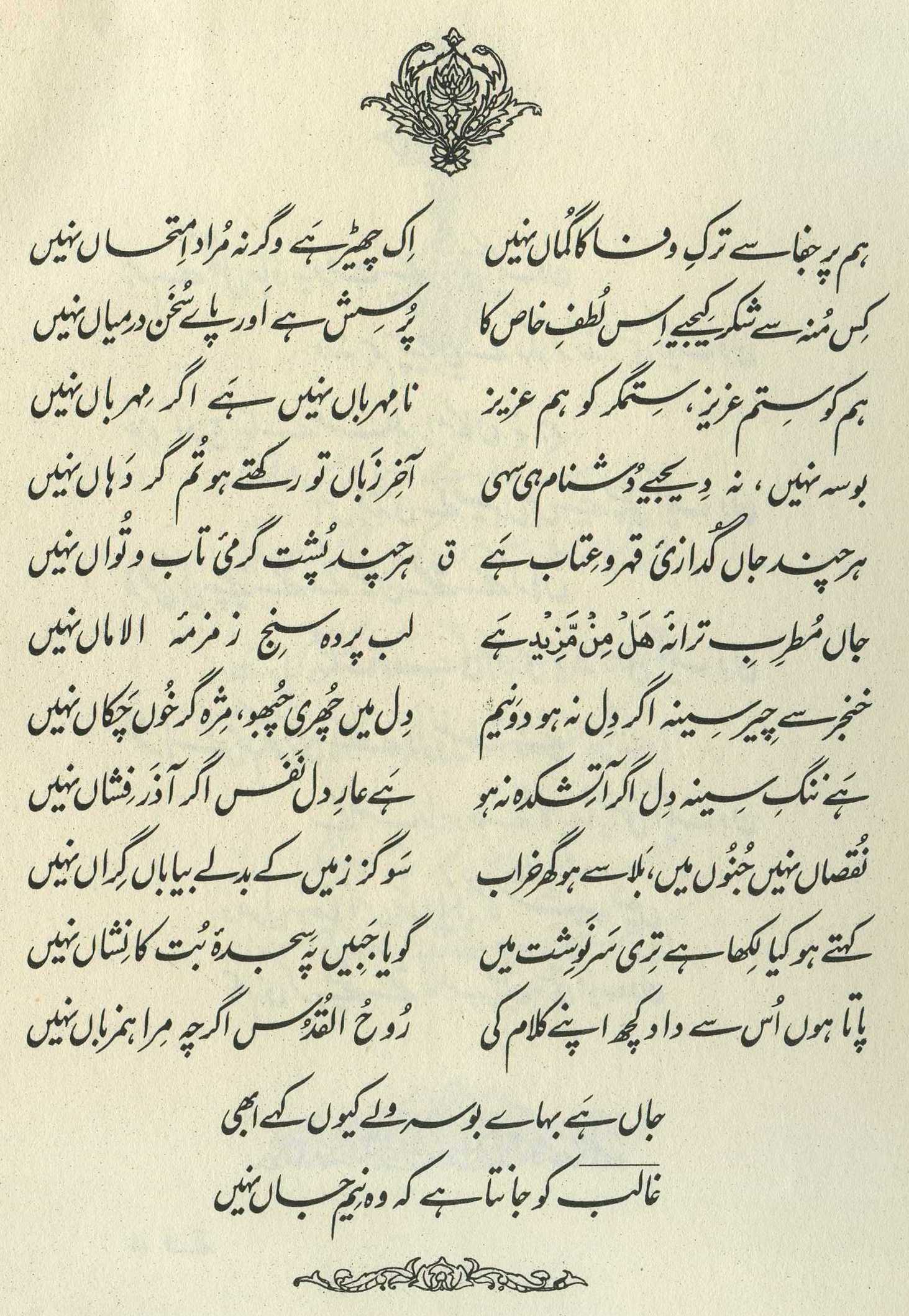
Here there is an in the word . The apparent meaning is that the language of human and angel cannot be one, and concealed within this is an indication that the Pure Soul’s language is not as eloquent [] as mine.
==Urdu text: Yadgar-e Ghalib , p. 146
That is, not even the Pure Soul has attained the language that I've attained. But although he understands something of my speech/poetry, he understands that, and gives justice/praise. In short, my speech/poetry is entirely revelation. (90-91)
== Nazm page 90 ; Nazm page 91


: Hazrat Jibra'il, who used to bring the Lord's message to the prophets. Although my language has not been vouchsafed even to Jibra'il, is it a small thing that he understands my speech/poetry, gives it justice/praise? That is, my speech/poetry is revelation, it is mysteries. (187)
By is meant the angel Jibra'il, who in the gathering of the angels is the highest in rank.... In the first line, the word 'some' is very enjoyable. From it there's the point that full justice/praise not even Jibra'il gives; I am entitled to even more praise than his. It's a boastful [] verse. (183)
It's easy to imagine what a successful mushairah verse this one would be. The first line of course withholds the identity of the 'him', so that under mushairah performance conditions we'd have to wait a bit, in suspense, to find out whose opinion Ghalib, most unusually, cared about even enough to mention. And that 'some' []-- it sounds as if the unknown person gives only moderate praise, or does only partial justice, to Ghalib's poetry.
Then in the beginning of the second line we learn that it is no less than the Angel Gabriel, the 'Pure Soul', who is the connoisseur in question. Next we learn there's some qualification-- 'although'. And only in the last possible slot, as the rhyme -word, do we get the irresistibly witty punch-word .
As the commentators observe, there are two ways to read . The first is as 'language-sharer', which works very nicely-- naturally Gabriel speaks a lofty angelic language, and doesn't know our human speech, so it's very much to the poet's credit that even though Gabriel doesn't deign to really study the poet's language, he still offers 'some' praise to the poet's power of speech.
But the second, and far more amusing, reading is to take it as 'fellow-speaker' more generally. Which yields the alternative suggestion that Ghalib has a level of literary speech, language excellence, poetic skill, that is decidedly beyond Gabriel's level of attainment. All Gabriel can do is grasp 'some' of the poet's achievements, and do 'some' justice to the poetry, despite finding it distinctly over his head.
Underlying both readings is the witty effect of the poet's insouciance. Whereas most people would speak of the angel Gabriel with great reverence, and would regard a single glance from him as the high point of a lifetime, Ghalib mentions him only offhandedly, and only incidentally, in the context of a literary discussion. Gabriel receives only lukewarm, almost grudging, praise, as a hearer who can, despite his obvious limitations, do 'some' justice to the poetry. And that neatly and casually puts him in his place! When they heard this one for the first time, how could the whole audience not have burst out laughing?
graphics/gabriel.jpg