Verse 31847aa;Nnahii;N
G3
1
tyranny is dear to us, we are dear to the tyrant
2
she is not unkind, if she is not kind
| References | |
|---|---|
| Arshi, Imtiyaz Ali | Ghazal# 108 |
| Raza, Kalidas Gupta | 204 |
| Hamid Ali Khan | Open Image |
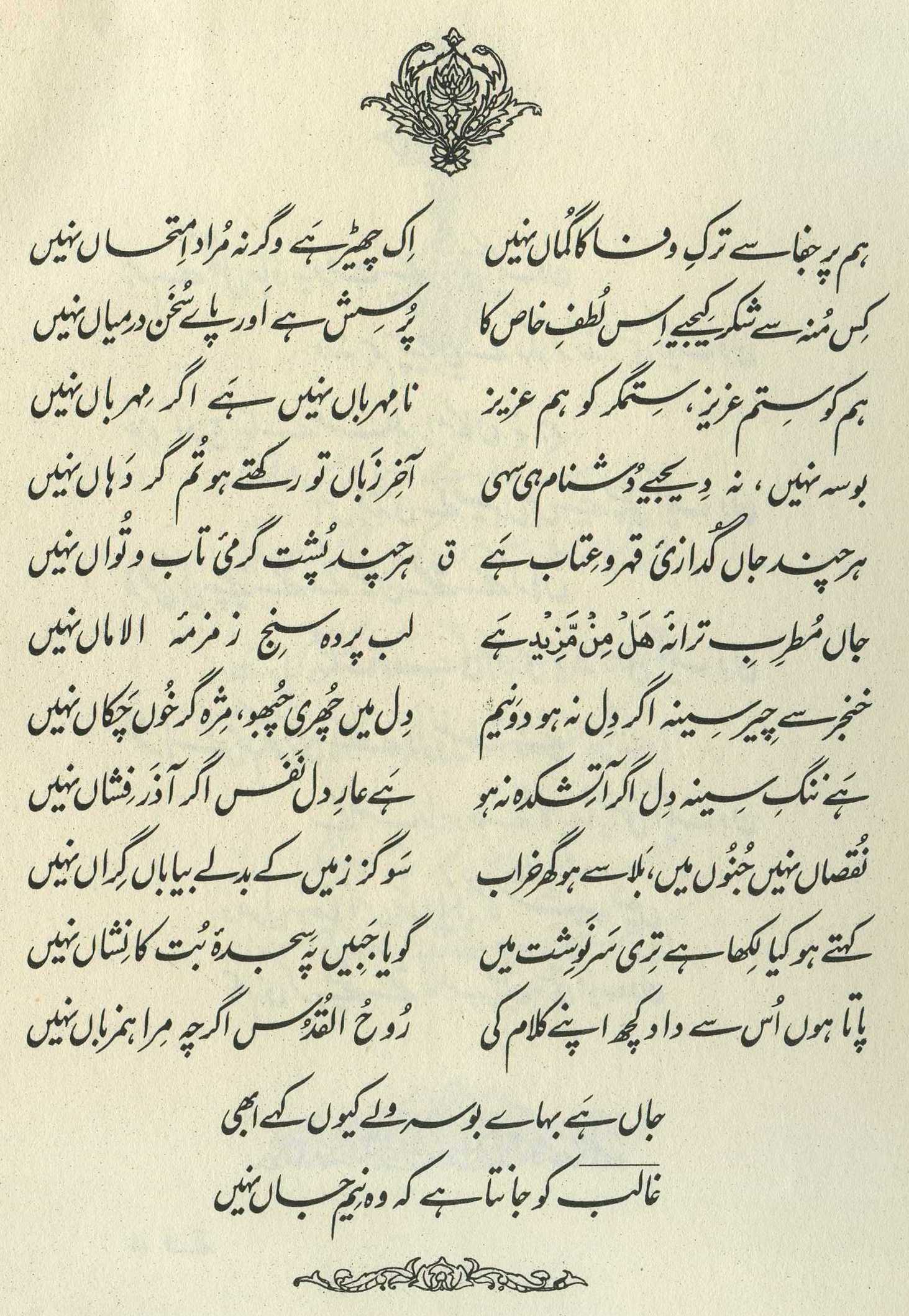
The meaning of the first line is that my enduring tyranny, and her practicing tyranny, is because she is dear to me and I am dear to her. Or consider it differently, like this: that if she is dear to me, and for this reason her tyranny too is dear, and she practices a kind of tyranny on me that I desire, then I too am dear to her. Now it has the connection with the second line that her unkindness-- that is practicing tyranny-- is exactly kindness. That is, the thing that I want is exactly what she does. If she's not kind, then she's not unkind, and she's not unkind if she's not kind. (89-90)
== Nazm page 89 ; Nazm page 90


Tyranny is dear to us, and she practices tyranny; thus it's proven that she holds us dear. Because she gives us that very thing that we hold dear. (81)
He says, we are dear to the tyrant because her tyranny is according to our power of endurance. She doesn't practice such cruelty that would leave us half-dead or kill us entirely. Thus we can say that if we too were not dear to this tyrant, then she would have taken our life. From this expression it has been proved that if that tyrant is not kind to us, then she is also [] not unkind to us. (141)
If we can't call her kind, then we also [] can't call her unkind. That is, if she didn't practice graciousness, then she did practuce cruelty. She didn't forget us entirely....
Janab Hasrat didn't reflect that on his view, the 'if she's not kind' part becomes useless. Janab [Nazm] Tabataba'i too says something of that same sort as Janab Hasrat; thus this objection applies to his words as well. (185)
An example of Ghalib's habit of finding a surprising aspect of something quite ordinary. Of course, a great deal of pleasure is derived from the repetition of words in their simple and compound forms and the ploy of the double negation in the second line.
The second line may be read to imply an 'even if' rather than a simple 'if'. (8)
The first noteworthy point is that in this verse an uncommon kind of parallelism is found. In parallelism usually two words are brought into comparison, and in such a way that when one word would come into comparison with another, the second word would be metrically identical to the first. [An example is given from Iqbal .] In the present verse there's none of this, but there are four parts. From the point of view of meaning, each part is complete. The first part of the first line is metrically identical to the first part of the second line; and the second part of the first line is metrically identical to the second part of the second line-- that is, the form becomes A/B, A/B. It's clear that such parallelism cannot be established easily, nor can it easily be noticed....
[Commentators are wrong to add a to the second line and read it as 'even if', or the like.] Tyranny is dear to us; the meaning of this is that we are dear to the tyrant. If the tyrant is not kind, then the meaning of this is that she is not unkind. Now consider the explication: an important part of the personality of the tyrant is tyranny-practicing. This tyranny is lovable to us. That is, between tyranny and us there is a special connection . But tyranny is also an important of the personality of the tyrant. Accordingly, between tyranny and the tyrant there's a special connection. That is, between the tyrant and us is the shared quality that we both hold tyranny dear. 'A' is attracted to 'B', 'C' too is attracted to 'B'. Thus it's clear that 'A' will be attracted to 'C', because they both have the same taste and temperamental inclination.
Thus the meaning of our holding tyranny dear is that the tyrant holds us dear. The tyrant's task is to practice tyranny-- that is, to be unkind. But we hold unkindness (=tyranny) dear. Accordingly, if she is unkind to us (practices tyranny), then please understand that she is showing us kindness. Her unkindness itself is kindness, because she is giving us that thing (tyranny) that we like. The first line has made it clear that the tyrant holds us dear. It's clear that she expresses her kindness in the guise of unkindness alone. This too is a proof that if she's not kind, then she's kind.
== (1989: 112-14) 2006: 134-36
Nazm, Hasrat and Faruqi seem to be broadly in agreement: they want to reinforce the paradox ical, but also paradoxically quite logical, quality of the verse. By contrast, the two Bekhuds and Naim seem to be concerned to offer a more pragmatic interpretation that breaks down the acutest paradoxes. The little word becomes the symbolic crux of their disagreements. 'She is not kind, if she is not unkind' is starker and more radical than 'she is not kind, even if she is not unkind'.
I prefer the starker and more radical reading, the one that moves away from practical accommodation ('she doesn't torture him as much as she might have done') toward abstraction and the pleasures of major word/meaning play. Naim mentions these latter verbal pleasures, and Faruqi analyzes them in detail, pointing out their metrical dimensions as well. 'She's not unkind, if she's not kind' has so many possible readings:
=She wants to be kind, but she has to be unkind in order to be kind.
=She wants to be unkind, but she has to be kind in order to be unkind.
=She may not actually be unkind, but neither is she kind.
=She may not actually be kind, but neither is she unkind.
This is one of those brilliant verses like a jewel-- its four parts are perfectly organized into two lines, and all the parts and both the lines play off each other and resonate with each other in an astonishing number of ways. It's often said that in a great ghazal verse not a word could be changed without ruining the effect; for this verse it's entirely true. As a bonus, all the repetition and parallelism creates great sound effects in the verse, too.
The second line in particular-- we enjoy it the first time we hear it, in its balance and rhythm and repetitions, and as we say it again we enjoy it more, and more variously. It's so opaque to the mind, yet so invitingly sayable. No matter how elegantly the commentators dissect it, its punch, its shock, is reinforced by so many verbal devices that it's always freshly there. Any rational things we can say about it are always provisional and secondary compared to the line itself. And what more can we ask of great poetry?
Note for meter fans: The official form of this meter is: = = - / = - = - / - = = - / = - = , so that it consists of four different feet. (In the meter list , it's #5.) I have always insisted to Faruqi that the 'real', ear-perceived form of this meter is quite different-- I think we feel it as: = = - = - = / - - / = = - = - = . In other words, I think it is experienced as 'syllable group + small break + same syllable group', so that it feels somethat like the meters that consist of two identical halves with a quasi-caesura between them (such as meter #4). This is the only meter for which I make any such case. Faruqi has not been much impressed by my argument; he considers that the official metrical pattern is quite satisfactory. But I think his 'four-part' division of this verse, which he treats as a special case, is really just Ghalib making full use of the syllable pattern as I perceive it. (For what it's worth, this is also my own very favorite meter; I would take it with me to a desert island.)
For a somewhat similar idea, more ruefully expressed, see 413x,1 .
graphics/beloved10.jpg