Verse 71847aa;Nnahii;N
G3
1
cleave the breast with a dagger, if the heart would not be in two halves
2
thrust a knife into the heart, if the eyelashes are not blood-dripping
'A knife; a dagger; a scalpel'.
'To stick (into), run (into), to prick, pierce, penetrate'.
| References | |
|---|---|
| Arshi, Imtiyaz Ali | Ghazal# 108 |
| Raza, Kalidas Gupta | 204 |
| Hamid Ali Khan | Open Image |
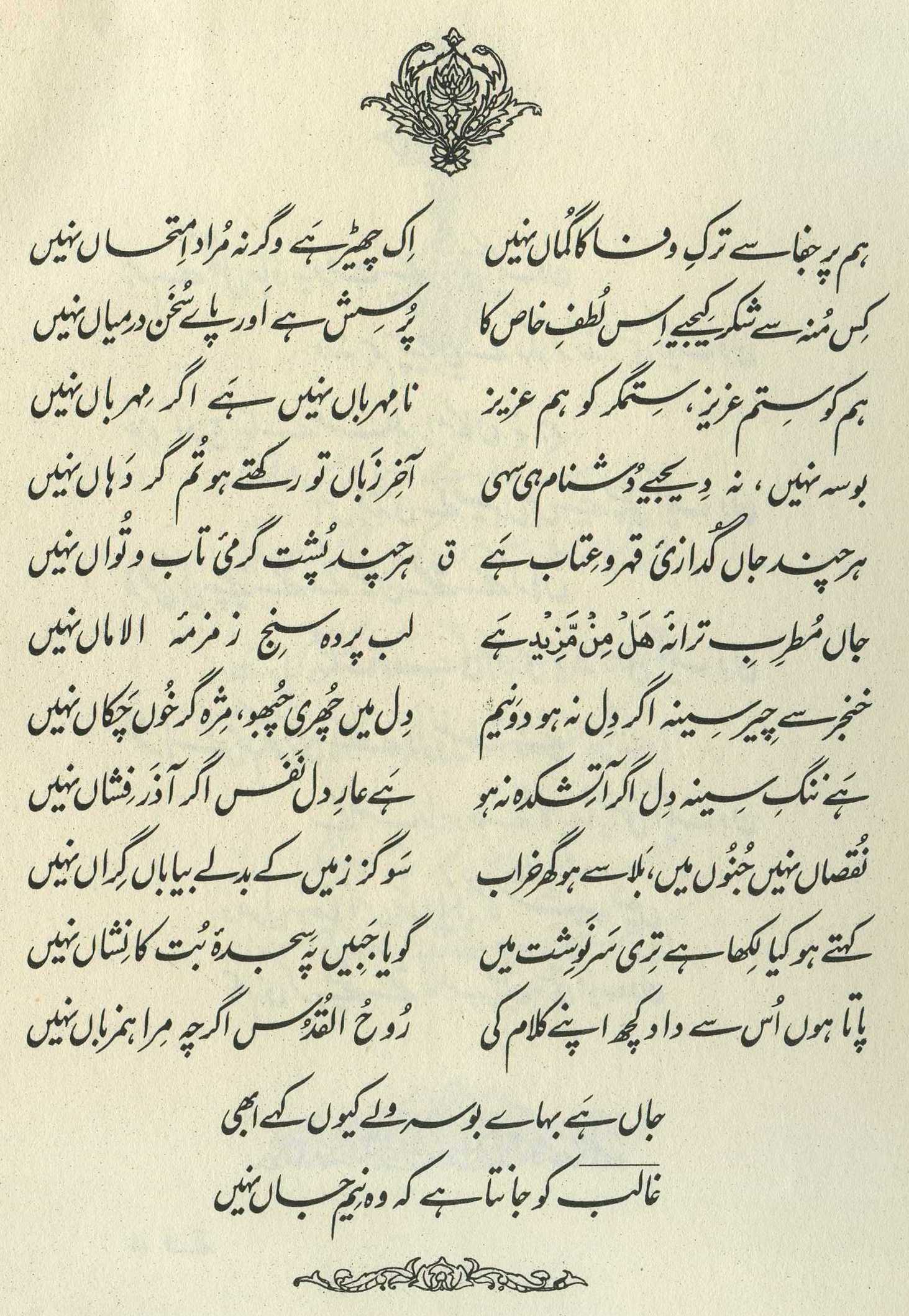
That is, in the split-open heart and the blood-dripping eyelashes is such pleasure that if the knife of passion has not split the heart in two, then pierce the heart with a dagger and split the heart in two. And plunge a knife into the heart to make the eyelashes blood-dripping. For of what value is that breast in which the heart doesn't burn, and of what use is the heart that is not fire-scattering? To [metrically] shorten the of is permissible, but [only] in Persian. (90)
== Nazm page 90

He says to the beloved, or to the True Beloved, that if the heart has not become two pieces, then why do you hesitate? Take a dagger and cut the heart in two. If up to now tears of blood don't emerge, then plunge a knife into the heart. Tears of blood will spontaneously emerge.
And if we link this with the next verse, then the meaning will be that the poet addresses his heart and is saying, 91,8 . (186)
The beauty of parallelism I have already mentioned in discussing 91,3 . Now, in the verse under discussion, please consider the arrangement of sound: . Through these words, an atmosphere of sound is created that is an evocation of the teeth-gritting effect of a knife deliberately being plunged, in cold blood, into one's own or another's body. [A comparison with Shakespeare: Othello says 'And smote him, thus', and then plunges his dagger into his own breast.]
Now consider the aspect of meaning. If the heart is not split open, then it's necessary to split open the breast, and if the eyelashes are not blood-dripping, then plunge a knife into the heart. That is, in both cases the heart is the victim. There's an extraordinary ambiguity about the rhetorical structure. Who is the addressee, and who is the speaker? That too has not been made clear. For these reasons a number of interpretations of the verse emerge. For example:
1) The speaker says to himself, 'If your heart is not split open, or would not yet have been able to be split open, then split your breast open with a dagger. And if blood doesn't drip from the eyelashes, or has not yet been able to drop, then plunge a knife into the heart, for it's necessary for the lover to have a split-open heart and blood-dripping eyelashes.'
2) The speaker says to himself, 'If your heart hasn't become split open, and your eyelashes blood-dripping, then they haven't. A dagger and a knife are available, use them to cut open your breast and heart.'
3) The speaker says to himself, 'If your heart isn't split open (that is, isn't pain-filled) and if your eyelashes aren't blood-dripping (that is, if the liver has not become blood), then give yourself this punishment: cut open your breast and heart.'
4) The speaker says to the beloved, 'Come look at the condition I'm in. If my heart isn't split in two and my eyelashes aren't blood-dripping, then split my breast with a dagger and plunge a knife into my heart.' (That is, give me the punishment of a painful and tormenting death.)
5) The speaker says to the beloved, 'You have doubts about me, as to whether my heart is split open and my eyelashes are blood-dripping (and yet I still claim to be a lover). Come, split open my breast and take a look. You yourself will see that my heart is in fragments. And plunge a knife into my heart and look.' (Because I no longer have a heart at all, it's all turned into blood and flowed away.)
6) The speaker says to the beloved, 'If your airs and graces and disdain have not yet split my heart in two, and if my eyelashes aren't blood-dripping, then so what? Split open my breast with a dagger, and plunge a knife into my heart.' (I am ready in every way to die.)
7) The beloved sarcastically says to the lover, 'What! and you made a claim to be a lover! Neither is your heart split in two, nor are your eyelashes blood-dripping. Lower your eyes to your robe and look. If I am speaking correctly, then use a knife, and put yourself into the state that a lover ought to be in.'
8) The beloved sarcastically says to the lover, 'All your claims are false. Reflect on your condition. If neither is your heart split in half, nor are your eyelashes blood-dripping, then it's something over which you ought to die of shame. Get a dagger and knife, and take your own life.'
In the light of the above points, this can be declared a kind of 'miracle of expression' verse in which theme-creation , meaning-creation , the ' description of an affair ', all have come together in one place.
== (1989: 115-17) 2006: 137-39
The elegantly developed meanings provided by Faruqi all depend on the permutations of whether the speaker is the lover or the beloved; and of whether the use of knife and dagger to slash open breast and heart is considered a (normal or desperate) means to a desirable end, or a (fatal?) punishment for not having achieved that end.
Nazm and some other commentators treat this verse and the next one, 91,8 , as a sort of undeclared verse-set , and comment on both together. Either that, or else perhaps they consider these two verses to be a continuation of the verse-set that begins with 91,5 and definitely includes {91,6}. Since by convention only the beginnings of verse-sets are marked, it is left for the reader to decide where the verse-set ends. I am treating {91,5-6} as a verse-set, and {91,7} and {91,8} as two verses that simply have a lot in common-- much more with each other than with {91,5-6}.
It's a dramatic verse, and with its two imperative verbs, to the max. I especially like not only the effortless-seeming multiplicity of meanings, but also the harshly powerful sound effects that Faruqi points out.
Note for grammar fans: The first line has an intimate imperative ( ), while the second line has a familiar imperative ( ). Yet the parallelism of structure is such that it doesn't seem at all reasonable to imagine two separate addressees. Surely the discrepancy is just meant to be casually colloquial (and of course it's metrically convenient).
graphics/heartdagger.jpg