Verse 51821ardar-o-diivaar
G9
In this meter the next-to-last long syllable may be replaced by two shorts.
1
if you have a mind/'head' for the madness/merchandise of waiting, then come
2
for they are a shop for the goods/merchandise of sight/gazing, door and walls
[from the Persian] 'Goods, wares; trade, traffic; marketing; purchase, bargain'.
[from the Arabic] 'Melancholy; hypochondria; frenzy, madness, insanity; love'.
'Merchandise; goods, chattels, furniture; clothes, effects; utensils; valuables'.
| References | |
|---|---|
| Arshi, Imtiyaz Ali | Ghazal# 58 |
| Raza, Kalidas Gupta | 330-31 |
| Nuskhah-e-Hamidiyah | 101-102 |
| Hamid Ali Khan | Open Image |
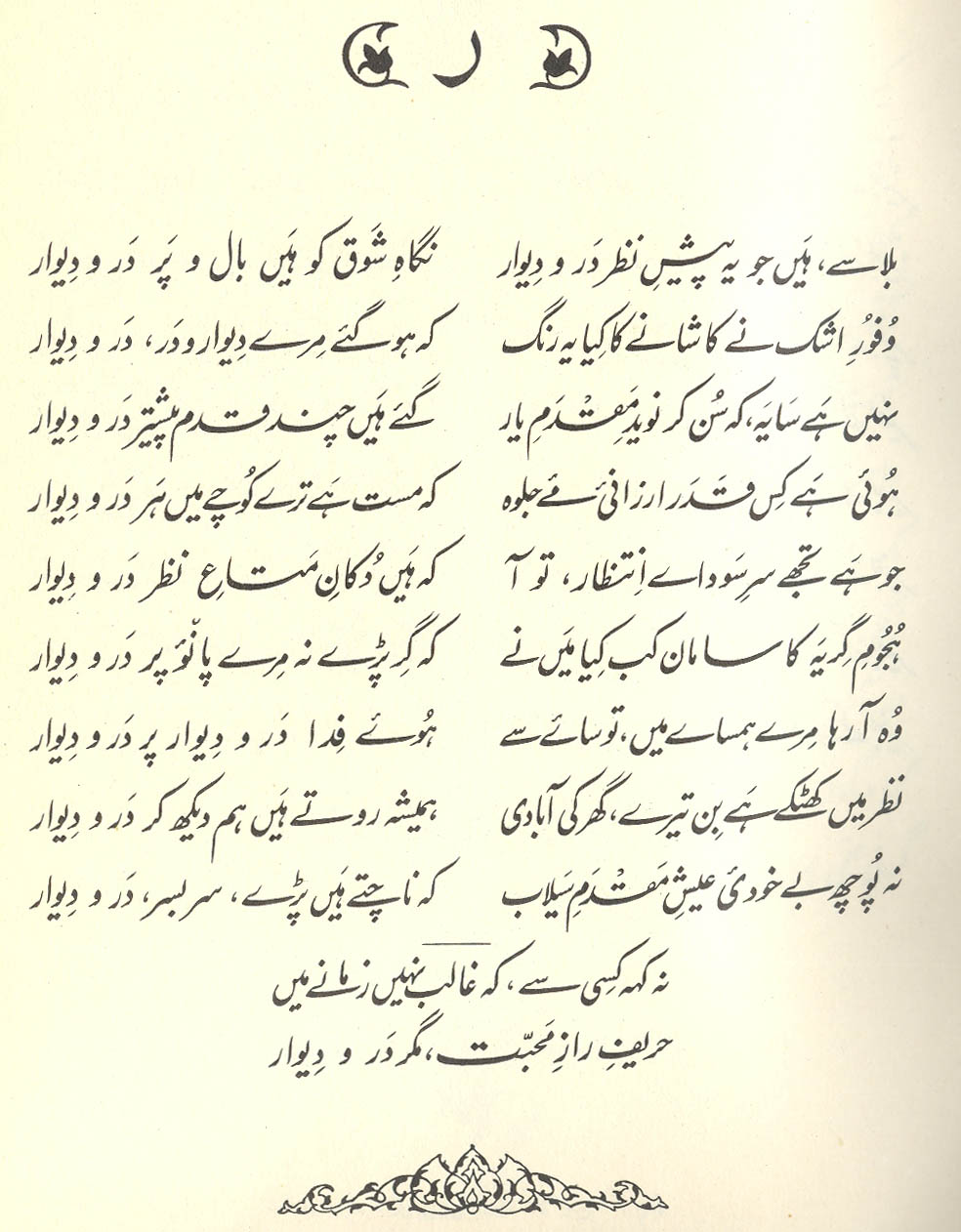
That is, my or the lover's gaze has dwelt so heavily on doors and walls, in the state of waiting, that it's as if they've become a shop for the goods of waiting. If you are a purchaser and connoisseur of these goods, then come. (53)
== Nazm page 53

He says, if you want to buy the merchandise of waiting, then come and see the spectacle: in the state of waiting, my glances have adhered to the doors and walls the way goods for sale are arrayed in shopkeepers' shops. (100)
Having said that much [as Nazm has said], the commentary is not complete. Mirza says, 'Oh beloved, the group of lovers stand intently staring at your doors and walls. If you want to enjoy this spectacle, then come-- the sight is worth seeing' ....
[Or:] If you have a nature that can endure the difficulty of waiting, then come. Doors and walls have become a shop for the goods of sight (sight-illuminating beauty). That is, if you have a nature fit for waiting, then there's no lack of radiance/appearance. (127)
The word , meaning 'madness', has come as a wordplay with 'shop', because in a shop too goods are sold. (135-36)
ABOUT : At the heart of the wordplay here is , with its double meaning of the Persian 'merchandise' and the Arabic 'madness' (see the definitions above). In fact the present verse is careful to activate both meanings. The first line juxtaposes to 'head' [] (which I've translated as 'mind' to convey the idiomatic sense more accurately), so that we think first of the more common ghazal-world sense of 'madness'; the reference to 'waiting' also reinforces this reading. Only when we hear the second line, with its references to a 'shop' [] and 'goods, wealth' [] do we realize that it's partly (but of course not wholly) the sense of 'merchandise' that's intended. For another verse that rests on the same elegantly exploited double meaning of , see 214,8 . For verses that seem to play on the two senses of without actually using the word, see 91,9 and 199,6x .
Then in addition we have the wordplay of , 'wait', and its root, , 'sight'. (This because to wait for someone, , literally means something like 'to keep an eye out for someone'.) Endless waiting is part of the lover's madness. And 'sight' or 'gazing'? It is aligned with madness-- and with commerce too, for the shop offers the 'goods/property of sight'.
Finally, what does the shop consist of? 'Doors and walls', of course, presumably those of the lover's house. After all his waiting and (vain) gazing, the doors and walls are now so saturated with it that he has enough for all his likely customers. Probably he is only addressing one customer, with the intimate -- himself? the beloved? a confidant? And of course, nobody but a madman would 'have a mind' to buy 'gazing' anyway, or think to see a display of it on the walls and doors of a mad lover's house.
graphics/waiting.jpg