Verse 81821ardar-o-diivaar
G9
In this meter the next-to-last long syllable may be replaced by two shorts.
1
in the gaze/eyesight, the flourishingness of the house pricks/rankles, without you
2
we always weep, seeing/'having seen' doors and walls
is an archaic form of ( GRAMMAR )
'To prick, to rankle (in, - ), to fester (in); to prove offensive (to)'.
'Inhabited spot or place; ...prosperity; state of comfort; happiness, joy, pleasure.'
| References | |
|---|---|
| Arshi, Imtiyaz Ali | Ghazal# 58 |
| Raza, Kalidas Gupta | 330-31 |
| Nuskhah-e-Hamidiyah | 101-102 |
| Hamid Ali Khan | Open Image |
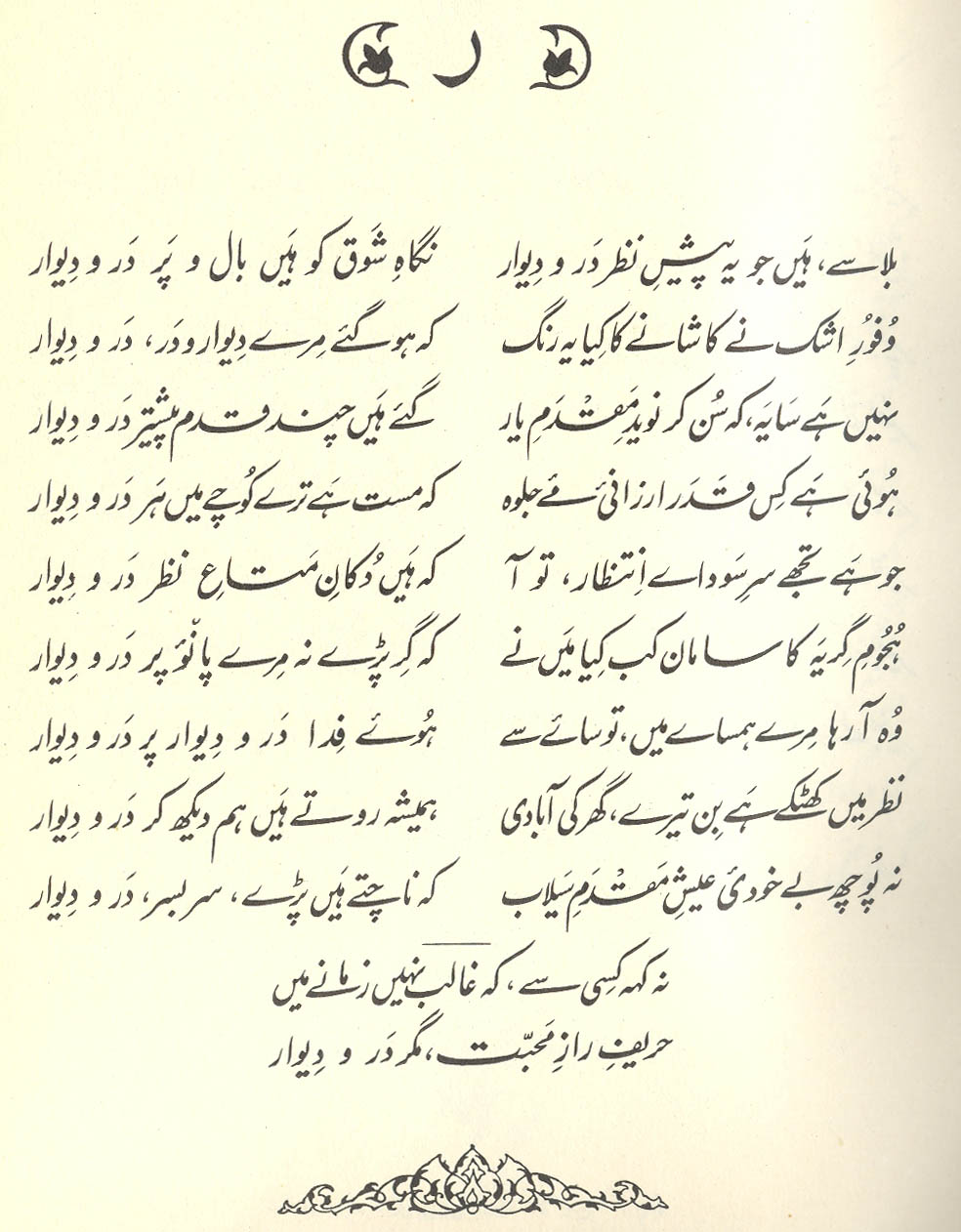
== Nazm page 53

He says, in separation from you the bustle of our house pricks in our eyes; the necessary result of something's pricking in the eyes is that tears begin to flow. When we see our doors and walls we always weep at the memory of you. (100)
Bekhud Mohani compares this verse to M 265,5 , one of Mir's great masterpieces, a verse so brilliant, mysterious, and full of mood -- especially the second line-- that it greatly overshadows the present verse.
Unlike Mir's 'mood' verse, Ghalib's is based partly on wordplay: the idea of 'in [the lover's] eyesight', . In a general way, what is in his eyesight is the house and its doings; but in a specific way, what is in his eye(sight) is a thorn, suggested by the verb , 'to prick'. The house collapses into a 'thorn' because both of them are 'in [his] eyesight'. And the inevitable result of either one would be tears, so having both in his eyes together makes him constantly weep.
More punchy and remarkable, however, is the second line. Since we know from the first line that it's the , the 'inhabitedness' or 'flourishingness' (see the definition above), of the house that makes the lover weep, we expect in the second line some reference to people, activity, hustle and bustle-- what in Urdu is often called the , the 'glory', of a house. That in itself would be sufficiently punchy, since what makes everyone else happy would make the lover weep.
But then we learn that what the lover calls is-- doors and walls. What he means by 'inhabitedness, comfort, prosperity, joy' is simply the solitary, stark enclosure of the house itself. What an enjoyable shock to our expectations! Without the beloved, even that minimal degree of domestic 'comfort' offends him. Remember 56,3 , in which the lover reproaches his heart for presuming to want even so much as a nap.
And if the lover in fact weeps any time he sees any doors and walls, in anybody's house-- as seems quite a possible reading, because the verse says nothing about the house being his own-- he'll be weeping all the time. (Why are we not surprised?)
graphics/abadi.jpg