Verse 41821ardar-o-diivaar
G9
In this meter the next-to-last long syllable may be replaced by two shorts.
1
to what (an) extent there has occurred abundance/cheapness of the wine of glory/appearance?!
2
that in your lane is intoxicated, every door and wall
'Cheapness; abundance, plenty; good harvest'.
| References | |
|---|---|
| Arshi, Imtiyaz Ali | Ghazal# 58 |
| Raza, Kalidas Gupta | 330-31 |
| Nuskhah-e-Hamidiyah | 101-102 |
| Hamid Ali Khan | Open Image |
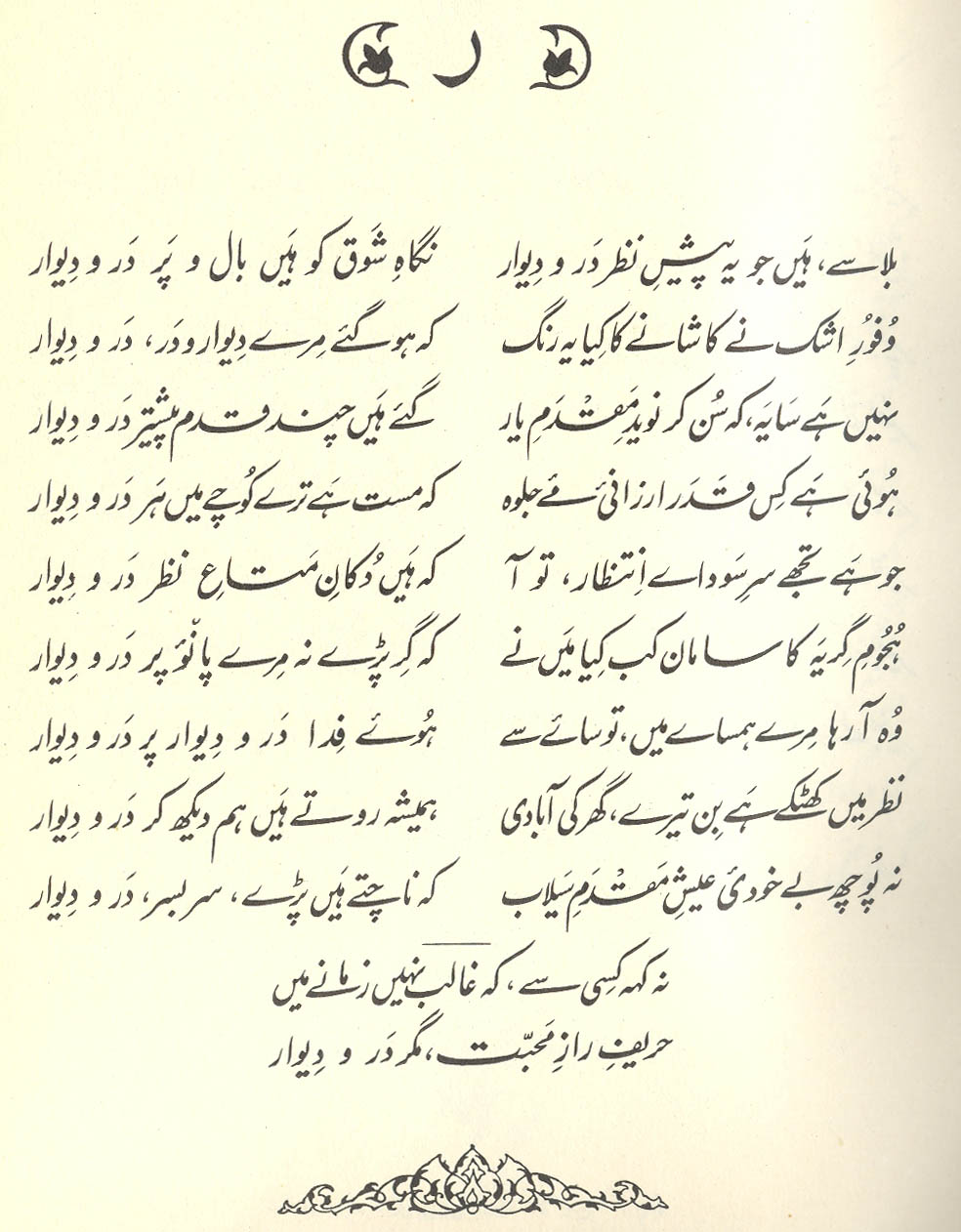
By way of a taunt, the poet says, to what an extent now you'e made the wine of the sight of you available to anybody and everybody! (53)
== Nazm page 53

He says, it's a great pity-- you've made the wine of splendor/appearance so cheap that even the doors and walls of your lane have become intoxicated with the wine of the sight of you. (100)
The lover has been so affected and intoxicated by the splendor/appearance of the beloved that to his unfocused gaze doors and walls appear to be swaying like drunkards (when intoxication is very acute, that is exactly how things appear). (127)
The first line can be, thanks to a variant form of the 'kya effect', either a question or an exclamation of amazement.
Nazm and Bekhud Dihlavi see the verse as a taunt or reproach to the beloved, who is intimately addressed in the form. The sense of as 'cheapness' (see the definition above) works for this reading. The beloved's proper role is to be difficult of access, not to freely show herself to all and sundry. The proof that she is easily visible is that all the walls and doors in her lane are intoxicated and reeling with her splendor. She shouldn't be providing her radiance, like cheap and abundant wine, to all comers.
But also means 'abundance, plenty, a good harvest'. Perhaps the beloved's radiance penetrates the street even without her showing herself in any cheapening or undesirable manner. How can she help it if the very air in her vicinity, the very walls and doors in her street, are electrified by her presence? In fact it's a tribute to the irresistible, pervasive power of her beauty.
As Bekhud Mohani observes, however, it's also quite possible that the lover himself is the one who's intoxicated, rather than the walls and doors. Thus as his head reels, he sees the doors and walls as swaying, and thinks of them as reeling and staggering with drunkenness.
And of course, the possibilities aren't mutually exclusive either.
graphics/streetjaisalmer.jpg
graphics/intoxication.jpg