Verse 31821ardar-o-diivaar
G9
In this meter the next-to-last long syllable may be replaced by two shorts.
1 a
it's not a shadow; for, having heard the good-news of the coming of the friend/beloved
1 b
there is no shade/shelter; for, having heard the good news of the coming of the friend/beloved
2
they have gone some steps forward, doors and walls
'Shadow, shade; shelter, protection'.
(from the Arabic , 'to come, arrive') 'Coming, arriving; arrival'.
(from the Arabic , 'going before, preceding') 'The foot; sole of the foot; a foot's length; a footstep, step, pace; —a going before; merit:'.
| References | |
|---|---|
| Arshi, Imtiyaz Ali | Ghazal# 58 |
| Raza, Kalidas Gupta | 330-31 |
| Nuskhah-e-Hamidiyah | 101-102 |
| Hamid Ali Khan | Open Image |
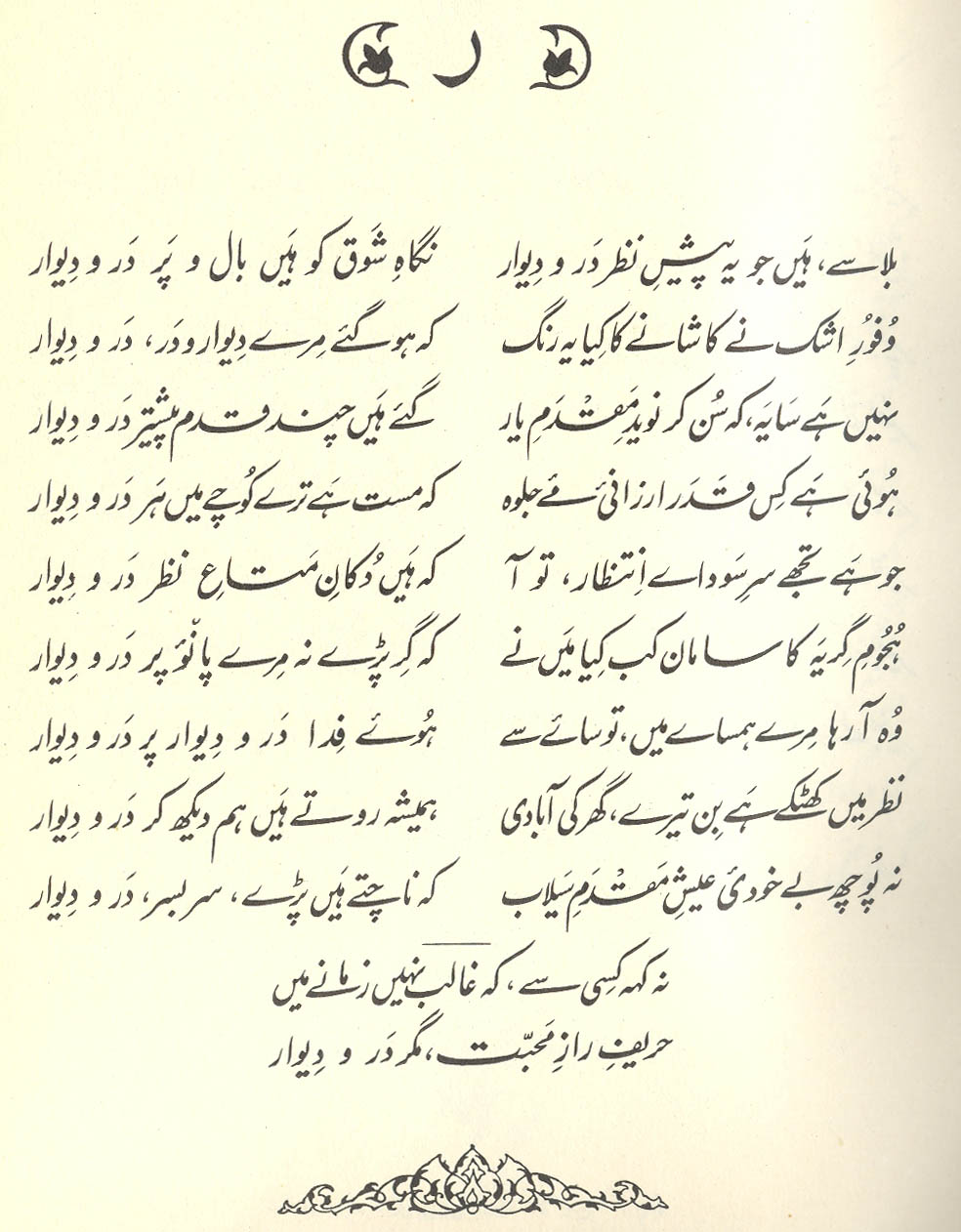
'Shade' refers to the shade of the doors and walls, which have run out some steps beyond the door in order to welcome the guest. (53)
== Nazm page 53

He says, this is not the shadow of the doors and walls that can be seen at a little distance from them; rather, having heard the good news of the beloved's coming, doors and walls themselves have gone some paces forward to welcome the guest. (100)
At the time when his beloved comes, the lover is so happy and so absorbed that he doesn't think a shadow is a shadow, but considers it to be doors and walls. And he says that not only I, but doors and walls too, are joyous. And so joyous that they have advanced some steps forward in order to greet the beloved. (126)
With what artistry he has made this extremely narrow, extremely limited and 'stony' [] ground into water [i.e., irrigated it]! No verse is devoid of inventiveness of thought [] and felicitousness of expression [].... Shadow, and in it this light of elegance of meaning []-- praise be to God! (135)
The commentators tend to go for (1a), in which perhaps someone outside the lover's house notices what he thinks is a large dark shadow, only to be corrected by the lover: that's not a shadow, that's the walls and doors themselves! They so deeply share the lover's ecstatic joy at the news of the beloved's arrival that they've gone forward a few steps to meet her (in the traditional gesture of courteous welcome).
Or else as in (1b), the lover, entering his house, notices that it no longer provides any protection or shelter from the elements-- the walls and doors have gone out to welcome the beloved. Since can mean both 'shadow' and 'shelter' (see the definition above), both readings are fully available.
As Bekhud Mohani implies, all this could well be happening only in the mad lover's fevered imagination. But nothing in the verse requires this supposition; the grammar is straightforward and the tone matter-of-factly explanatory. This makes the verse much more amusingly deadpan.
Then there's the elegant wordplay of and , which actually come from different roots (see the definitions above) despite their immense congruity of sound and sense. Here Ghalib is using the verbal device called 'doubt about derivation'; for more on this, see 57,11x .
Josh describes the rhyming elements of this ghazal as a 'stony ground ' [], punning on the literal meaning of 'ground', . He means one that is unpromising, rebarbative, difficult to work with. Later critics have often been ready to identify such 'stony grounds', but I always wonder whether the poets themselves would have agreed with them. For of course, there's really no way of telling whether Ghalib himself found this particular ground 'stony'.
graphics/noshade.jpg