Verse 101821ardar-o-diivaar
G9
In this meter the next-to-last long syllable may be replaced by two shorts.
1
don't say/tell it to anyone!-- for, Ghalib, in the world/age there's no
2
confronter/sharer of the secret/mystery of love-- but/perhaps doors and walls
'Time, period, duration; season; a long time; an age;... --the world; the heavens; fortune, destiny'.
'A fellow-worker (in one's craft or ordinary occupation), an associate, a partner, a mate; --a rival, opponent, adversary, antagonist; an enemy'.
'If not, unless, except, save, save only, but; besides, however, moreover; — perhaps, perchance, peradventure, by chance, haply, probably, possibly; in case'.
| References | |
|---|---|
| Arshi, Imtiyaz Ali | Ghazal# 58 |
| Raza, Kalidas Gupta | 330-31 |
| Nuskhah-e-Hamidiyah | 101-102 |
| Hamid Ali Khan | Open Image |
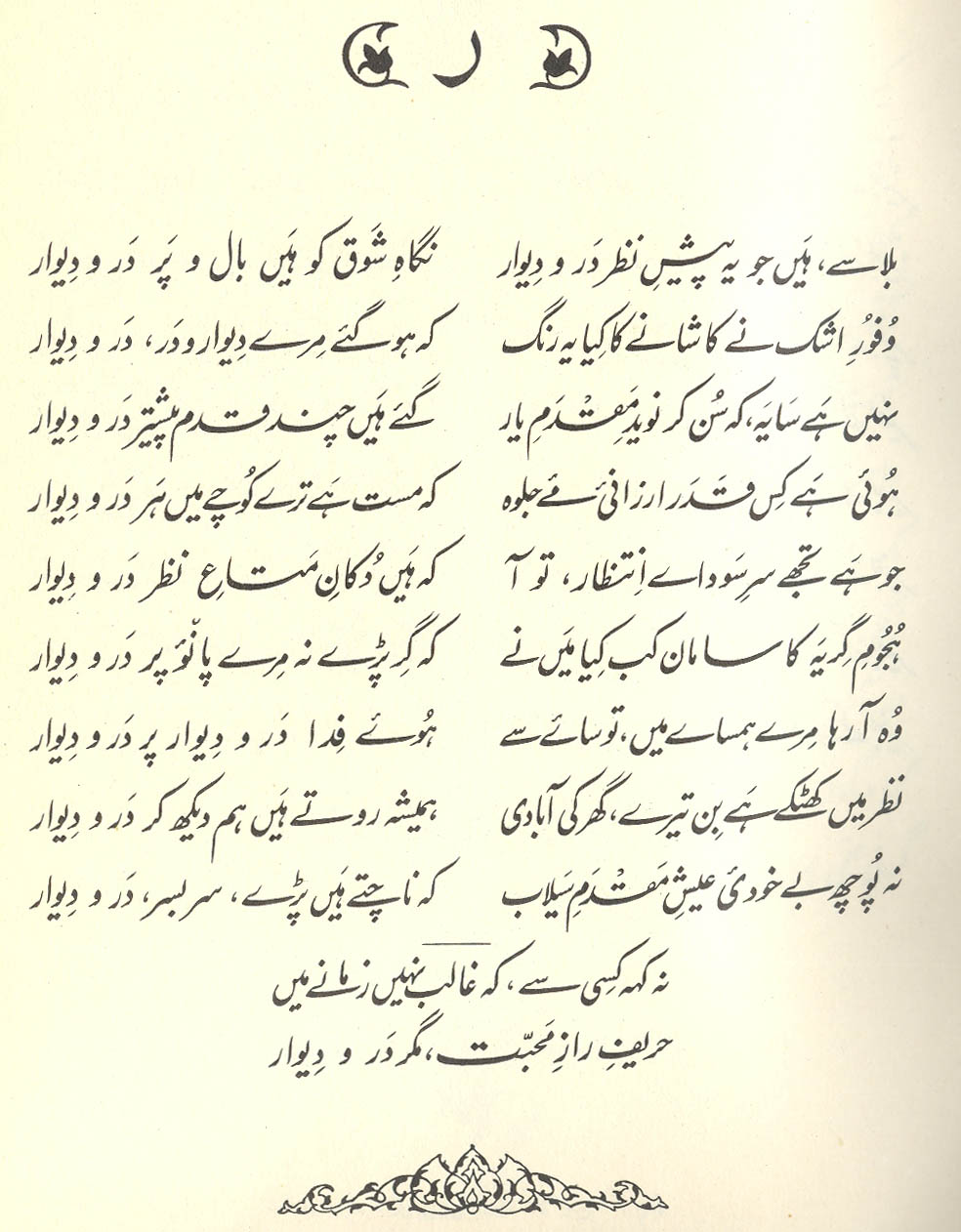
That is, don't tell the secret of love to anyone else, because no one else in the world except doors and walls is trustworthy. And to talk to doors and walls is a futile action; the result is that you should never let the secret of love pass your lips. (54)
== Nazm page 54

Mirza says, 'Oh Ghalib, don't tell your secret of love to anyone except for doors and walls'. That is, if you can't keep your secret of love concealed, and consider it necessary to tell it to someone, then instead of a person, tell it to doors and walls. The meaning of the verse is that the secret of love should never emerge from the mouth. (101)
Oh Ghalib, you've said to me that besides doors and walls, there's no one in this world/age worthy of keeping the secret of love.... Oh cruel one, can such a thing be so?! If there were not such people then the world would not remain established. (169)
../apparatus/txt_sets.html The complexities of work well here (see the definition above). It can mean a peer, comrade, equal; or an enemy, rival, antagonist-- maybe a 'frenemy'. Either way, it's someone or something who can suitably be juxtaposed to the thing in question-- can be a companion to it, or can confront or withstand it. The thing in question is the 'secret of love', and the only possible for it seems to be 'doors and walls'. Anybody else will break down and tell the secret, or will be burnt out by the effort of containing it, or will perhaps helplessly become a lover himself (as in 43,1 ). But 'doors and walls' are perhaps made of tougher stuff.
Nazm takes a dim view of talking to doors and walls. After going through this ghazal, it's hard to agree with him. Doors and walls have become the lover's reliable companions and intimates, reacting to and even sharing his passion. Why not imagine the lover as talking to his doors and walls? After all, why would he not? The verse tells us clearly that no person in this world/age is capable of handling the powerful secrets of passion, except the (personified?) doors and walls, making them the ideal confidants.
Unless, of course, we read not as 'but, save for', but as 'perhaps, possibly' (see the definition above). In that case, the verse simply recognizes the doors and walls as possible candidates for the role of confidant. They might or might not turn out to be suitable-- but while nobody and nothing else is suitable at all, they at least are still in the running.
The remarkable closural force and rueful, ironic, wryly humorous tone of this closing-verse make it a real delight. How better to wrap up a ghazal about doors and walls? Once you've read this verse, you can't imagine how else the job could possibly have been done.
graphics/saugorfortpalace1873.jpg