Verse 61821ardar-o-diivaar
G9
In this meter the next-to-last long syllable may be replaced by two shorts.
1 a
when did I ever collect the equipment for an attack/onslaught of tears
2 a
that the doors and walls didn't fall at my feet? [they did so every time!]
1 b
when did I ever collect the equipment for an attack/onslaught of tears! [I never did!]--
2 b
for didn't the doors and walls fall at my feet? [and prevent me?]
'Assault, attack; effort; impetuosity; --crowd, throng, concourse, mob; a swarm'.
'That, in order that, to the end that, so that, for that, in that, because, for; if; and; or; whether; namely, to wit, saying, thus, as follows'.
| References | |
|---|---|
| Arshi, Imtiyaz Ali | Ghazal# 58 |
| Raza, Kalidas Gupta | 330-31 |
| Nuskhah-e-Hamidiyah | 101-102 |
| Hamid Ali Khan | Open Image |
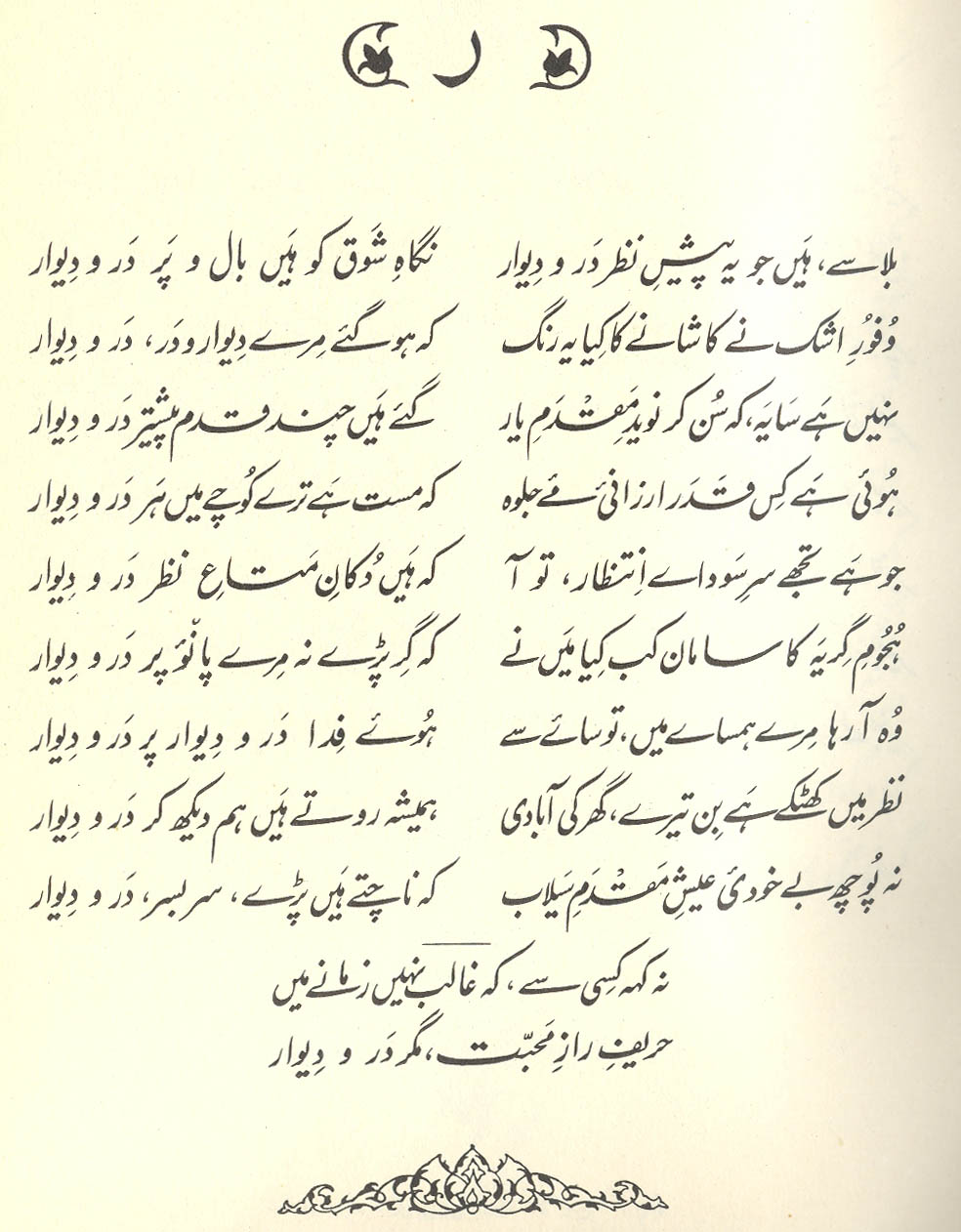
In the framework of a negative rhetorical question [] he says, 'When did I do that?-- that never happened!' That is, [it never happened] that I collected equipment for weeping, and doors and walls didn't fall at my feet. (54)
== Nazm page 54

He says, whenever I have wanted to weep my heart out, then at once the doors and walls have fallen at my feet. The meaning of the verse is that there is so much effect in my weeping that before my intention is completely accomplished, its effect becomes apparent. (100-01)
The meaning is that if I had not seen doors and walls falling at my feet (that is, collapsing), then I would have wept my heart out, and the house which appears to be in this ruined state (that is, with the walls collapsed and the door fallen in) would already have been torn apart long ago and not even a trace of it would have remained.... In another place he has said, 27,7 . (128)
This verse, with its radically structure, permits two negative-question readings. In the first reading, the framework is 'When did I ever do X, that Y didn't happen!'-- that is, that every time I did X, then Y happened. In the second reading, the framework is, 'When did I ever do X? Didn't Y always happen, to prevent me?' So either the speaker did X many times (always with Y as one result), or else he never did X at all (since he was deterred by Y). The key to these two readings is the versatility of the omnicompetent little clause-introducing conjunction .
The X is, of course, collecting the 'equipment' for an 'attack, onslaught' of tears; in other words, preparing to create a devastating personal flood, as in 58,2 . The Y is, the lover's doors and walls' falling at his feet. Just as in English, falling at someone's feet [] suggests, most probably, deliberate collapse as a gesture of humility and supplication; or, alternatively, simple collapse (reason unspecified; the collapse just happened to take place near the feet).
In this case, the first sense would provide the image of the doors and walls begging the lover not to weep such a flood that they would be destroyed; the second sense would suggest that the lover's mere preparations for a flood of tears were so potent that the doors and walls were knocked down even before the actual flood hit them. (As in 5,4 , where even a passing 'thought' of wildness or madness burns the desert to ashes.) Nobody will be surprised to realize, knowing Ghalib, that both senses of 'falling at the feet' work for both readings of the verse, given above in the translation.
We are left nicely and undecidably balanced among several sets of possibilities. One set: If the lover's tears destroyed his doors and walls, they did so either physically (his preparations led directly to actual tears) or by suggestion (the mere preparations caused his house to collapse). And this destruction happened either repeatedly, as in reading (a), or never, as in reading (b). Another set: If the lover's tears didn't destroy his doors and walls, it was because he heeded the humble supplication of the fearful doors and walls themselves; and this supplication happened either repeatedly, as in reading (a), or never, as in reading (b).
graphics/iln1868.jpg