Verse 11821ardar-o-diivaar
G9
In this meter the next-to-last long syllable may be replaced by two shorts.
1
to hell with those before-the-sight doors and walls!
2 a
to the gaze of ardor, doors and walls are wings and feathers
2 b
to the gaze of ardor, wings and feathers are doors and walls
'Trial, affliction, misfortune, calamity, evil, ill; a person or thing accounted a trial, affliction, &c.... (N.B. The word is often used most idiomatically in a manner difficult to be rendered in English; e.g. , sc. , lit. 'It concerns your evil genius'; it is no concern of yours; what is it to do with you, never mind: -- , 'What awful thing are you?' Who cares for you? You are of no significance: -- , 'What fearful or trying work'; what a fearful amount of work: -- , 'They have put in a fearful or tremendous quantity of chillies today.')'.
| References | |
|---|---|
| Arshi, Imtiyaz Ali | Ghazal# 58 |
| Raza, Kalidas Gupta | 330-31 |
| Nuskhah-e-Hamidiyah | 101-102 |
| Hamid Ali Khan | Open Image |
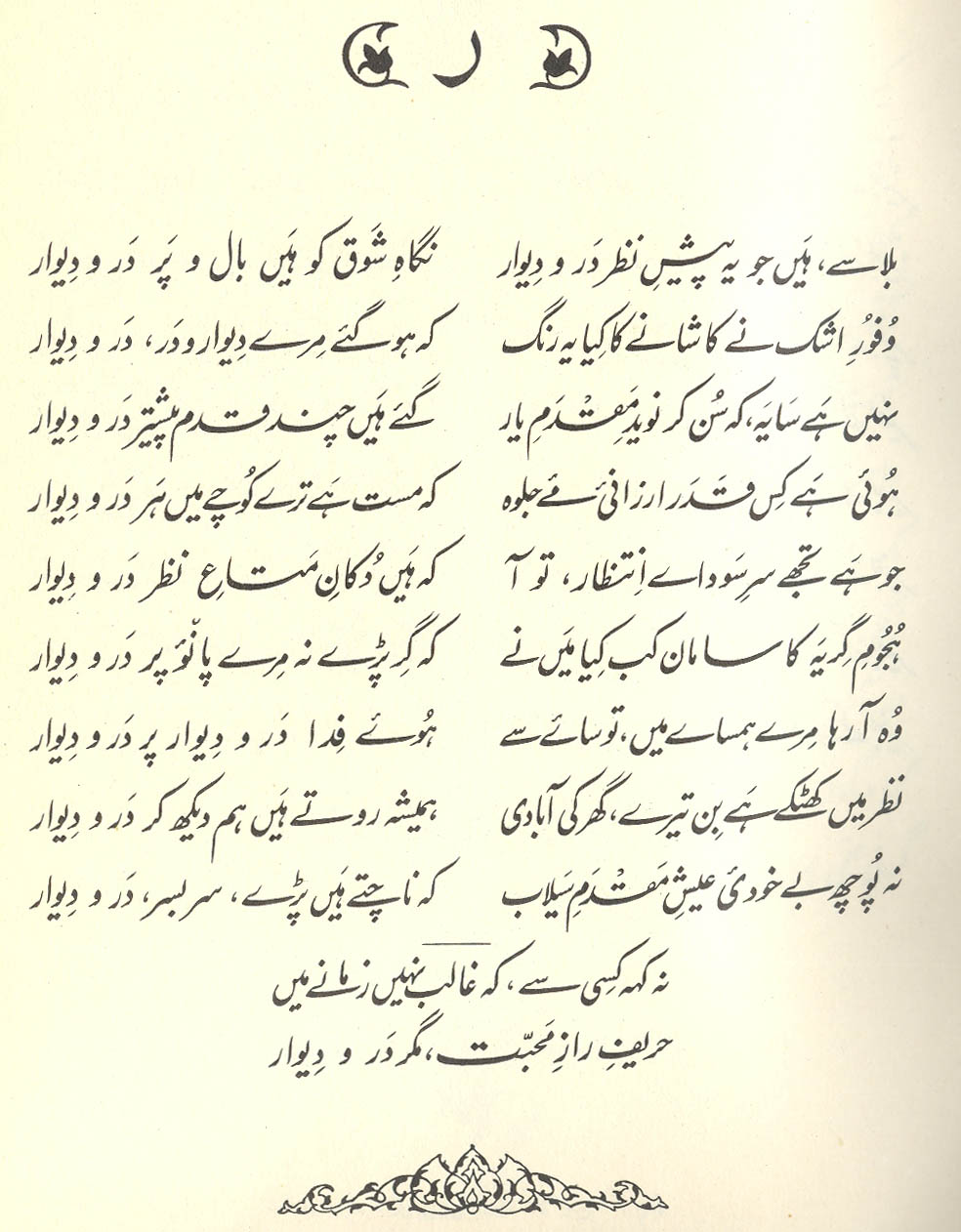
That is, doors and walls are barriers to the gaze. But when it is obstructed by them, passion becomes sharper, as if they had become wings and feathers for the flight of the gaze of passion. (53)
== Nazm page 53

He says these doors and walls that are barriers to the gaze and don't let the glance reach to the beloved-- their interposition does us no harm. Our glance of ardor has begun to reach the beloved in imagination, and the practice of imagination is also the disguise/veil of the door and walls, as if they, by interposing, became wing and feather of the glance of ardor. That is, because of them alone this power has been born in the imagination. (99)
For people of ardor, doors and walls are not barriers to sight. Rather, they act as wings for the bird of the gaze. That is, however many restrictions there are, that's how much progress ardor will make. (126)
Compare 62,10 . (203)
ABOUT expressions: The colloquial expression is a generalized malediction, wishing evil on whatever is mentioned. 'To hell with!' is probably the nearest we can get in English. Here are additional examples of this idiomatic usage: 91,9 ; 99,4 , in the fuller form ; 107,2 ; 234,2 . (It mustn't be confused with ; on this latter expression see 21,11 .) A use of alone, to mean something like 'fearfully much': 6,8x . Platts really struggles to capture such usages; see his elaborate definition above. For contrast, here are some 'straight' uses of the word : 20,8 ; 21,13 ; 57,9 .
ABOUT refrains in translation: I once did a translation of this ghazal that sought to preserve both rhyme and refrain . Versions of it were published in an article on the ghazal , co-authored with S. R. Faruqi, and also as an appendix to Nets of Awareness . Needless to say, it's not easy to preserve both; it's easier to preserve just the refrain, and most English-knowers will hardly even register the awkwardly-achieved additional presence of the rhyme. Obviously, only a handful of ghazals with unusually suitable refrains will lend themselves at all well to this kind of translation. If anybody wants to try, I recommend 5 ('burned'); 49 ('wave of wine'); 57 ('after me'); 75 ('candle'); and 80 ('rose'). Since 'after me' works, you'd think 208 , 'before me', would work too, but it doesn't (unless you omit some verses); try it and you'll see why. Nor does 73 , 'fire'. But then, there's also the odd little 127 , with the refrain .
The phrase is a kind of petrified idiomatic whole: it takes plural verbs, and refers to doors and walls in general, not one single particular door and wall. Thus it also easily becomes a synecdoche (part-for-the-whole metaphor) for a house or home.
Some modern editors (including Hamid) have in lieu of . As always, I follow Arshi.
In its apparent simplicity, this verse offers some enjoyable word/meaning plays. The 'doors and walls that are before the sight' in the first line may be so described merely casually, to identify them: the physical ones, the ones the speaker can see. But they may also be 'before the eyes' in the sense that they are blocking the lover's vision and preventing him from seeing what is beyond them, the way a blindfold 'before the eyes' would interfere with the power of sight. This irritation would provide an excellent reason for abusing them.
Then in the second line, the grammatical fact of 'symmetry' makes two readings possible. If the gaze of passion sees 'doors and walls' as 'wings and feathers', as in (2a) and the general commentarial reading, then the implication is that these physical barriers and protections merely inspire the lover's imagination to fly beyond them, and empower him to break out of their imprisoning shelter.
If the gaze of passion sees 'wings and feathers' as 'doors and walls', as in (2b), the sense would be that the lover has no fixed abode-- he lives only in flight, in movement, in wandering, so that his habitual surroundings, the 'doors and walls' of his home, would be 'wings and feathers', and the 'flight' of the imagination. (See 18,3 , in which Majnun's house is 'without a door'.)
For another fine 'doors and walls' verse, see 106,1 .
graphics/saugorfortpalace1873.jpg