Verse 31821aazahthaa
G1
1
who is a forbidder of the {wildness/wilderness}-walkings of Laila ?!
2
the house of Majnun the desert-wanderer was door-less
'A desert, solitude, dreary place; --loneliness, solitariness, dreariness; ...wildness, fierceness, ferocity, savageness; ...distraction, madness'.
'Going round, revolving; traversing, travelling or wandering over, or through, or in (used as last member of compounds,'.
| References | |
|---|---|
| Arshi, Imtiyaz Ali | Ghazal# 12 |
| Raza, Kalidas Gupta | 324-325 |
| Nuskhah-e-Hamidiyah | 53-54 |
| Gyan Chand | 90-91 |
| Hamid Ali Khan | Open Image |
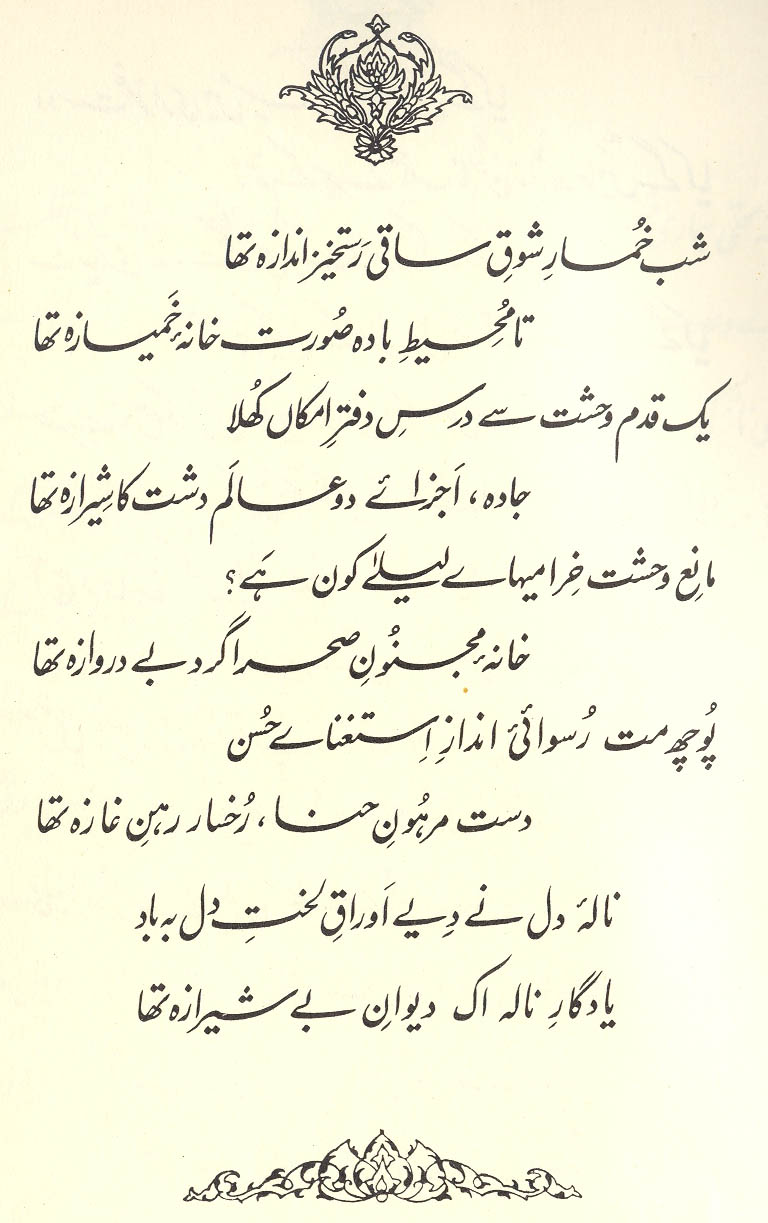
That is, Majnun's house is the desert, and the desert is a house with no door. So why does Laila not run wild/mad and come away to him? Who prevents her? (19)
== Nazm page 19

Urdu text: Vajid 1902 {18}
In this verse is the verbal device of question-and-answer. In the first line the question is, after all, who forbids Laila's desert-wandering? That is, why doesn't Laila come out in madness toward Majnun in the desert of Najd? Then it gives the answer itself: Yes, now I understand. Hazrat Majnun was mad, after all. When did he ever stay in one place? Now he is here like a will-o-the-wisp, now like a whirlwind there. If the poor thing came, then where would she come? And if she searched for him, then where would she search? (45)
In the light of the first interpretation of the question [as a rhetorical question], we learn that madness is not inducing action, and it can be confidently concluded that Laila does not have the kind of madness of passion that Majnun does.
In the interpretation as a negative question, we learn that there is no forbidder, and that it can be confidently concluded that Laila too will set her face toward the desert.
== ( 1973: 148 )
[Compare his comments on Mir's M 95,6 .]
Who is the forbidder, after all? Majnun, who makes himself impossible to find? Laila herself, who doesn't seek her lover even though no door bars her way? Nobody, so that the question is rhetorical and she's not forbidden at all? Or is it a mystery of her fate, so that she's somehow forbidden but not by any forbidder? (Here is used to achieve something like the 'kya effect'.)
And then, does the doorlessness of Majnun's house show that there's no barrier (so that there's no door to prevent her entry)? Or does it constitute a barrier in itself (how can she visit him, when there's not even any door to knock on and be admitted through)? Does Majnun even have a house at all-- is the desert itself his house? (For another such un-pin-downable house, see 127,2 .)
One further, even stranger view of the verse occurs to me. Mystically speaking, Majnun and Laila are sometimes said to be one; despite their physical separation, their identification with each other and obsessive concentration on each other was so intense that they almost became each other. On this view, the two lines fit together elegantly: both describe the situation of lived in by Laila-and-Majnun, as they wander in the wildness/wilderness of passion.
This verse is both transparently simple, and ultimately opaque. It makes masterful use of one of Ghalib's favorite devices, speech that asks unanswered-- and often unanswerable-- questions. Like so many of his verses, it gives us no guidance about how exactly to connect the two grammatically and semantically separate lines.
There's also the sound of the second line, with its rhythm, long vowels, and flowingness . To me it has that quality of mystery and mood that marks unforgettable lines. It's rich with meanings-- but there are so many of them, they open so many imaginative doors, that the verse cannot be pinned down. Which of course is one of the reasons that it lingers in the memory.
For another haunting, resonant verse about Majnun's 'house' in the wilderness, see 140,6 .
graphics/afghandesertruins.jpg