Verse 61821aashai
G3
1
every single dwelling has nobility/dignity through the dweller, Asad
2
{since / in that} Majnun has died, the wilderness is indifferent/solitary/sad
'Highness of rank, &c., exaltation, eminence, excellence, rank, grandeur, glory, honour, dignity, nobility'.
'A jungle, wood, forest, thicket; forest land; waste land; land or country overgrown with long grass and weeds; a wild or uninhabited part'.
'Indifferent (to, - ), unconcerned, apathetic; unsettled in mind; retired, lone, solitary; forlorn, dejected, sad, sorrowful; dull, dispirited, cast-down; grieved'.
| References | |
|---|---|
| Arshi, Imtiyaz Ali | Ghazal# 137 |
| Raza, Kalidas Gupta | 343 |
| Nuskhah-e-Hamidiyah | 188 |
| Asi, Abdul Bari | 219 |
| Gyan Chand | 334 |
| Hamid Ali Khan | Open Image |
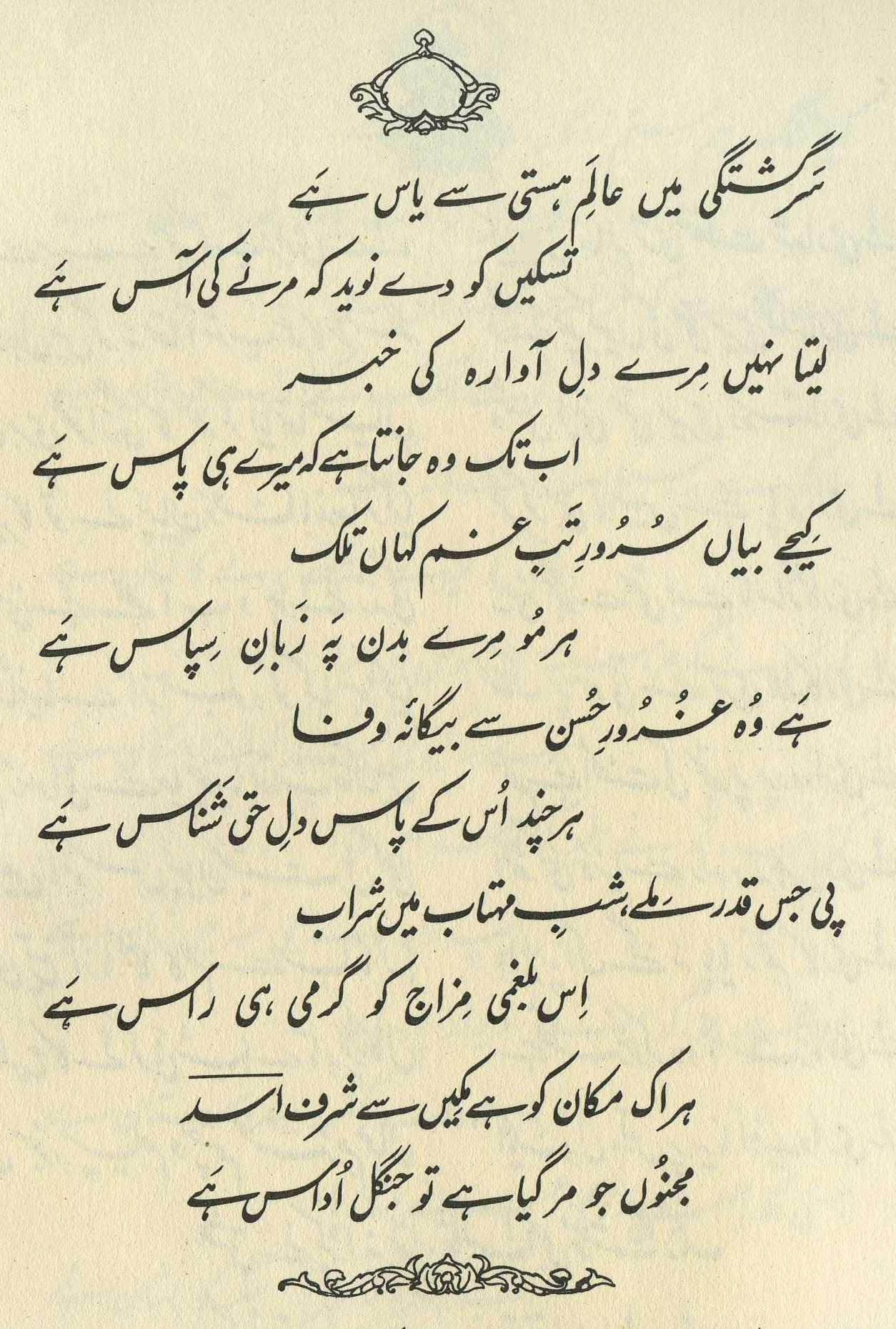
That is, this is the reason that the wilderness is ; otherwise, it would not have been . (151)
== Nazm page 151

He says, oh Asad, every dwelling receives honor/rank from the dweller. The inhabitedness/liveability [] of the wilderness was dependent upon Majnun. After his death, the wilderness has become . (208)
The prestige/respect of a house is from the master of the house alone. Just look-- after Majnun's death, how spread over the wilderness, and what a 'howling wilderness' [] it has become! From this the point emerges that only Majnun was a lover, and all the rest is a mere imitation/show []. (275)
In the first line the fact has been given that every dwelling receives honor/rank from its dweller. But in the second line it's not the dwelling of Majnun that is being mentioned; rather, it's the wilderness. It's obvious that the second line doesn't 'prove' the first line; on the contrary, it mentions a second situation: that upon Majnun's death, instead of his house the wilderness is . And with this the interpretative aspect of the verses changes: that in it, instead of some ordinary matter, some extraordinary matter has been expressed.
(1) In truth Majnun's dwelling was the one that he abandoned when he came into the wilderness. The wilderness was not Majnun's dwelling. And in the verse, the ' mood ' too is created when it's accepted that the wilderness was not Majnun's dwelling. Now an aspect of amazement enters into the verse: since every dwelling receives honor/rank from its dweller, upon Majnun's death his dwelling ought to have been ; but what happened was that instead of his dwelling, the wilderness is . Now the power of the verse is being expended not in proving the fact that 'every dwelling receives honor/rank from its dweller', but rather in proving that Majnun's wildness of passion was so perfect that his relationship with his dwelling had been entirely ended.
And the wilderness's becoming upon Majnun's death is a very important point not because he had adopted the wilderness as his home... but rather because it proves that the wilderness had accepted Majnun in the status of its dweller. The wilderness had become so familiar/intimate with this wild madman that upon his death it was .
(2) In poetry, Majnun is usually mentioned in connection not with the wilderness, but with the desert.... But Ghalib rejected the obvious word 'desert' [] and used 'wilderness'. And this verse also demanded this very word, because the desert is already associated with the effect of a 'howling wilderness' and an 'extinction of fire', and this effect is similar to that of . In contrast to this, the wilderness is the world of wild animals and the like. The mention of the spreading of in the desert, at Majnun's death, does not make manifest such a change in the state of affairs, as does the spreading of it in the wilderness.
(3) ... Today when we see a desolate desert-- this in truth was a wilderness full of the shapes and sounds of life, which after Majnun's death became and has turned into a desert.
== ( 1973: 202-204 )
Many modern divan editions have instead of ; as always I follow Arshi. His is definitely the better reading, because the tendency with is to read it with word-grafting, which here would be unmetrical; ditto for .
The first line offers a kind of dry, abstract, general statement, one that is destined, in the ghazal world, to be backed up by a 'proof', or illustrated by an example of some kind. Naturally, we are curious to hear the second line. And when we get the second line-- after, under mushairah conditions, a suitably piquant delay-- we are lavishly rewarded with its gorgeous sound effects and rich range of meanings.
Monier Williams in his Sanskrit-English Dictionary defines (literally, 'aside' + 'sit') as 'to sit separate or away from, sit on one side or apart; to abstain from participating in; to take no interest in, be unconcerned about, be indifferent or passive' (Delhi: Motilal Banarsidass, 1974 [1899], p.185). This conspicuously Hindi-side word surely counts as a ' fresh word '; this is its only occurrence in the divan. As can be seen from Platts's definition above, the meanings that have accrued to it over time all come directly from that primary concept of being seated apart, with its implications of sadness, indifference, isolation. Here are some of the possible readings:
=Because Majnun has died, the wilderness has been in full mourning; it has been paying the tribute of grief to the one whose residence gave it the 'nobility' to feel such honorable emotions.
=Because Majnun has died, the wilderness is sad; it knows it will now be an empty shell, like an abandoned house; it will no longer have the kind of prestige and honor that it did when he dwelt in it.
=Because Majnun has died, the wilderness is indifferent and solitary; it now holds itself aloof from human affairs, as is appropriate for one of high rank who will tolerate no inferior company.
=Because Majnun has died, the wilderness is now neglected and ignored; nobody cares about it any more, since it's of no more value than a long-abandoned house.
There's also Nazm's reading: the reason that the wilderness is so wild, desolate, remote, forbidding, is that Majnun has died; otherwise, it would not have been so. On this reading, the verse becomes a witty example of ' elegance in assigning a cause ': the obvious fact that the wilderness-- and in Urdu is much broader than the English derivative 'jungle'-- is wild, desolate, etc., is no mere happenstance of nature, but rather a direct result of Majnun's death.
And surely the second line is one of the most resonant and haunting ones in the whole divan . But when I try to analyze the reasons, I find it hard to put my finger any single one. Maybe it's not just sound effects, but also a case of mood . There's also the fact that the semantic structure of the line fits with complete perfection into the metrical foot pattern. And the sound effects are there: all the resonant long vowels, contrasted powerfully with the three clipped, short-a consonantal syllables and and . Try it yourself-- see if this line isn't very easy to memorize, and enjoyably resonant to recite.
A terrific verse for comparison is 18,3 , another meditation on Majnun's wilderness 'house'. Also compare 4,15x , on the relation between the 'owner' and the 'house'.
graphics/majnun.jpg
graphics/desert.jpg