Verse 41821aashai
G3
1
she is, from the pride/vanity of beauty, a stranger to faithfulness
2
although in her possession is a {right/truth}-acquainted heart
'(orig.) A thing by which one is deceived'; pride, haughtiness, vanity, vainglory'.
'Rendering to everyone his due; able to appreciate and ready to reward; knowing and performing (one's) duty; — grateful; — one who renders to everyone his due, &c.'.
| References | |
|---|---|
| Arshi, Imtiyaz Ali | Ghazal# 137 |
| Raza, Kalidas Gupta | 343 |
| Nuskhah-e-Hamidiyah | 188 |
| Asi, Abdul Bari | 219 |
| Gyan Chand | 334 |
| Hamid Ali Khan | Open Image |
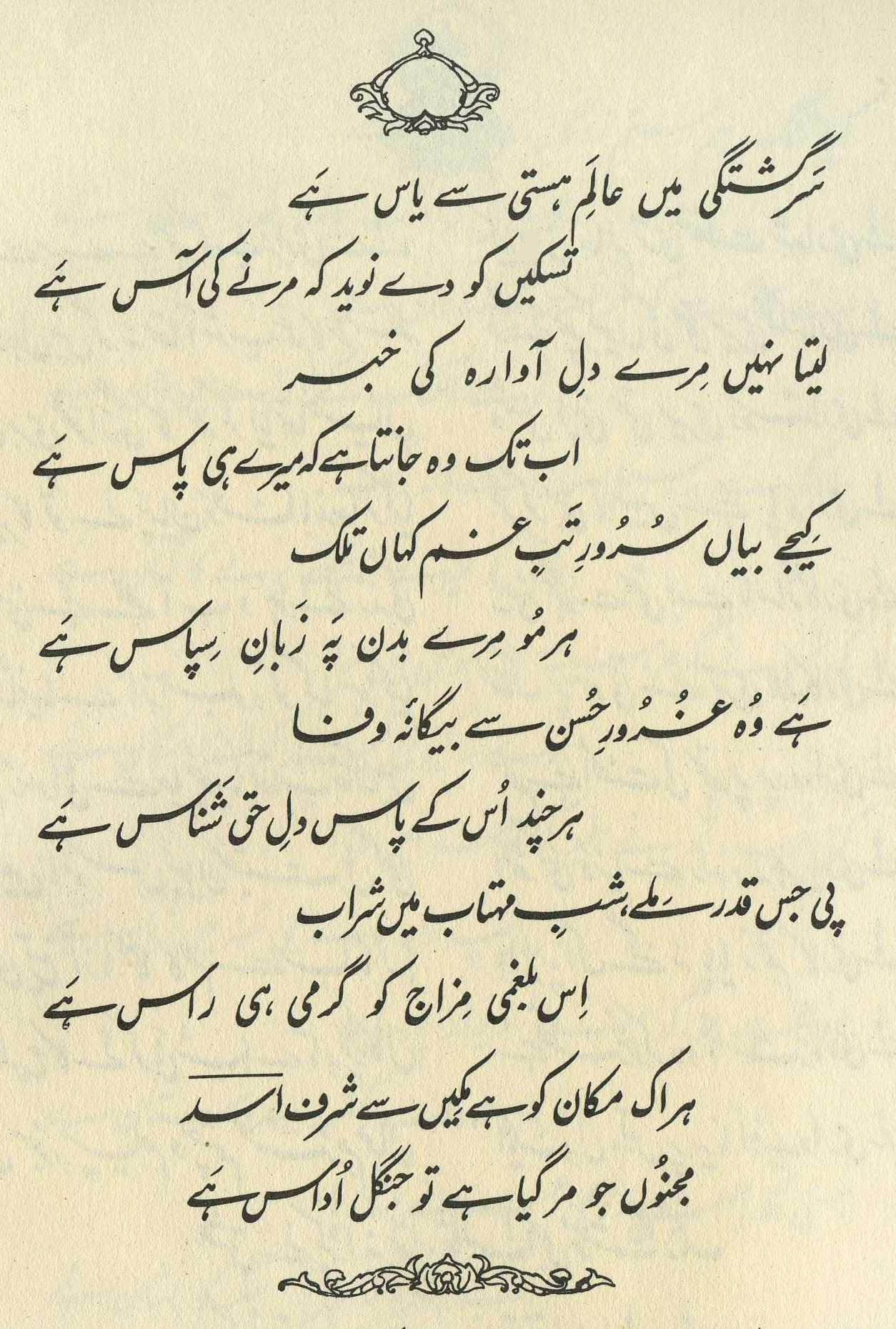
That is, my right-acquainted heart is in her possession, and it has made her aware of the right of faithfulness. But in her pride of beauty, when does she listen? If we take the right-acquainted heart to mean the beloved's heart, then it will be against the idiom. No one says, 'In his possession [] is an enlightened heart and an insightful eye'; rather, one ought to say, 'His heart [] is enlightened and his eye insightful'. (150)
== Nazm page 150

Although the beloved is unfaithful to the lover, he doesn't like it if anyone would call her unfaithful or unacquainted with the right. Thus he says that the cause is the pride of beauty. Or rather, say that to comfort his heart, he has established this opinion. (275)
In there are two components: (meaning a stranger, unrelated, not acquainted, not recognizing) and -- that is, instead of recognizing faithfulness, the beloved is unacquainted with it. In this regard, in the second line he has said -- that is, 'recognizing the right, knowing the truth'. Thus it can be seen that 'faithfulness' and 'right' are two names for the same thing. Faithfulness is the right, faithfulness alone is the greatest truth. But if the beloved's heart is 'truth-acquainted'-- that is, recognizing faithfulness-- then why is she unacquainted with faithfulness?
The reason for this is that the beloved has pride in her beauty. This reason is extremely subtle, because pride closes a person's 'eye of insight'. (There's an idiom, 'to be blind with pride' [].) Within this reason the beloved's mind is concealed as well, because her beauty too is so peerless that her pride in it is rightful and appropriate. The lover shows faithfulness, but before the beloved's eyes is the curtain of the pride of beauty. Thus even though she has a 'truth-acquainted' (that is, faithfulness-acquainted) heart, she doesn't recognize the lover's faithfulness. It's a tour de force of theme-creation .
== (1989: 262-63) 2006: 286-87
Faruqi sees this as an extremely subtle, complex verse involving the nuances of the beloved's pride in her beauty. I see it as a wryly funny one, and a classic mushairah verse in style and structure. The first line sets up an archetypal ghazal-world problem: the beloved is arrogantly absorbed in her own beauty, and completely indifferent both to the lover's own faithfulness, and to his wistful longing for her to be faithful in return. This is such a stock situation that it gives us absolutely no hint as to where the second line might take us.
Finally, after (under mushairah performance conditions) a properly tantalizing delay, we get to hear the second line. But even then, the second line withholds the kicker until the last possible moment. Even after we've heard 'although in her possession', we have no clue to what's coming. Only at the very end do we learn that what's 'in her possession' is a 'right-acquainted heart'. This seems to be part of a conventional frame for moral rebuke-- 'You treat me badly, although you know better'; 'You treat me cruelly, although you have a good heart', etc.
But even then, we've been led into a clever grammatical trap. We expect, appropriately to the 'moral rebuke' reading, that the heart will be hers. But the unusual, uncolloquial usage, emphasized by Nazm, of 'in her possession' [] gives us pause. And then all at once we realize-- oh of course, it's not her own heart that's 'truth-acquainted' instead, it's the lover's truth-acquainted heart that's 'in her possession'! With the sudden burst of recognition, with the reframing of the whole line, the wry humor of the verse hits us all at once. Such light, sly, deftly self-mocking wit-- surely the audience must have relished it.
There's some enjoyable wordplay too, about being a 'stranger' versus 'acquainted'. And additional overtones of 'truth' versus 'deceitfulness' (see the definition of ) as well.
graphics/knowingheart.jpg