Verse 11821aashai
G3
1
in vertigo/stupefaction, there is despair/terror of the world of existence
2
for peace, give the good news that there is hope of dying
[a variant of ]: ''The head whirling round', dizzy, vertiginous; stupefied, bewildered, confounded, amazed, astonished; wandering, straying; distressed, humble, depressed'.
'Despair, desperation, hopelessness, despondency; --fear, terror'.
| References | |
|---|---|
| Arshi, Imtiyaz Ali | Ghazal# 137 |
| Raza, Kalidas Gupta | 343 |
| Nuskhah-e-Hamidiyah | 188 |
| Asi, Abdul Bari | 219 |
| Gyan Chand | 334 |
| Hamid Ali Khan | Open Image |
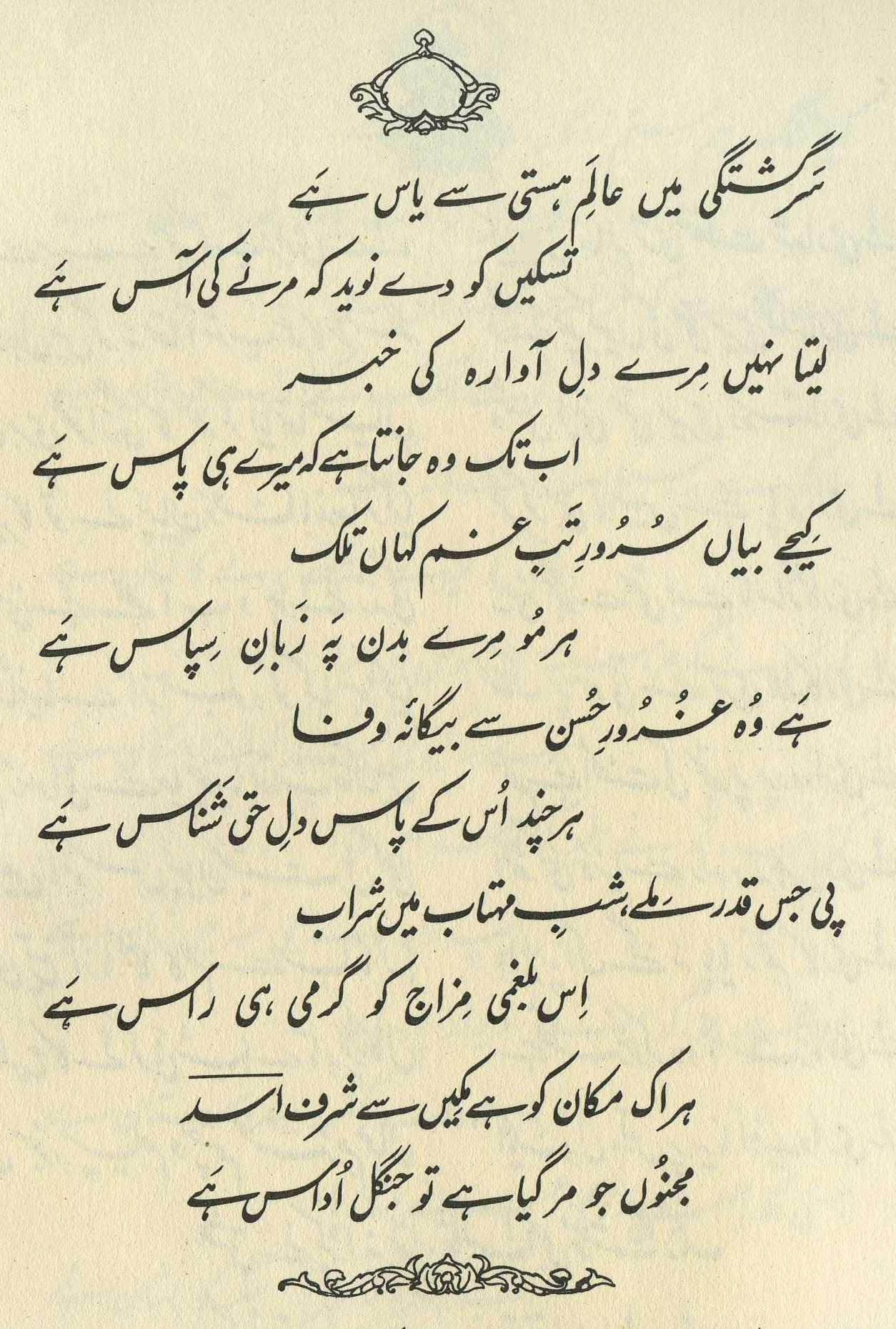
That is, because of vertigo/stupefaction, there is despair of life. Now, for peace, let there be the good news that after death, there will be salvation from stupefaction. (150)
== Nazm page 150

He says, because of my vertigo/stupefaction, I've become hopeless of life. Now, for peace, congratulations ought to be given, because after death comes, there will be certain salvation from stupefaction. (207)
Anxiety has reached such a limit that I have become entirely without hope toward the world or life. But peace will come, and will definitely come. Because now there's the hope of dying. (274)
Here, means 'for'; it's basically substituting for ; this is a common colloquial usage. (In standard usage, the effect would be to mark 'peace' as an object, as in 159,1 ).
And in fact that little is the pivot on which the verse turns-- turns in a way that makes it clever and also possibly terrifying. For what exactly does 'for peace' [] mean?
If we decide, as the commentators do, that 'for peace' applies to 'dying', then it refers to the 'peace' that will be available after death: 'If you want to attain peace, then the good news is that you just wait, and you'll have it after dying'.
But oh, the other possible reading! If life is unbearable, if you're in vertiginous stupefaction and despair, cheer yourself up at all costs. For the sake of 'peace', tell yourself some comforting lies. Tell yourself that you'll eventually die. And tell yourself that after death, no such suffering will remain. Give yourself all this 'good news' not because it's true, but only because you need it so badly-- give it 'for peace'.
In fact, as we know, a longed-for death may, as in 161,9 and many other verses, prove to be a mirage, always on the horizon but never actually arriving. And would such a death, if it ever came, actually bring peace? Conscious self-deception in matters like this is all too possible: for a cynically perfect illustration, see 174,10 .
graphics/dizziness.jpg