Verse 10after 1847aalachchhaa hai
G5
In this meter the first long syllable may be replaced by a short; and the next-to-last long syllable may be replaced by two shorts.
1
we know the reality/truth of Paradise, but
2
to keep the heart happy, Ghalib, this idea/thought is good
'The garden, the abode of recompense, paradise'.
'Essence (of a thing), essential property or quality; truth, reality, fact, true or real nature or state or circumstances or facts; gist; pith; --rightness, sincerity; --account, narration'.
| References | |
|---|---|
| Arshi, Imtiyaz Ali | Ghazal# 217 |
| Raza, Kalidas Gupta | 402-03 |
| Hamid Ali Khan | Open Image |
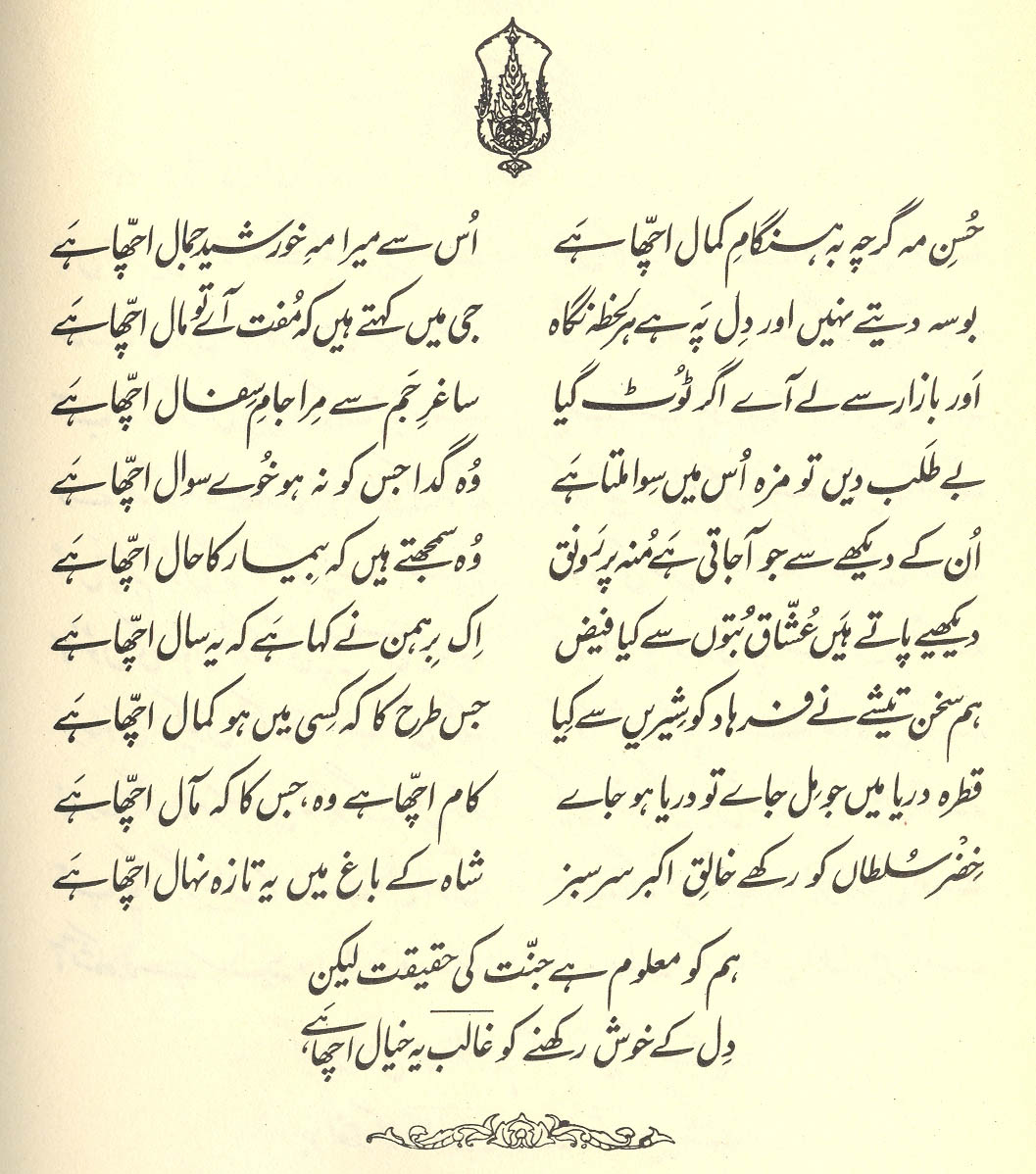
The meaning is, what is Paradise? They've shown to the uncomprehending a green garden. (196)
== Nazm page 196

He says, oh Ghalib, we know the truth/reality of Paradise, but to keep the heart amused/distracted, this idea is good. In this closing-verse Mirza has used a Doomsday-like mischievousness []. (253)
We are acquainted with the truth/reality of Paradise. That is, it's the goal of the Ascetic s' worship. What do lovers have to do with it? That is, lovers of the Lord consider only the attainment of the sight and self of the Lord to be their goal....
[On Nazm's reading:] In a rakish mode [] this reading is certainly attractive. But the first reading [of mine] seems to be more suitable. (343)
It's easy to see why this verse would get people's attention. Hali includes it in his discussion of Ghalib's religious views (p. 75), and the commentators generally read it as a religious statement of some kind. It belongs to what I call the 'snide remarks about Paradise' group; for other such verses, see 35,9 .
But nobody points out the cleverness of its structure. The first line seems to set us up to expect a much more conventional kind of verse: 'Yes, we know the truth of Paradise, but...' Then in the second line we would expect to hear 'We have no hope of getting there', or 'We just can't manage to be virtuous', or words to that effect. The use of gives an implication of 'truth' or 'reality' that lends itself well to such a reading-- the 'truth' of Paradise might well be completely unchallenged, for all we know in the first line. For an example of exactly this kind of structure in a verse, see 161,4 .
Under mushairah performance conditions, we would have to wait in expectation to hear the second line. And when we do hear it, our expectations are shattered in an instant: how stark and tough-minded it sounds! The speaker knows 'the truth' about Paradise, but also knows that the idea of it is useful in cheering people up. On the face of it, the speaker sounds like an atheist recognizing the social utility of religious fictions. Bekhud Dihlavi hastens to describe this as the most extreme-- amusingly, he says 'Doomsday-like'-- 'mischievousness' [], a term and concept that take us right back to 1,1 .
Bekhud Mohani prefers to read the verse as similar to 10,1 , so that what is being debunked is only the relative, anthropomorphic, unduly literal-minded 'Paradise' of the Ascetic , which the speaker, with Sufistic insight, can view only dismissively. On this reading, the speaker patronizes the naive 'Paradise'-believers not because they're believers, but because they're naive.
The verse carefully doesn't tell us whose heart is to be kept happy (the speaker's? those of the naive common people?), nor does it define 'this idea' (the Islamic paradise? religious heavens in general? naively literal heavens in particular?). As he so often does, Ghalib once again leaves us to decide for ourselves.
graphics/walledgarden.jpg