Verse 8after 1847aalachchhaa hai
G5
In this meter the first long syllable may be replaced by a short; and the next-to-last long syllable may be replaced by two shorts.
1
if/when a drop would mingle with the sea, then it might/would become the sea
2
that task is good, of which the outcome/end is good
'A place (and a state or condition) to which a person or thing returns, and to which he (or it) ultimately comes; end, aim, event, consequence, termination, issue, tendency'.
| References | |
|---|---|
| Arshi, Imtiyaz Ali | Ghazal# 217 |
| Raza, Kalidas Gupta | 402-03 |
| Hamid Ali Khan | Open Image |
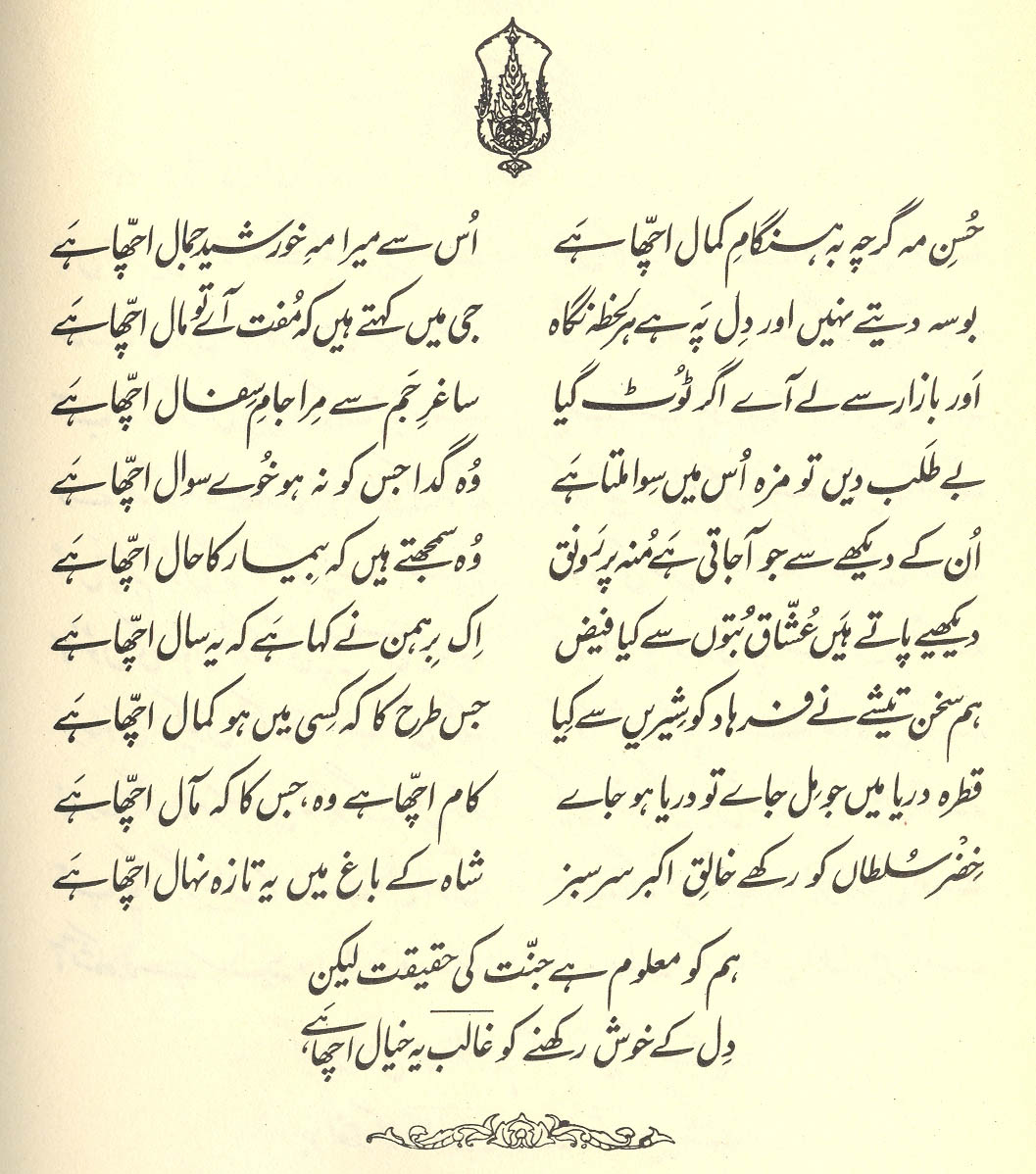
The allegory of the drop and the sea has been taken from the Sufis, but it has also extremely much pleased the poets. No one has omitted it, so much so that this theme has become shopworn. Now, whoever versifies it, the verse itself becomes devoid of relish/pleasure. The author too has composed with this theme a number of times, and the best one is 21,8 , because the relish of the idiom has spiced up a flavorless theme. (195-96)
== Nazm page 195 ; Nazm page 196


He says, for the branch/offshoot to move toward its source/origin [] is better than all other actions in the world. (253)
When the drop merges with the sea, then it no longer has any further fear that the earth or the air might swallow it up. In the same way when a man would merge his individual self with the Lord, then he no longer fears oblivion, and he becomes protected from all the world's changes. That task of which the result would be good, only that one is good-- that is, for a person only to merge into the source is good. (343)
The commentators are convinced that the verse is recommending such a merger, but if we look closely at the grammar, it's not necessarily so. The first line actually uses two subjunctive verbs, the effect of which is to render the proposition extremely tentative-looking. (More common, and more assertive, is a subjunctive 'if/when' verb paired with a future 'then' verb.)
After such a tentative first line, the second line moves to radical abstractness. A certain kind of 'task' or 'action' is defined as 'good'-- but we're not told whether the action described in the first line falls within this definition or not.
The process of deciding is made remarkably subtle and elegant by means of the word , which is related to and has a strong connotation of returning to one's origin. The task is good of which the aim or purpose-- or 'return to origin'-- is good. There's a doubleness here of teleology on the one hand (the sense of a final purpose or goal), and source on the other (the sense of a return to some primal condition).
So we're still left to ask, is it good for the drop to merge, in either a teleological or an originary way, into the sea? The Indo-Muslim Sufistic chorus answering affirmatively is loud and clear, and just about unanimous. It seems almost perverse to consider any other possibility. I offer only two small bits of counterevidence: the unusually tentative grammar of the first line, and the conspicuous set of verses in which Ghalib insists on the virtue of using only one's own resources, and the shame of borrowing or being dependent; on such verses, see 9,1 .
I certainly don't think that Ghalib meant for us to conclude that the drop should not merge with the ocean. But it's also clear that in this verse (unlike some others) he didn't set up-- as he certainly could have-- a resonant endorsement in favor of its doing so. He's taken care to leave the question open, to force us to decide for ourselves, bringing to bear the evidence of our own temperaments and our own lives. In some respects the role of the second line here resembles the role of the second line in the previous verse, 174,7 .
And do we really need that in the second line? My students all agree that it ought to count as padding ; for more on this, see 17,9 .
Here's my long-ago attempt at a translation (1985) of this verse.
Note for meter fans: The word is pronounced and scanned ma-))aa-l, short-long-short. See the definition above. It's not to be confused with meaning 'wealth, property' (used in 174,2 ).
graphics/oceandrop.jpg