Verse 3after 1847aalachchhaa hai
G5
In this meter the first long syllable may be replaced by a short; and the next-to-last long syllable may be replaced by two shorts.
1 a
they brought more/another from the bazaar, if it broke
1 b
[someone] would bring more/another from the bazaar, if it would break
2
than the Cup of Jamshid , my cup of clay is better
| References | |
|---|---|
| Arshi, Imtiyaz Ali | Ghazal# 217 |
| Raza, Kalidas Gupta | 402-03 |
| Hamid Ali Khan | Open Image |
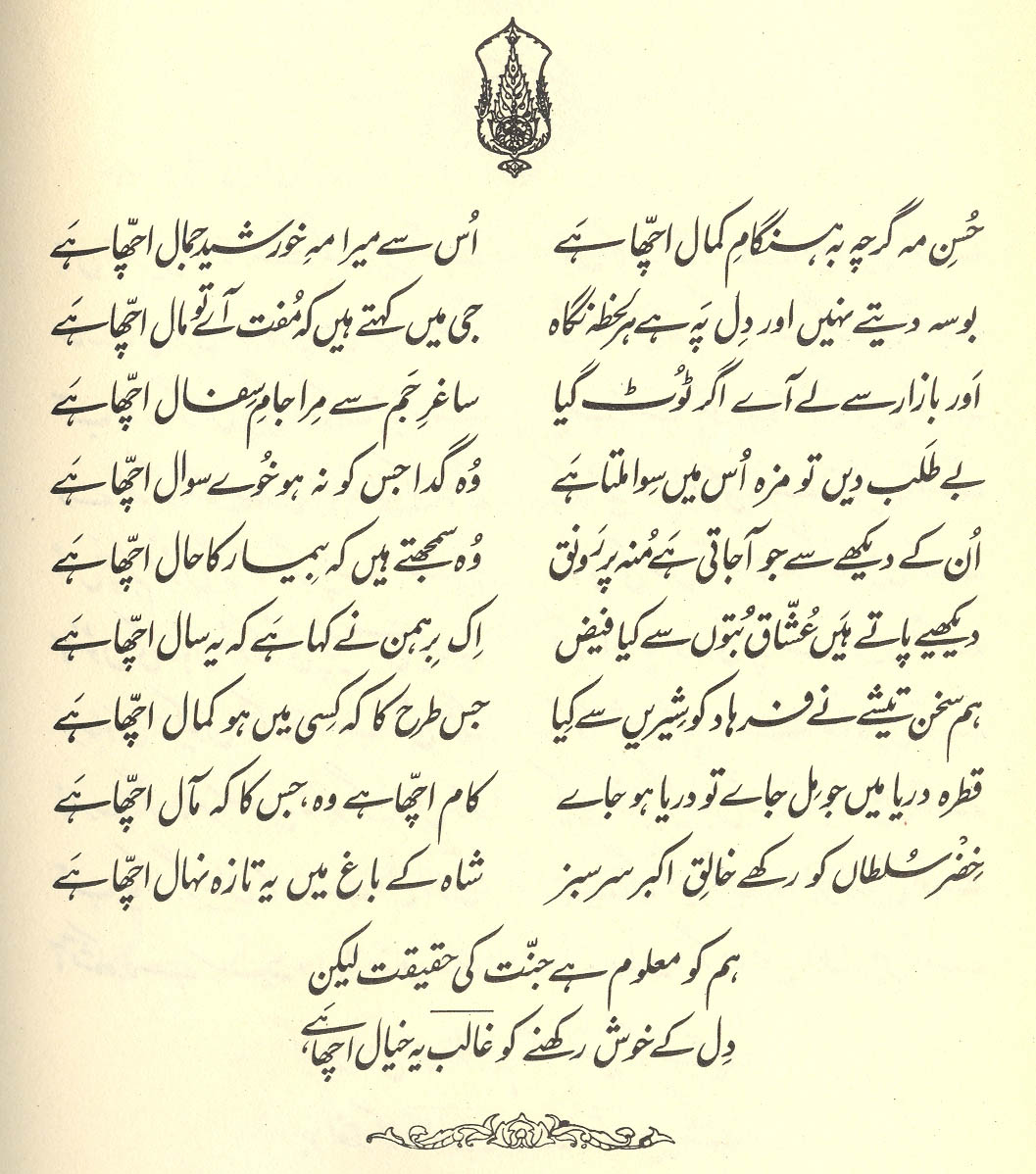
How excellently he has preferred the cup of clay over the Cup of Jamshid cannot be sufficiently praised; and it is an entirely new idea, that has never been seen anywhere before.
==Urdu text: Yadgar-e Ghalib , p. 125
The meaning is that too much formality [] is a cause of trouble []. (194)
== Nazm page 194

Our clay cup is better than the Cup of Jamshid because if it would break, then one would bring another from the bazaar; and if the Cup of Jamshid would break, then it would not be able to be repaired, nor would another such cup come to hand. That is, 'in formality is trouble' []. With such beauty Mirza has proved the cup of clay to be better than the Cup of Jamshid. (341)
This is a delightful, cleverly framed mushairah verse. The first line carefully withholds all notion of what it might be that would break, and even any clear indication of who might be the bazaar-goer, so we have no clues at all. We have to wait in curiosity and suspense for the second line.
And in proper mushairah-verse style, the second line withholds its punch-word until the last possible moment. Even when we hear about the Cup of Jamshid, we can't guess what the other term of comparison will be. Then when we finally hear it, when all at once we 'get' it, the result is so amusing, so witty-- and, up to a point, so right. What price magical world-vision, compared to throwaway (self-recycling) convenience and a free mind? What's not to like, in a casual, lazy, elegant little charmer like this?
Compare 62,4 , another verse about buying cheap replacements from the bazaar. Then there's 79,6x , which finds a light carefreeness preferable to the heavy burden of kingship. Similarly, in 210,2 the lover is happy to sell his fancy wine-drinking vessels.
Note for grammar fans: In the first line can very intuitively be a masculine plural perfect (1a), read as the generalized 'they brought'. (It can't be 'we brought', since the speaker uses for himself in the second line; it also can't be 'they would bring' since that would be .) One could also read as a singular subjunctive (1b); as we know, the masculine singular perfect can also be colloquially used as a subjunctive; for discussion, see 35,9 . But the subject then would have to be 'he' or 'she' or 'someone' in the third person singular, which is annoyingly pseudo-specific (a servant? a friend?). So I prefer the (1a) reading.
graphics/claycups.jpg