Verse 2after 1816aakho ga))e
G3
1
for the cost of wine, the utensils of wine-drinking became spent
2
there were only/emphatically these two calculations/reckonings-- thus, casually/'like this', they became cleared/'pure'
'Use, employment; expending; expenditure'.
'Price, value'.
'A numbering, counting, reckoning, calculation, computation; arithmetic; account, accounts; bill (of charges); rate, price, charge; --measure, measurement; proportion; rule, standard; --estimation, judgment, opinion'.
'Thus, in this wise, in this manner;—just so, for no particular reason; without just ground, vainly, idly, causelessly, gratuitously; to please oneself'.
'Pure, clear, clean, holy, spotless, blameless, innocent, free (from, ), undefiled, unpolluted, immaculate'.
| References | |
|---|---|
| Arshi, Imtiyaz Ali | Ghazal# 196 |
| Raza, Kalidas Gupta | 304 |
| Nuskhah-e-Hamidiyah | 278 |
| Hamid Ali Khan | Open Image |
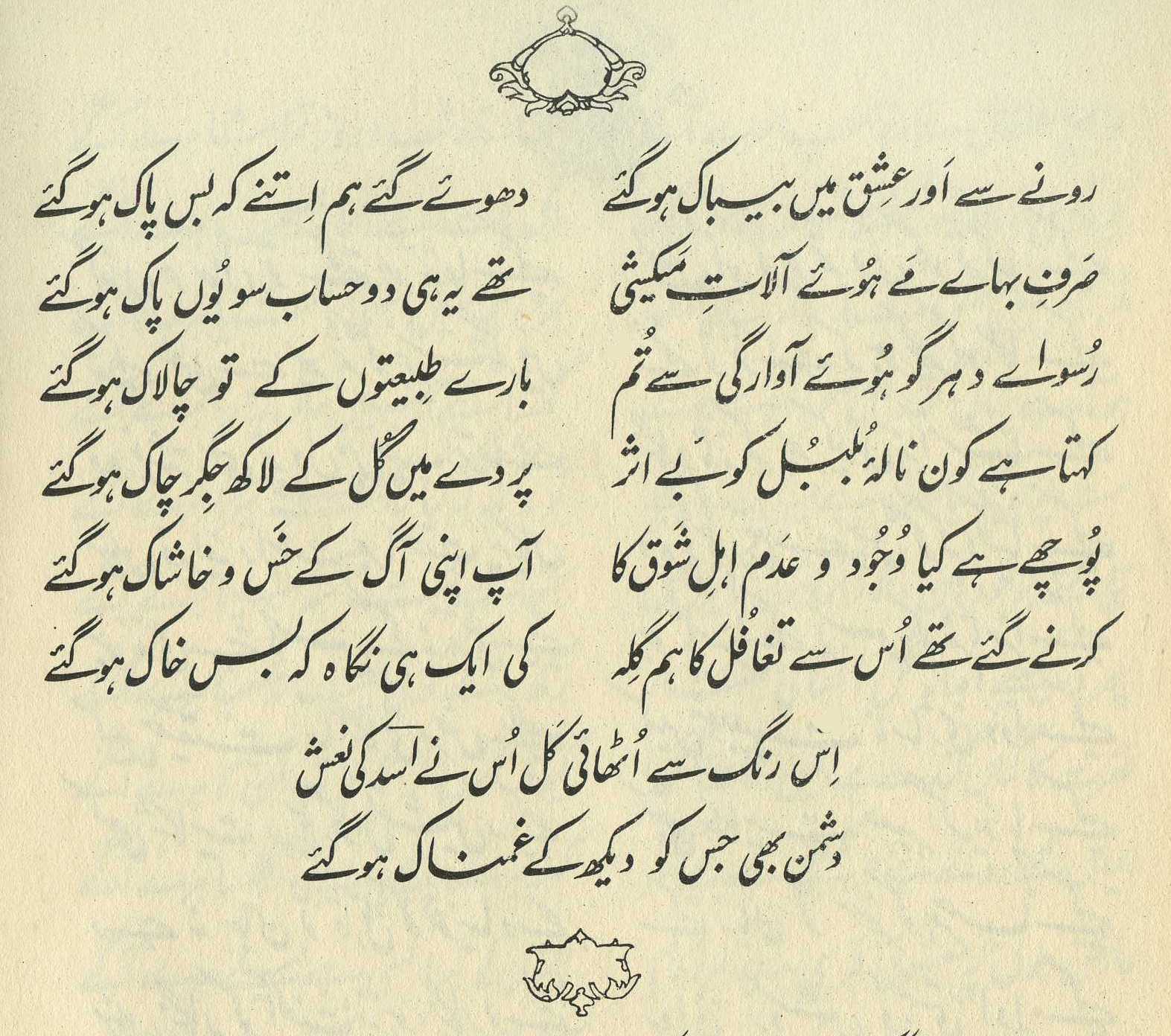
One calculation was, from where would we drink wine? The other, where would we store the utensils of wine-drinking? These were our only two calculations. They became cleared in this way: that we sold the utensils too and drank wine. We became free of the bonds of relationships and formalities, and drank wine, and got wine to drink. How can the ingenuity of the rakish ones [rind] go beyond this? (238)
== Nazm page 238

He says, he's made a list of the requisites for wine-drinking; every day he had to take stock of them. To take care of the utensils, to close up and lock the expensive things, tolook out for them. In short, his life was made a burden. A number of wine-glasses were of silver and gold. He sold them all, and used the proceeds to drink wine. He neither remained in debt to others, nor did the care of the utensils and the stock-taking remain a bother any longer. (297)
Now we had these two reckonings: where would we get the cost of wine, and how would we wander around carrying the utensils of wine-drinking? Both these reckonings have become cleared in this way: that having sold the utensils of wine-drinking, we drank up the wine. Good-- now we're at leisure! (427)
This verse repeats the rhyme -word from the previous verse, 210,1 . It's not so common to use the same rhyme-word twice in a ghazal, but Ghalib didn't hesitate to do it when he chose. Some later critics have declared such reuse to be a poetic 'fault'. Since Ghalib here does it in adjacent verses, he obviously didn't agree with them.
As Nazm says, this is 'rakish' bookkeeping-- it hardly makes much ordinary, worldly sense. There are several tones in which the second line might be read:
=with naive pride: 'See how clever and financially astute I am? Probably you didn't think an unworldly person like me could manage business affairs so efficiently!'
=with rueful regret: 'I'm so deep in debt that my only possible show of accounting efficiency is something shambolic and self-defeating.'
=with rakish amusement: 'Let me show you how little regard I have for normal worldly prudence-- let me give you an example of how I do my kind of accounting!'
The two reckonings became cleared-- 'like this' That , 'like this', is an enjoyably tricky word. How exactly are we to take it? As endorsing such transactions? As questioning them? As laughing at them? Or of course can also mean 'casually, for no particular reason', which would suggest that the feat of bookkeeping described in the verse is radically unmotivated and haphazard. Needless to say, Ghalib leaves us to decide all such nuances for ourselves.
And even that requires subtleties of tone. The two accounts (the cost of the wine, the value of the wine-set) balance each other out, and the result, we are told, is a perfect financial cancellation. Leaving us to wonder, of course, how the speaker will drink wine in the future. In a practical sense, he might drink it out of a clay cup (as in 174,3 ), but how will he pay for it? The verse doesn't at all suggest that he plans to give it up. Rather, his concern is only with balancing out his accounts. And since he tells us there were 'only/emphatically these two reckonings' in his whole commercial landscape, wine-drinking seems to be at the center of his universe.
Moreover, the positive moral valence of (see the definition above) suggests something more transcendant: has the speaker become so purified and innocent that it's as if he never drank wine or incurred debt at all? Has he become so purified and innocent that he can now start his wine-drinking (and account-keeping) afresh, with a clean slate?
In fact, the situation resembles that of the previous verse, 210,1 , in which tears washed away shame or guilt (and/or atoned for sin), so the result was a fresh start, with renewed vigor, for the speaker's sinful behavior. (Or is the claim made ironically, is 'pure' to be in invisible quotation marks?)
For another 'rakish' verse about wine-drinking and finances, see 90,3 .
Compare Mir's own rueful take on such expenditures: M 490,2 .
graphics/wineset.jpg