Verse 7after 1816aakho ga))e
G3
1
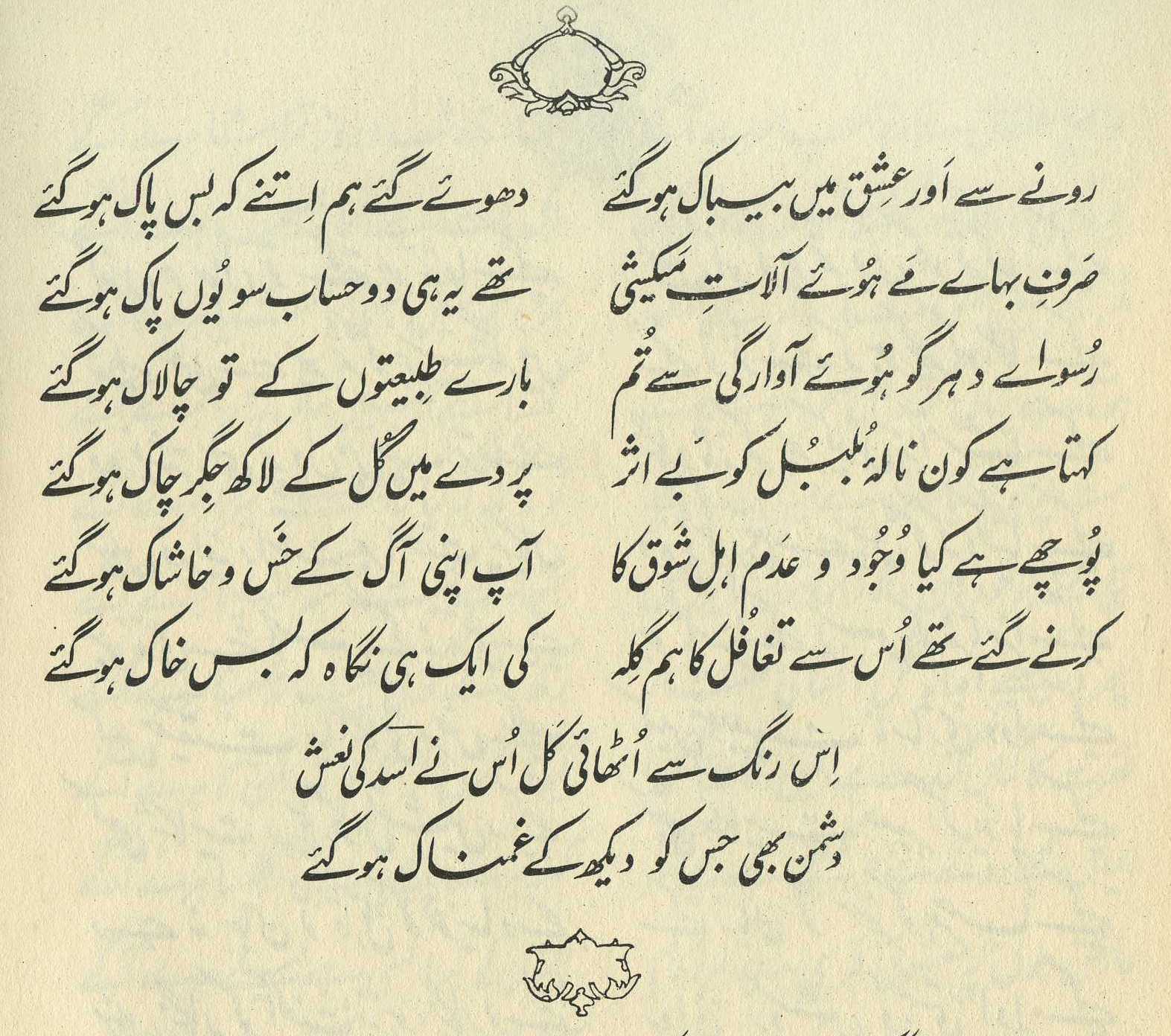
in {this / such a} style/manner/mood she yesterday lifted up Asad 's bier
2
that even/also the enemies, having seen it, became grieved
'Beauty, bloom; expression, countenance, appearance, aspect; fashion, style; character, nature; mood, mode, manner, method; kind, sort; state, condition'.
| References | |
|---|---|
| Arshi, Imtiyaz Ali | Ghazal# 196 |
| Raza, Kalidas Gupta | 304 |
| Nuskhah-e-Hamidiyah | 278 |
| Hamid Ali Khan | Open Image |
In which style did she lift it? With contempt? Or with respect, such that she herself lent a shoulder, she herself honored it? Between these two meanings, for neither one to be selected-- this is the reason that the verse seems loose []. [He goes on to criticize, for reasons of technical metrical theory, the treating of the final syllable in as short.] (238)
== Nazm page 239

He says, contrary to expectation, she lifted the bier of Mirza Asadullah Khan Sahib 'Ghalib' with such respect and honor that, seeing it, the fire of envy/jealousy flared up in the enemies' livers. (298)
[Disagreeing with Nazm:] Alas-- what in the verse is an excellence, is here being called a flaw. If some one meaning were selected, then the other aspect would have been left behind. Now this verse can be recited on an occasion of contempt, in the same way as on an occasion of honor. [He goes on to respond to Nazm's metrical arguments:] In this way, when reading the verse, having arrived at a kind of musicality [] and force is created. Rather, the surprise and heartfelt grief of the speaker are conveyed. (429)
Nazm is dead wrong-- surprisingly so, for someone who is usually such a perceptive reader. And how much Bekhud Mohani must have enjoyed having such a juicy chance to lambaste him! Bekhud Mohani rightly says that what Nazm presents as a flaw is the verse's remarkable and even stellar virtue. For it's perfectly clear that, as so often, each of the readings of the first line yields a differently complex and enjoyable reading of the second line. Such a basic Ghalibian structural principle-- how could Nazm miss it?
This could be called a verse of implication , because the interpretations of the first line don't depend on any shifts in the actual literal reading of the line, but simply on differently imagined understandings of what is implied by 'in such a (literally, 'this') way' []. (Even if it were read as 'in that way', with an , the only difference would be perhaps a small loss of immediacy.)
Thus if she lifted the bier in an extremely contemptuous, disdainful way-- or with careless indifference, as though she couldn't even recall whose funeral it was-- then even the enemies would be grieved, because such a hostile overreaction, even after Asad's death, would make even them feel sorry for the deceased. And perhaps they'd feel sorry also because they'd realize, if they were in fact Rival s, that the same fate might well befall them.
And if she lifted the bier in an extremely (and unexpectedly?) respectful, sorrowful, even reverent way, her (show of) mourning would awaken the humanity in the enemies' hearts, and make them reflect on the human condition, the common fate of us all, and so on; so that they too would feel their own share of the grief of mortality. (On this reading the excellently versatile seems closer to 'also' than to the more common 'even'.)
Would the beloved really have become a pallbearer, and have helped to lift her lover's bier with her own delicate hands? It does seem quite unlikely. Surely we are meant to imagine her as orchestrating the funeral procession-- causing the bier to be lifted in her presence and by her command. Or else we could imagine the beloved as a beautiful youth. Literal grammar can't always be an exact guide, in the ghazal world; if nothing else, there's always the constraint of meter and rhyming elements.
This is of course another verse from the 'dead lover speaks' set; for other such verses, see 57,1 .
graphics/southdelhitombs.jpg