Verse 4after 1816aakho ga))e
G3
1
who calls the Nightingale 's lament 'ineffective'?
2
in the rose's veil/pardah, a hundred thousand livers became torn/lacerated
'A curtain, screen, cover, veil, anything which acts as a screen, a wall, hangings, tapestry; ... secrecy, privacy, modesty; seclusion, concealment; secret, mystery, reticence, reserve; screen, shelter, pretext, pretence'.
| References | |
|---|---|
| Arshi, Imtiyaz Ali | Ghazal# 196 |
| Raza, Kalidas Gupta | 304 |
| Nuskhah-e-Hamidiyah | 278 |
| Hamid Ali Khan | Open Image |
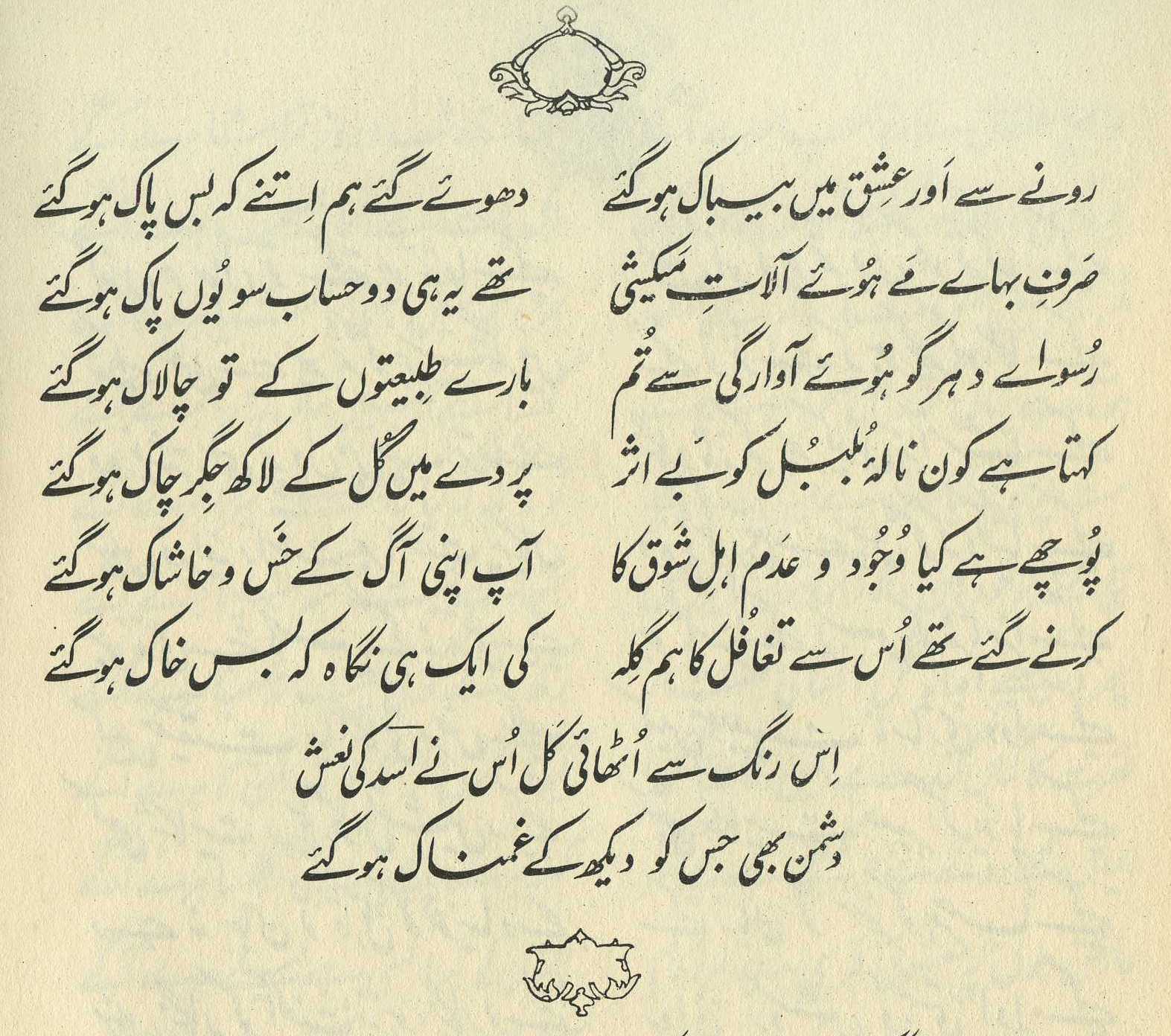
He claims that flowers do not bloom: rather, from the effects of a lament, hundreds of thousands of livers have become torn. (239)
== Nazm page 239

He says, 'Who calls the Nightingale's lament ineffective? Let the one who says that come before me. In the garment of the rose, hundreds of thousands of livers have become torn.' He has constructed the blooming of flowers as the liver's becoming torn. In short, for there to be effect in the lover's lament is necessary and unavoidable. (297)
The buds certainly open. But the poet turns his poetic attention to this: that each petal of the flower is becoming separate from every other petal. They didn't open-- rather, the effect of the Nightingale's lament has torn the liver into fragments and flung them away. Probably this verse is intended to move the beloved to mercy. (467-68)
There's a name for what this verse is doing: ' elegance in assigning a cause '. We had previously thought that the rose's petals opened out and bloomed, and then withered and fell away, in the natural course of the seasons.
But now we realize that we were wrong. In the rose's heart, the Nightingale's lament did after all have an effect; although the rose tried to maintain its privacy and seclusion, it suffered severely. The rose's heart was ripped to pieces, its liver was lacerated and torn. Ultimately it was unable to conceal the marks of its suffering-- so now we know that no one should call the Nightingale's lament 'ineffective'.
But then-- if the Nightingale's lament, his love-song to the rose, ends up hastening the already imminent death of his beloved, can such a lament really be called 'effective'? If the lament lacerates the livers of a hundred thousand (dying) roses, does that count as a properly romantic 'effect'?
For a more complex meditation on the 'effectiveness' of laments, see 86,4 . For structural parallels, see 16,6x .
Compare Mir's vision of the rose's lacerated liver: M 276,1 .
graphics/tornrose.jpg