Verse 3after 1816aakho ga))e
G3
1
although you became disgraced in the world/age, from wandering
2
finally you did become 'quick/clever of temperament'
'Without house and home; wandering, roving; astray; abandoned, lost; dissolute'.
'Time; a long period of time; an age; eternity; fortune, fate; chance, adverse fortune, misfortune, calamity, adversity; danger; —custom, habit, mode, manner; care, solicitude; the world'.
'Once, one time, all at once; at last, at length'.
'Active, alert, fleet, nimble, quick, smart; expert, dexterous; clever, ingenious; laborious, hard-working; vigilant; artful, cunning, designing, astute'.
| References | |
|---|---|
| Arshi, Imtiyaz Ali | Ghazal# 196 |
| Raza, Kalidas Gupta | 304 |
| Nuskhah-e-Hamidiyah | 278 |
| Hamid Ali Khan | Open Image |
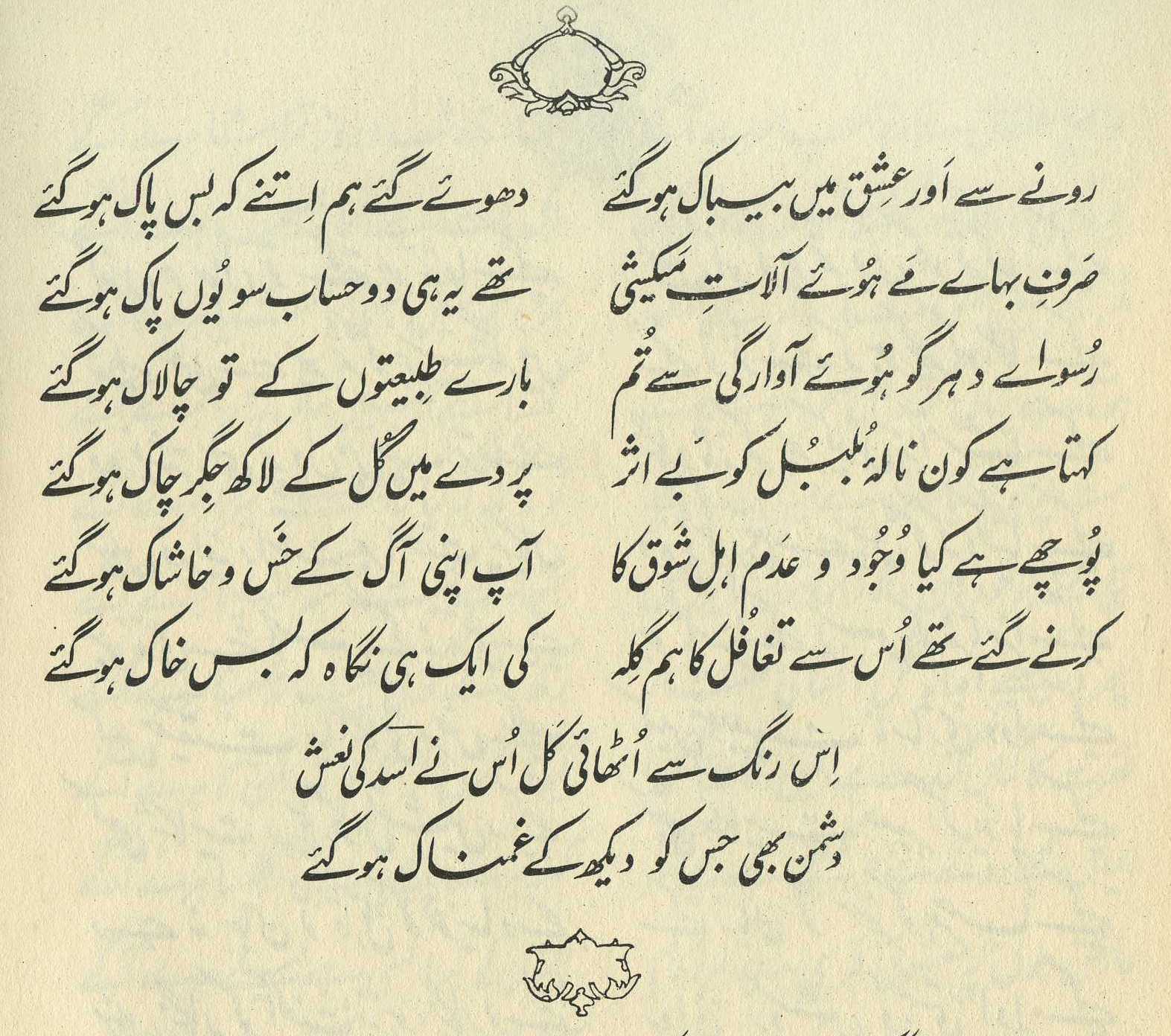
He taunts the beloved. is an idiom. It is used as either singular or plural. But the author is the first person who versified it in the plural, and this is what's called ' freshness of word '. (239)
== Nazm page 239

He says, 'Although because of wandering you became disgraced in the whole world, nevertheless there was this much benefit, that you became mischievous of temperament and swift in repartee'. is an idiom; it is used in both singular and plural. (297)
He makes a taunt: through your wandering you became notorious in the whole world, but then, what's the harm? Now you've become clever-- you've lost this much, and gained that much; it wasn't a bad deal. (427)
Nazm's claim that the lover is taunting the beloved is surprising. Since when does the haughty, arrogant, disdainful beloved go 'wandering' disreputably and humiliatingly throughout the world? Just the contrary is the case, in fact: 'wandering' is part of the stock in trade of the lover. He wanders in the desert, he wanders on the roads, he wanders through the lanes of the city. His heart itself is hopelessly inclined to wander: for proof, see 42,4 and 140,2 .
Surely, in this verse, someone is addressing the lover (or the lover is talking to himself). The speaker is looking back on the lover's life, and trying to put a positive spin on his years of wandering and disgrace. The consolation prize is that at least he finally became clever, quick-witted, shrewd'.
We might read the two lines as related only after the fact: this late-blooming cleverness might be simply a normal result of knocking around the world, with no special significance or emphasis. In fact its disconnectedness from the cause of his wandering might be part of the ironic meaning of the verse: his wandering brought him something irrelevant to his earlier life; it brought him a gift (of cleverness) that he hadn't sought or even wanted. Is this all he's gotten out of it? On this reading, the very fact of its irrelevance shows how far he has failed to attain, or even to approach, any longed-for goal that caused him to wander in the first place.
Or we might read the two lines as more intimately connected, through 'at length' []. On this reading, if the lover had been 'quick-witted' in the first place, he never would have gone wandering at all. (He might perhaps have realized that his passion for the fickle, cruel beloved was futile, and might have renounced his folly.) Through spending years of his life in wandering and disgrace, he finally acquired the insight and shrewdness that could have saved him from that wandering and disgrace. Now his situation is that of the proverb 'the bald man has gotten fingernails' []. Shrewdness has come to him after such a long apprenticeship that it may not be of much use.
This verse reminds me of the much simpler, but still beautifully evocative, verse that Shahryar composed for Umrao Jan to sing in the 1981 film :
[what/whom we searched for, we didn't find
but/perhaps through this excuse, we saw the world]
The commentators testify that the idiom simply describes the speaker's own temperament, as though the plural were a singular. But the plural form keeps suggesting that we might think also of other people's temperaments-- especially since the first line gives us a highly relevant example in the form of the whole age or world. On this 'straight', non-idiomatic reading, after his years of wandering and disgrace the speaker finally realizes what other people's temperaments are like. And what in fact are they like, what kind of realization is it? As so often, the verse leaves us to supply our own (ominous?) conclusions.
graphics/wit.jpg