Verse 1after 1847aalachchhaa hai
G5
In this meter the first long syllable may be replaced by a short; and the next-to-last long syllable may be replaced by two shorts.
1
although the beauty of the moon at the season/time of its fullness/perfection is good
2
than it, my moon with sun-beauty is better
'Completion, conclusion; perfection; excellence; something wonderful, a wonder'.
| References | |
|---|---|
| Arshi, Imtiyaz Ali | Ghazal# 217 |
| Raza, Kalidas Gupta | 402-03 |
| Hamid Ali Khan | Open Image |
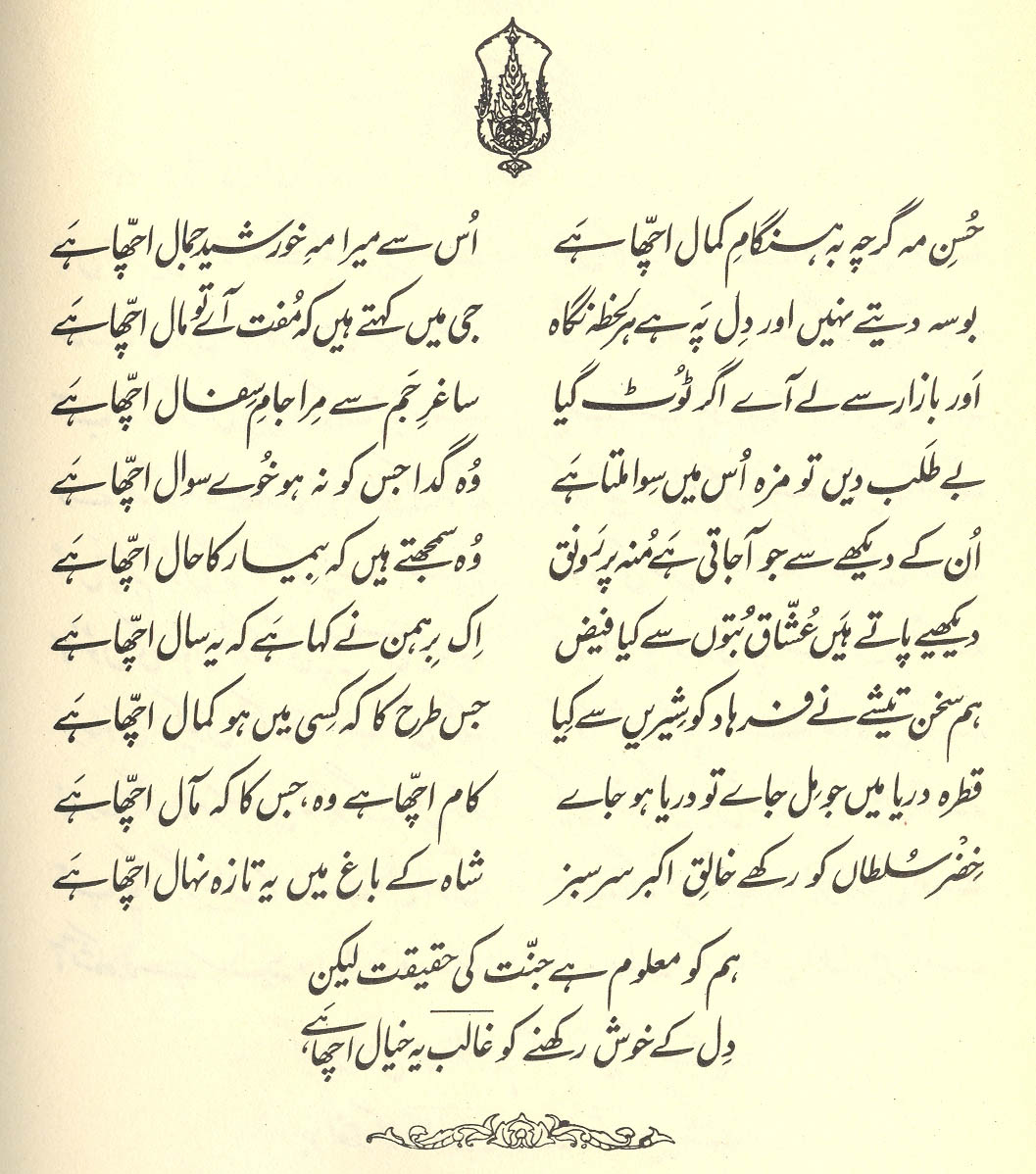
In the second line is a 'claim that includes a proof' []: he has called the beloved a moon with the sun’s beauty so that a reason would emerge for giving her preference over the full moon.
==Urdu text: Yadgar-e Ghalib , p. 158
The way the sun is better than the moon. (194)
== Nazm page 194

He says that the moon is good only at its greatest fullness. He has called the beloved a 'moon with the sun's beauty' because just as the sun never diminishes, in the same way my beloved's beauty too always remains in the same state. Then, why has he called her a moon? The reason for this can be said to be that the moon's light is pleasing, while the sun's light is not. He used the simile of the moon because from the glory/appearance of the beloved, the eyes, and the burning of the heart, are pleased. He used the simile of the sun only so that it would be clear that there would be no lack in her beauty, as there is in the moon's. (340)
Long ago, when I used to knock myself out trying to translate Ghalib, this was one ghazal I worked on obsessively, though I never published it. Anyway, I note my version here for pleasure and nostalgia:
The moon at its fullest
is good.
My moon bright as sunlight
is better.
She won't even give me a kiss,
She keeps her eye on my heart,
She feels the goods
she can get for free
are better.
If it breaks I can get another
from the bazaar.
Compared to the Cup of Jamshid
my cup of clay
is better.
A gift freely given
doubles the pleasure.
The beggar who does not ask
is better.
When I see her
my face lights up.
She thinks the invalid
is better.
Let's see what favor
it brings to lovers!
A pundit has said that this year
will be better.
His axemanship won Farhad
a chance to talk with Shirin.
In any case, for everyone
to have a skill
is better.
A drop that makes it all the way
to the river
becomes the river.
A task is worth undertaking
when its outcome
is better.
[verse omitted]
Oh, we know the truth about Heaven!
Still, to keep the heart happy,
Ghalib, such a notion
is better.
In this ghazal Ghalib takes advantage of the fact that the Urdu comparative of good [] is '[more] good than/from X' []. Therefore he's able to make the refrain shift at will from the one to the other. English, with 'good' and 'better', hasn't got a prayer of keeping up. So in my translation I cheated, as you'll notice, in order to keep 'better' at the end of all the verses. (Or rather, to put it more elegantly, I chose to preserve the regularity of the refrain even at some sacrifice of the literal meaning.) I also omitted the next-to-last verse, since it wasn't worth the hassle of explaining it in footnotes. It's very liberating to have this present commentarial space to work in, and not to be bogged down any longer in (vain) attempts like the above.
What a ravishing, flowing , light-hearted, irresistible ghazal this is! It makes me happy every time I read it, it's so swingy. The rhythm and swing are a kind of unifying tone for it, along with its relatively long and influential refrain. Its verses mostly aren't profound and deeply metaphysical, but who cares? Ghalib can create all kinds of effects when he wants to. And without this playful, witty ghazal, his divan would truly be the poorer.
graphics/fullmoon.jpg