Verse 5after 1847aalachchhaa hai
G5
In this meter the first long syllable may be replaced by a short; and the next-to-last long syllable may be replaced by two shorts.
1
from seeing her, the radiance that comes upon the face--
2
she considers that the sick person's condition is good
| References | |
|---|---|
| Arshi, Imtiyaz Ali | Ghazal# 217 |
| Raza, Kalidas Gupta | 402-03 |
| Hamid Ali Khan | Open Image |
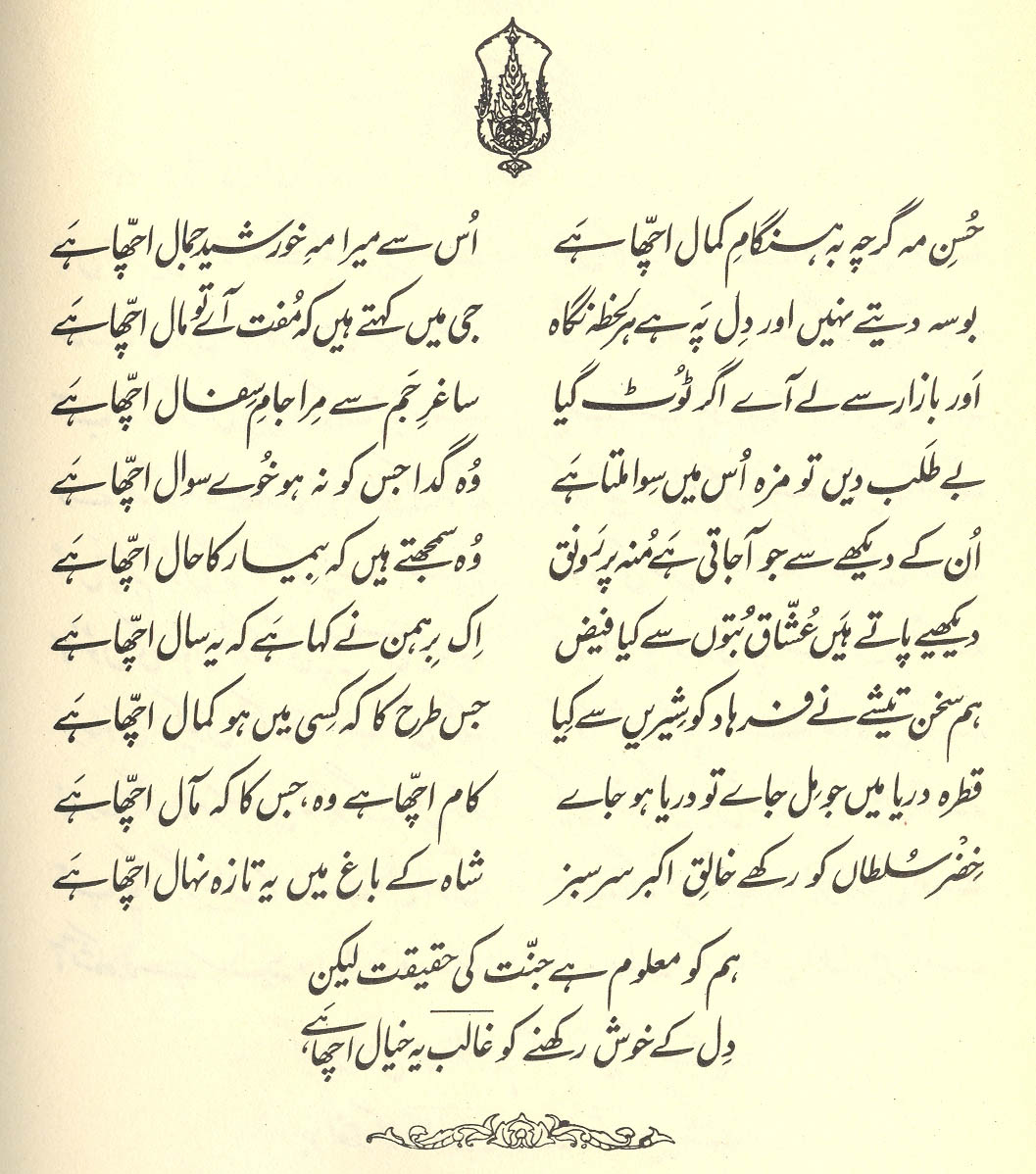
The excellence of this verse is manifest in its own right; no other words can go beyond it. (125)
== Nazm page 195

The lover cannot in any way express to the beloved his troubles during the time of separation, because when it is the time of trouble, then the beloved isn't there; and when the beloved is there, then the trouble no longer remains. (252)
This is not a verse, it is a masterpiece of poetry. (341)
Some manuscripts, and some modern divans, have instead of ; as always, I follow Arshi. See his discussion in his introduction, p. 123.
As Bekhud Dihlavi observes, the lover is in a kind of catch-22 situation: being separated from the beloved makes him (mortally?) ill, but when she then comes to his bedside, her presence so cheers him that he looks well, and she promptly leaves him again. Her absence makes him ill-- but she can never know this, because her presence instantly makes him seem well again.
Since the surrounding circumstances are left entirely vague, there are several possibilities:
=The lover is in fact mortally ill, but when the beloved comes in, his face brightens so much that she thinks he's in fine shape-- but she's wrong, he's really done for.
=The lover was sick before, but when she comes in, he at once recovers; she rightly judges the improvement in his condition.
=The lover is only 'sick with passion', not physically ill, and the term 'sick person' is used teasingly or sarcastically-- for whenever the beloved glances at him, he looks fine.
The beloved comes in and makes a sort of snap judgment about his condition-- is that because she's casual and basically indifferent, and can't be bothered to investigate more closely? Is this her only visit, or does the verse report on something that happens time after time? Does she know, or care to discover, anything further about his welfare than the glow on his face? Is the glow on his face perhaps all that's really significant about him? All these questions are left for us to contemplate; nothing in the verse gives us the slightest clue.
Note for grammar fans: Nowadays would of course be replaced by . To me it looks as if the form should be short for , 'from being in a state of having seen', a postposition attached to an adverbial perfect participle. Similarly, in 78 attaches a postposition to what looks to me intuitively like the adverbial present participle. However, my intuitions in both cases are wrong. Our resident linguist, Peter Hook, comments: 'The example seems to be one of an alternate form of the infinitive followed (as is normal for infinitives) by a postposition. Most NIA [New Indo-Aryan] languages are more flexible than Hindi-Urdu in their use of postpositions with infinitives, and some (Gujarati, Shina) even allow a postposition to govern an entire finite clause.' The moral is, dear reader, that if you're serious about understanding archaic grammatical forms, you need a linguist, not just a notion based on similarity of modern form.
Compare Mir 's explanation for the transient flush on the wretched lover's face: M 1058,7 .
graphics/invalid.jpg