Verse 6x1816aanah maa;Ng
G3
1
entirely/'whole-fortuned' a height/ascendancy, the offering of the carefreeness/'light-weightedness' of Asad
2
on the head, the burden/bane of the shadow of the Huma 's wing-- don't ask (for it)!
'Portion, lot, fortune; good fortune, luck, prosperity'.
'Highest point, top, summit, vertex; zenith; height, altitude, ascendancy; highest apsis of a planet; highest position, rank, or dignity; preferment, promotion; prosperity'.
'A vow; an offering, anything offered or dedicated; a gift or present (from an inferior to a superior); a fee paid to the State or to its representative on succeeding to an office or to property'.
'Light (not heavy); light-footed, expeditious, active, nimble; light, frivolous, trivial, trifling; shallow; ... , adj. Of a light weight; lightly loaded, unencumbered; free from care'.
Unwholesome; burdensome; painful, vexatious; —s.m. An unhealthy climate or atmosphere; —anything painful or distressing; bane, pest, plague; —a crime, sin, fault; —punishment (for a crime); divine vengeance; curse; misfortune; ruin'.
| References | |
|---|---|
| Arshi, Imtiyaz Ali | Ghazal# 79 |
| Raza, Kalidas Gupta | 194-95 |
| Nuskhah-e-Hamidiyah | 130-131 |
| Asi, Abdul Bari | 146-148 |
| Gyan Chand | 240-242 |
| Hamid Ali Khan | Open Image |
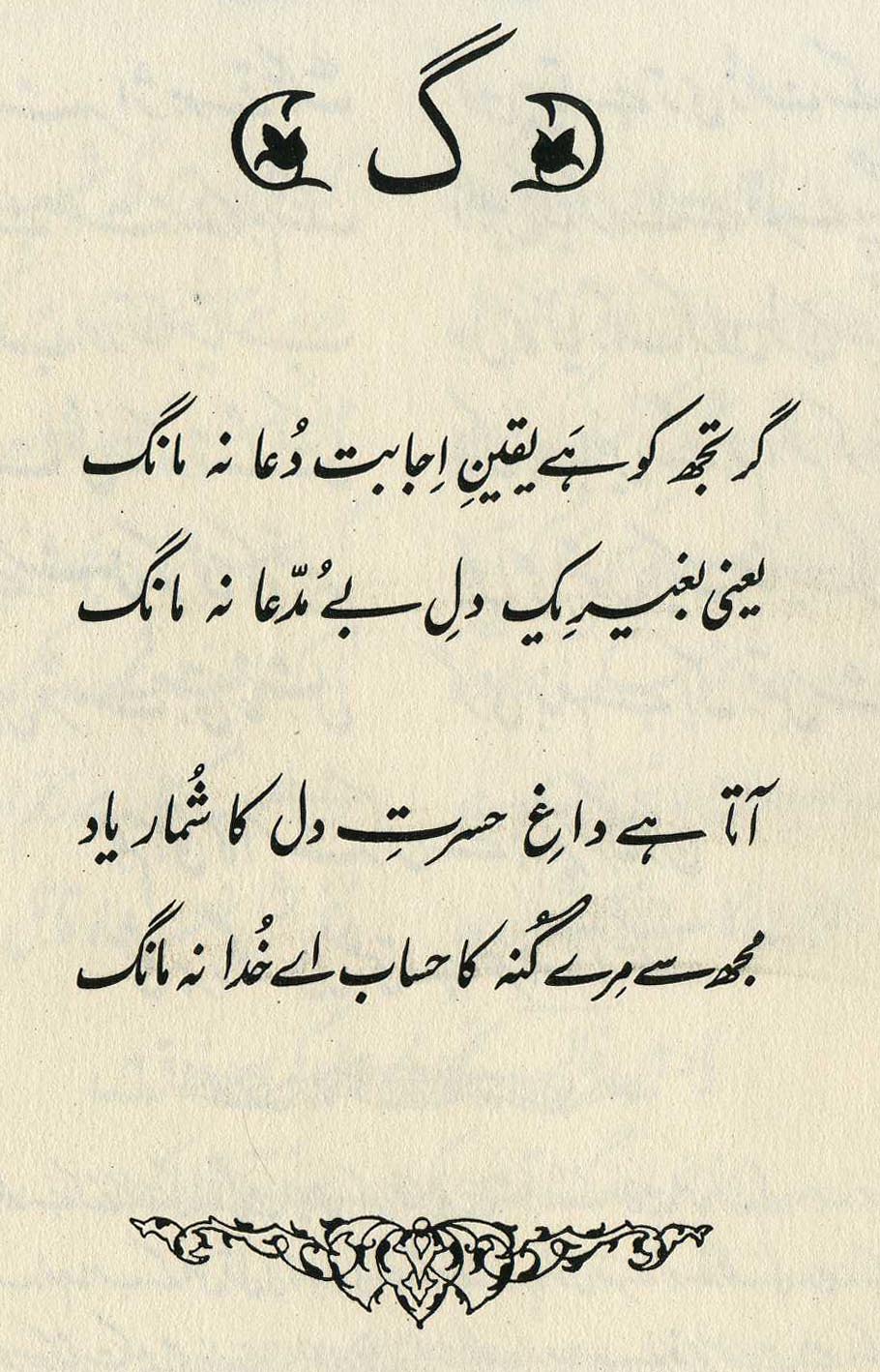
We know that if the Huma would cast its shadow on the head, then great ascendancy and supremacy is bestowed; but there's also the fact that before that event there is carefreeness. Thus in our opinion one ought to sacrifice entire ascendancy or supremacy for the sake of this carefreeness. The shadow of the Huma's wing is a burden; don't scheme to have it on your head to weigh your head down. [As Ma'ruf Dihlavi says:]
[with a headache, who has a mind to apply sandal-wood paste?
the rubbing and applying of it-- even/also this is a headache!]
== Asi, p. 148
[Asi gives the verse without attribution, and with a slightly different first line.]
The meaning is that when even the supremacy of the greatest lords is to be sacrificed for your carefreeness, why (oh Asad) do you wish to take the shadow of the Huma's wing over your head? That is, the ease/comfort that is in faqir-ship-- where is it, in kingship?! It is well known that the one on whom the Huma's shadow would fall, would become a great king.
== Zamin, pp. 213-214
From the falling of the shadow of the Huma's wing, a man becomes a king, but the English proverb is that the head on which there is a crown is forced to confront a nonexistence of peace [='Uneasy lies the head that wears a crown', from 'Henry IV']. As if the shadow of the Huma's wing is a burden. In order to show the level of elevation, Ghalib has used the construction . A 'whole fortune-ful' of loftiness-- that is, great loftiness.
= For there to be no burden, or very little of one. Kingship is a burden. Asad has sacrificed loftiness of fortune for carefreeness. He will neither be a king, nor fall into difficulties. Without responsibilities, he will wander around lightly and freely.
== Gyan Chand, pp. 241-242
For background see S. R. Faruqi's choices . For more on Ghalib's unpublished verses, see the discussion in 4,8x .
The phrase conveys completeness and universality, while the overtones of of course suggest fate and destiny, especially an auspicious one. For more on such expressions, see 11,1 . To be on a 'height' also suggests the astrological idea that one's 'star is in the ascendant'; for another such usage, see 169,4 . Asad's 'offering' is the loftiest possible one, the one that rises to the greatest height; appropriately enough, it consists of his 'lightness' or carefreeness.
By contrast to such 'lightness', the shadow of the Huma 's wing falling on one's head would be a heavy, undesirable burden. There are two kinds of pleasure here. The first is the depiction of the extreme lightness of Asad's carefreeness, such that by comparison even the shadow of a bird's wing would be a heavy weight. Thus the enjoyable wordplay of and becomes a form of meaning-play as well.
The second pleasure is the well-established fact that the man (it seems always to be a man) on whose head the shadow of the Huma's wing falls, is destined to become a king. And a king wears a heavy crown, he is burdened by affairs of state, he cannot feel 'lightness' or 'carefreeness'. But one of his perquisites is the receiving of 'offerings' and tribute from his subjects. So Asad's 'offering' of lightness or carefreeness might indeed be a lofty and acceptable one, since it's a gift of something that the king himself doesn't have.
Compare 174,3 , which similarly deprecates the Cup of Jamshid and praises a clay cup from the bazaar.
graphics/durerwing.jpg