Verse 11816aanah maa;Ng
G3
1 a
if you have assurance of [God's] acceptance [of your prayer], don't ask in prayer
1 b
if you have assurance in [your] acceptance [of God's will], don't ask in prayer
2 a
that is, except for a single heart with no desire/object, don’t ask [for anything else] in prayer
2 b
that is, without [having] a single heart with no desire/object, don’t ask in prayer
'Certain of sure knowledge, certainty, assurance, confidence, conviction, belief, opinion; truth, true faith, infallibility, evidence'.
'Granting a favourable reply; accepting (a petition or prayer); acceptance, approval; compliance, consent, sanction, assent'.
'What is claimed, or alleged, or pretended, or meant; desire, wish; suit; meaning, object, view; scope, tenor, drift; —object of search, stolen property'.
| References | |
|---|---|
| Arshi, Imtiyaz Ali | Ghazal# 79 |
| Raza, Kalidas Gupta | 194-95 |
| Nuskhah-e-Hamidiyah | 130-131 |
| Asi, Abdul Bari | 146-148 |
| Gyan Chand | 240-242 |
| Hamid Ali Khan | Open Image |
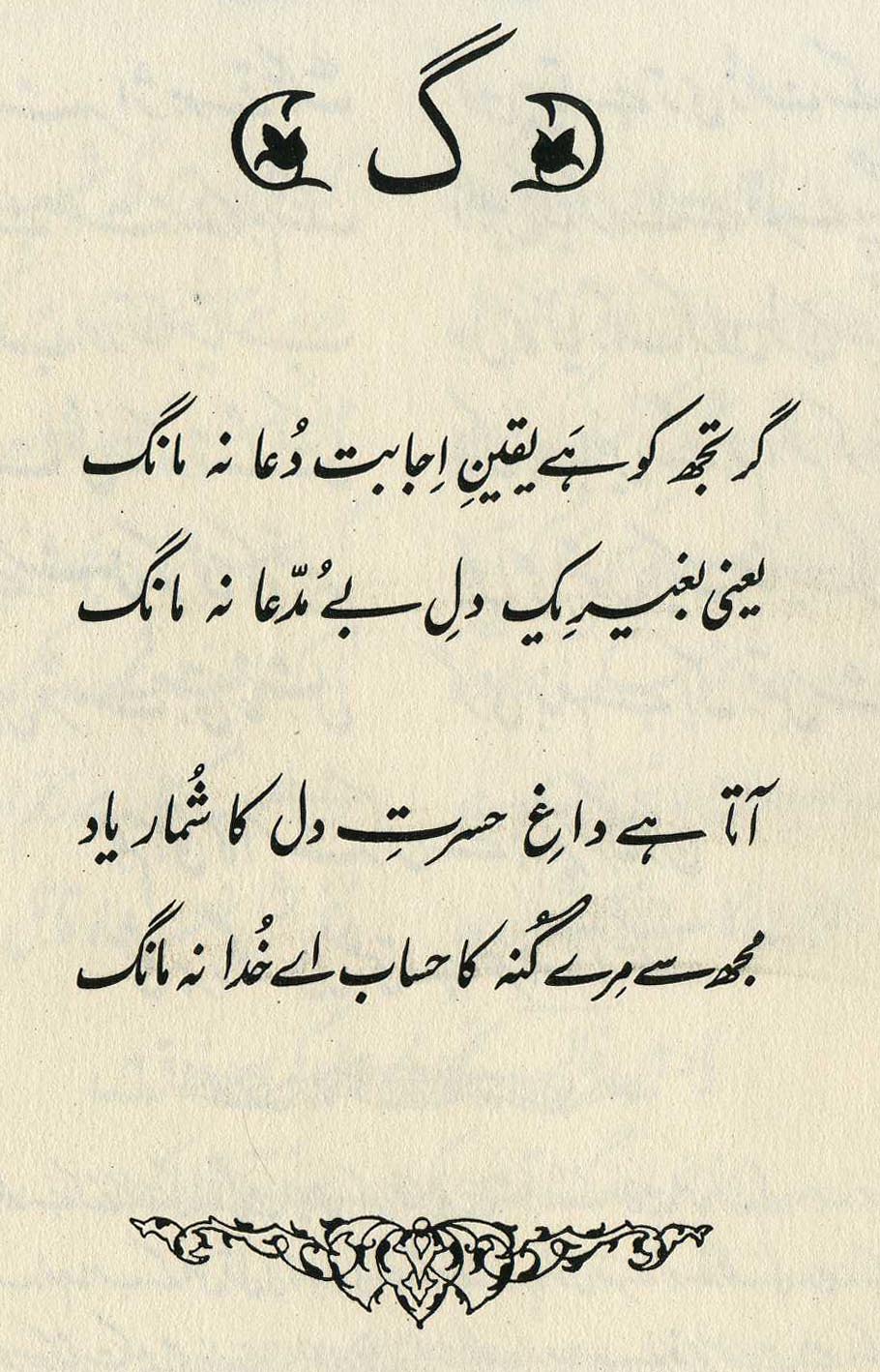
That is, when you have no desire/object at all, then there won't even be any need for asking for anything in prayer. (80)
== Nazm page 80

He says, if you have confidence that your prayer for something will be accepted, then why waste time in praying for it? Here, the meaning of is 'in addition to' []. That is, don't ask for anything else 'in addition to' a heart without desire/object. When there's a heart without desire/object, then nothing else is even necessary. No prayer can possibly be superior to this prayer. (127-28)
By 'a heart without desire/object' Mirza doesn't mean that in the heart there should remain no longing, no desire. He means only that it's not proper to pray for ordinary, trivial, commonplace things that are entirely worldly. (268)
[See his discussion of M 481,2 .]
This is one of only a handful of ghazals from which Faruqi has selected every single divan verse as superior.
In the case of the first line, , 'assurance of acceptance', can be read in two ways. The commentators adopt the obvious reading (1a), 'assurance about God's acceptance of your prayer'. But why can't it also work the other way? Then we would have (1b), 'assurance in your acceptance of God's will'. If you're confident that you can and will accept what God sends (and/or whatever comes along), then it's not proper to pray. Both meanings obviously work elegantly with the second line.
The second line features a lovely, extremely clever double use of to mean either 'except for' or 'without'. The second line thus urges the addressee either to pray for nothing else but an unmotivated heart (2a); or to pray for nothing unless s/he would have an unmotivated heart (2b). On the colloquial uses of , see 59,1 .
The commentators confront some, though by no means all, of the paradoxes of the verse. What does it mean to ask for-- or not ask for-- a heart that has no , no desire/object? If you pray for such a heart (2a), you are praying for something that will cause your prayers to cease. For if you don't have a purpose or desire (2b), you have nothing to pray for. Do you then pray only for a desireless heart? Do you pray only as a way of glorifying God? Do you not pray at all? (For a cynical comment on the 'power' of prayer, see 68,1 .)
And finally, what kind of 'assurance of acceptance' is required here, for the achievement of such ready access to God in prayer-- or such complete resignation to God's will? This verse is another of Ghalib's tightly constructed, unresolvable little 'meaning generators'.
graphics/prayerrug.jpg