Verse 11821aaz
G9
In this meter the next-to-last long syllable may be replaced by two shorts.
1
it's not the equal/confronter of a difficult purpose, the incantation of prayer/desire/neediness
'An associate, a partner, a mate; —a rival, opponent, adversary, antagonist'.
'Enchantment, incantation, fascination'.
'Petition, supplication, prayer; --i nclination, wish, eager desire, longing; need, necessity; indigence, poverty'.
'Prayer, supplication (to God); an invocation of good, a blessing, benediction; wish; congratulation, salutation'.
'Name of a prophet skilled in divination, and who is said to have discovered and drank of the fountain of life; hence he is considered as the saint of waters .... Travellers by boat always invoke his aid on starting .... He is by some confounded with the prophet Elias, and is regarded by others as a companion of Moses, or as Phineas'.
| References | |
|---|---|
| Arshi, Imtiyaz Ali | Ghazal# 68 |
| Raza, Kalidas Gupta | 332 |
| Nuskhah-e-Hamidiyah | 112-113 |
| Asi, Abdul Bari | 125-126 |
| Gyan Chand | 213-214 |
| Hamid Ali Khan | Open Image |
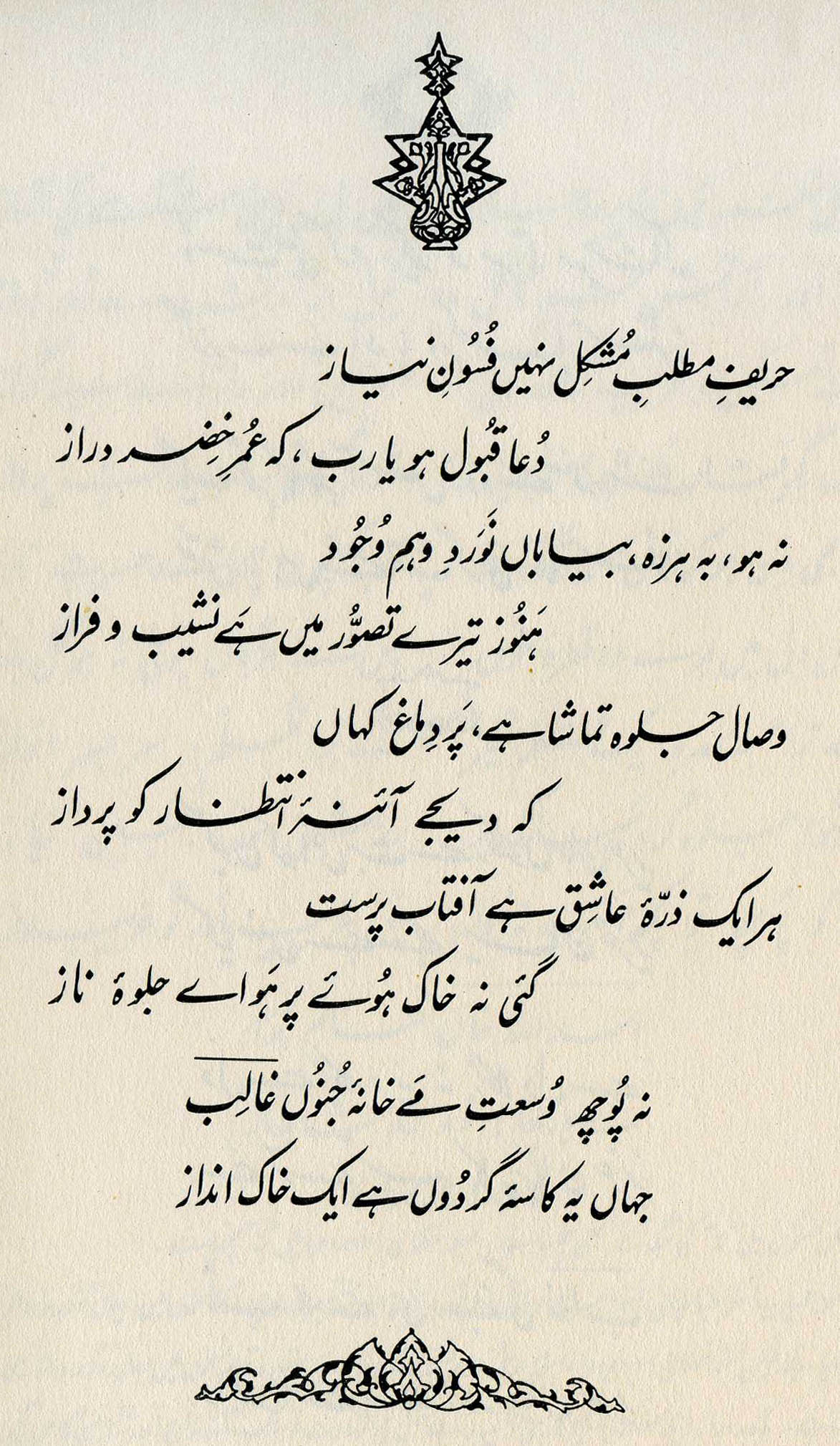
Because this thought was widespread, and the theme claimed inclusion in the opening verse, the first line has to some extent become remote from Urdu colloquial language; but it's entirely a new mischievousness, which perhaps has not occurred to anyone else. He says that in the achievement of some difficult purpose the spell [] of weakness and humility can do nothing; having no choice, now we will pray only: 'Oh God, may the lifetime of Khizr be long'; that is, we will seek such a thing as would already have been given.
==Urdu text: Yadgar-e Ghalib , p. 122
For example, if a prayer for our own long life will not be accepted, then we'll pray for the long lifetime of Khizr-- there, let Him accept that! (67)
== Nazm page 67

Hazrat Khizr is a prophet, who always shows the way to lost ones. He has drunk the Water of Life, and will remain alive until Doomsday. Whichever road he passes over, fresh green grass begins to wave on it. (150)
ABOUT KHIZR: There are many stories about Khvajah Khizr , who is thought in Islamic folk tradition to be present, though unnamed, in the Qur'an (see Platts's definition above). He is widely considered to be the 'one of Our servants' who enlightens Moses through seemingly perverse behavior (Quran 18:65-82). For further notes on Khizr, see Yusuf Ali 's translation of this passage and commentary on it. Khizr and Alexander went together to seek the Water of Life [] (for more on this see 49,6 ), but through one or another set of circumstances, only Khizr actually drank it. Thus he will live until Judgment Day. He wears green ( in Arabic), is associated with rivers and fertility, and acts as a guide to wanderers and lost travelers.
On the most obvious reading, the speaker says, in effect:' I strongly suspect that God will not pay much attention to a wretch like me; I don't have much leverage with him. So why don't I play it safe, and pray for something that has already been granted anyway, like the long life of Khizr? This may amuse God, or at least may show him my great humility and desire to please him.'
But as so often, this most obvious reading becomes, when closely scrutinized, more complicated. What is the relationship between in the first line, and in the second? A is a sort of magic spell or enchantment, the kind of thing that for good Muslims is at best dubious, and at worst positively forbidden. So the , the speaker's enchantment/spell 'of' (made by? made for? identical with?) his desire/neediness, may in fact be not prayer at all, but something more like a wistful, vain attempt at magic. Nazm guesses that its object may be long life for the speaker, which is an amusing and apposite possibility; but the desire could be for anything else as well.
When this attempt at magic fails, the only recourse is to give up on enchantment and try prayer instead; and how much confidence can the speaker have in that? In despairing cynicism, he'll just pray, in a spirit of amused or defiant irony, for the long life of Khizr. As Nazm says, 'There-- let Him accept that!' This reading, full of semi-serious (and semi-desperate?) 'mischievousness' [] toward God, is in a direct line of descent from 1,1 .
For a more serious look at the paradoxes of prayer, see 79,1 .
And here is Mir 's terse, brilliantly casual take on the possibility of Khizr's death [M 800,7 ]:
[now we don't run into him anywhere in the jungles/wildernesses
his excellency Khizr has died, perhaps]
graphics/khizr.jpg
_of_Firdausi_MET_DP215678.jpg)