Verse 51821aaz
G9
In this meter the next-to-last long syllable may be replaced by two shorts.
1
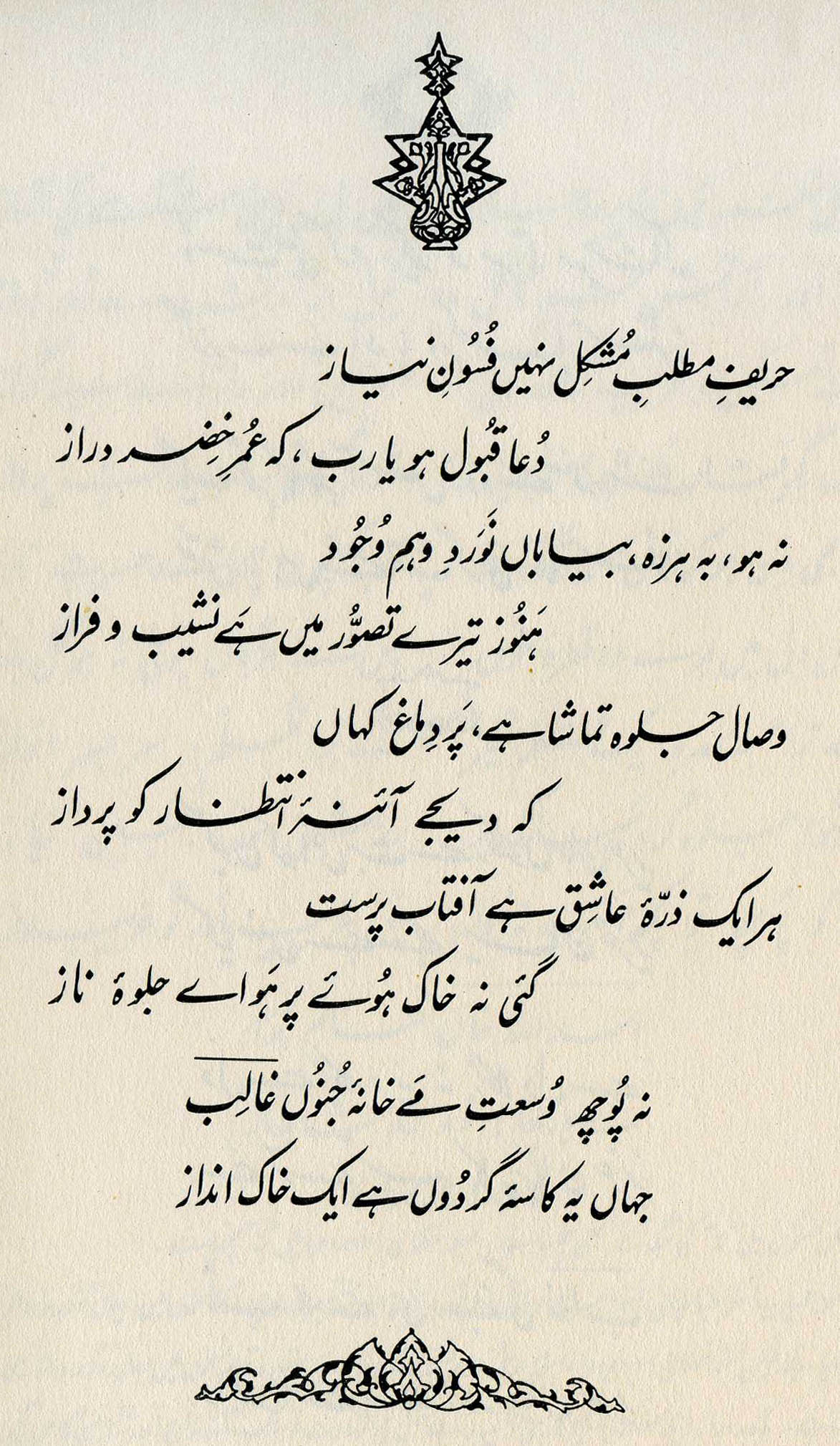
don't ask about the extent/capacity of the wine-house of madness, Ghalib!
2
where this bowl of the heavens/'wheel' is a mere/single/particular/unique/excellent dust-bin
'Latitude; amplitude; spaciousness; capacity; space, extent; space covered, area; dimensions; bulk; --convenience, ease; opportunity, leisure'.
'A wheel; the heavens, the firmament, the celestial globe or sphere; chance, fortune (and her revolving wheel)'.
'One, single, sole, alone, only, a, an; the same, identical; only one; a certain one; single of its kind, unique, singular, preëminent, excellent'.
'A shovel; loop-hole; a sling; fringe or skirt of a tent; a magician.' (Steingass p.441)
'A receptacle or pit for dust, earth, ashes, &c.; a place where rubbish is placed, a dust-bin; --(met.) the world'.
| References | |
|---|---|
| Arshi, Imtiyaz Ali | Ghazal# 68 |
| Raza, Kalidas Gupta | 332 |
| Nuskhah-e-Hamidiyah | 112-113 |
| Asi, Abdul Bari | 125-126 |
| Gyan Chand | 213-214 |
| Hamid Ali Khan | Open Image |
[The bowl of the sky is compared to a dustbin] and the ground of similitude is that the dust-bin is enclosed. And the point is that it is only filled with dust. That is, the bowl of the sky too is in the respect limited to a dust-receptacle, full of dust like a dust-bin. The point is that even in the wine-house of madness of the bowl of the sky, there isn't even enough scope for it to be numbered among bowls of wine; rather, it is only a dust-bin. The word 'single' [] in Urdu [here conveys diminution and contempt]. (67-68)
== Nazm page 67 ; Nazm page 68


He says, oh Ghalib, don't ask me about the extent/capacity of the wine-house of madness. I tell you in a few words, that there the bowl of the sky is like a receptacle for throwing away rubbish. (117)
How can I express the extent/capacity of the wine-house of passion! Where the sky, despite so much extent, is considered to have the capacity of a dust-bin. That is, there it is not even counted among the wine-glasses, but rather treated as a dust-bin. That is, the people of passion and mystic knowledge consider the world, and creation, as trifles. (151)
What an amusing, witty, vivid verse-- and so classically Ghalibian! One obvious parallel would be 10,1 , in which the whole heavenly Garden of Rizvan is reduced to a mere trifling bouquet lying forgotten in some dusty niche in the house of 'us self-less ones'. (For other dismissive-- or not-- uses of the roundness of the sky, see 138,1 and 217,4 , in which it's imagined as an egg; and compare also 147,3 .)
The 'wine-house of madness' is nonpareil because of its -- its scope, spaciousness, capacity, 'convenience, ease, opportunity, leisure' (see the definition above). It not only puts the 'bowl of the sky' to shame, but actually puts it to use-- as a dust-bin, a round container stuck discreetly in a corner and used for removing swept-up dirt and flinging away things no longer desired.
As Nazm points out, calling the sky not just 'a', but , a 'mere', dustbin can convey disdain-- making it an especially deft, offhand, and insouciant put-down. But it's impossible (and undesirable) to rule out the other senses of , for they too become variously piquant in their own right: see the definition above for the range of possibilities.
Literally, means 'dust-thrower'. In Persian, as can be seen from the Steingass definition above, it has one set of appropriate related meanings. But in Urdu, the commentators without exception take it to be a dust-bin, and I think it's clear that Ghalib does too, since otherwise the whole punch of the verse is lost. Here is one more example of the independent evolution of Urdu, with Persian words taking on new, autonomous meanings. A related usage in Urdu, to which might have been assimilated, is (see the definition above).
In the ghazal world, the mad, drunken lover is of course also the mystic knower, mocking the limited, limiting externalness of the world we live in (and, in this case, of the physical universe itself). Who wouldn't prefer a spacious, capacious, convenient wine-house, over a small, peculiar dustbin lying off in one corner of it? This verse belongs to the set of 'snide remarks about the natural world'; for others, see 4,8x .
graphics/dustbin.jpg