Verse 31821aaz
G9
In this meter the next-to-last long syllable may be replaced by two shorts.
1
union is a {glory/appearance}-spectacle, but where is the mind/spirit/mood
2
such that a finish/perfection would be given to the mirror of waiting?!
'Manifestation, publicity; conspicuousness; splendour, lustre, effulgence; displaying a bride (to her husband) unveiled and in all her ornaments'.
'The brain; head, mind, intellect; spirit; fancy, desire; airs, conceit; pride, haughtiness, arrogance; intoxication; high spirits'.
is an archaic form of ( GRAMMAR )
'Finish, accomplishment, perfection; frame or setting (of a picture)'.
| References | |
|---|---|
| Arshi, Imtiyaz Ali | Ghazal# 68 |
| Raza, Kalidas Gupta | 332 |
| Nuskhah-e-Hamidiyah | 112-113 |
| Asi, Abdul Bari | 125-126 |
| Gyan Chand | 213-214 |
| Hamid Ali Khan | Open Image |
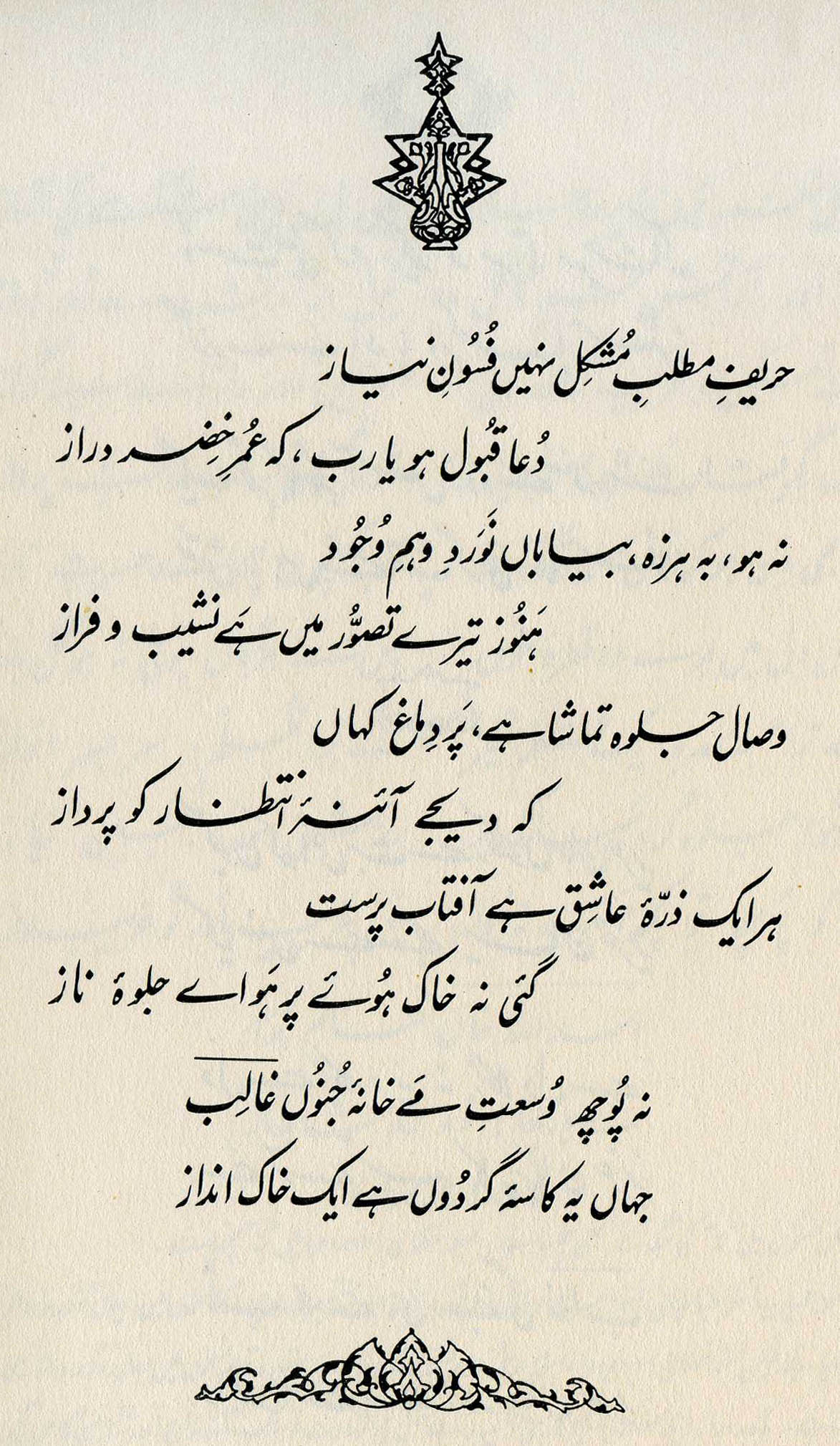
That is, I concede that union with the beloved is a glory-spectacle-- that is, that it shows the spectacle of the glory of beauty. But how can I have a mind to give a polished finish to the mirror of waiting? The conclusion is, who would wait until the spectacle of the glory of beauty would be vouchsafed? (67)
== Nazm page 67

He says, well, I agree that union with the beloved always shows ever-new spectacles of beauty. But how can I obtain a mind to sit and constantly polish the mirror of waiting? The meaning is it's easy to long for the spectacle of the glory of beauty; but it's a very difficult thing to endure the harshnesses of waiting. (116)
From this verse a picture of Mirza's rakishness [] begins to pass before the eyes. And he himself has just said: 22,2 . (151)
Initially, the most striking feature of the verse is , the first three words of the first line. It's not obvious how to put these three abstract nouns together. Metrically, there could be an that would give us a reading of , 'union of/with glory/appearance'. If we don't insert this optional , then we have to make into a (Persian-style) compound. This compound can mean either 'a spectacle of glory/appearance'-- that is, a of -- or, if we decide that it's adjectival, 'making a spectacle of glory/appearance', with the adjective applying to . Whatever choice we make, it feels somewhat arbitrary and confusing. Noun-noun compounds like are unnatural in Urdu, but very common in Persian; for discussion see 129,6x .
After this initial phrase, we encounter a problem or an objection: 'but where is the mind/spirit' []. This is an idiomatic expression meaning something like 'who needs that?!' or 'how could anybody put up with that?!'. For another example of this idiomatic use, see 27,6 .
What is it that one just doesn't feel like? We learn in the second line what it is: finishing/perfecting the mirror of waiting. The lover is just too impatient to be able to bide his time, it seems, or too arrogant to feel that even such a union is worth his waiting for. Bekhud Mohani speaks of his 'rakishness' (which could also be called 'mischievousness' []), and which points to 22,2 , in which the lover prides himself on what looks very much like this attitude).
Moreover, as usual Ghalib has used an idiom in both its colloquial and its literal senses. For can also be taken literally, not just as an emotional idiom of rejection but as a serious question. Where in fact is the mind that's capable of finishing, perfecting, polishing the 'mirror of waiting' so as to reveal these glories of union? Merely waiting is only the beginning: the sensibility must be refined, honed, focused. With the best will in the world, does anyone have a mind of such powerful mystic capabilities?
And as a fringe benefit, with this realization comes a fresh enjoyment of the first three words of the first line. No wonder they are confusing-- they describe a state that no one has the mental ability to properly envision, evoke, imagine. We see them through a blurry, only semi-polished mirror. No wonder they look like awkward, unresolved shapes. In King James Bible terms, we still see ' through a glass darkly '; will we ever be able to come 'face to face' with the divine Beloved?
graphics/mirror.jpg