Verse 41821aaz
G9
In this meter the next-to-last long syllable may be replaced by two shorts.
1
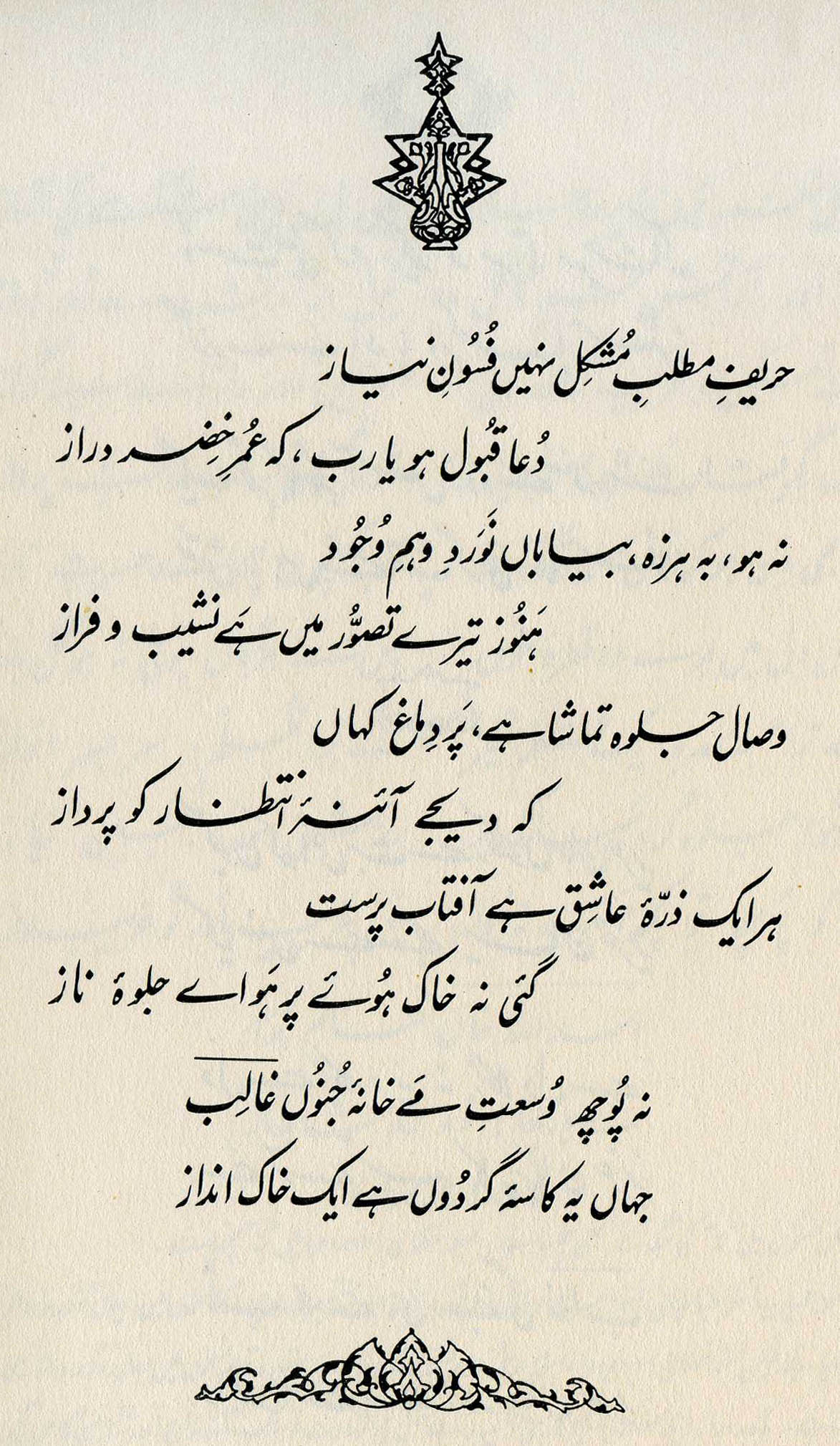
every single sand-grain of the lover is a sun-worshipper
2
even on [his] having become dust, the desire/wind of the glory/appearance of coquetry did not go
'Air, wind, gentle gale;... --affection, favour, love, mind, desire, passionate fondness'.
| References | |
|---|---|
| Arshi, Imtiyaz Ali | Ghazal# 68 |
| Raza, Kalidas Gupta | 332 |
| Nuskhah-e-Hamidiyah | 112-113 |
| Asi, Abdul Bari | 125-126 |
| Gyan Chand | 213-214 |
| Hamid Ali Khan | Open Image |
There is an in the word -- that is, the dust-grain is in the air ( ); the past tense [of ] is . (67)
== Nazm page 67

He says, every single grain of the lover's dust is a sun-worshipper []. Even after his turning to dust, the longing for the glory of coquetry was not erased. The meaning is that just as grains of dust begin to sparkle when confronted by the sun, so the grains of dust of the lover seek light from the sun of the beauty of the beloved. (116-17)
The grains always fly in the wind []. But the poet expresses the captivating cause of this: that the lover's form has mingled with the dust, mixed with the dust. But even now so much glory-worship remains that every grain has become a sun-worshipper.
Janab Shaukat says that in the second line there's a need for 'even' [], [such that it should read] [even upon becoming dust, the longing for the glory of coquetry did not go]. In this line, could not enter without murdering eloquence []; for this reason Mirza kept in view flowingness , and composed it in this way. From one necessity is fulfilled, but it also engenders convolutedness . (151)
Ghalib loves to think about grains of sand and the way they glitter in the sun; for more on this see 16,4 . He imagines the lover's body as decomposed into dust, each grain of which glitters adoringly in the sunlight, capturing and returning the glowing rays of the radiant, coquettish presence (of the sun and/or the beloved).
Nazm calls attention to the multivalence of . He cites its identity in spelling with the masculine singular perfect form of ; this is made especially prominent by its placement almost directly after , the masculine plural perfect form of . Thus one might well read it initially as .But then, in view of the and the rest of the line, it becomes clear that the word is not at all, but is the identically-spelled feminine noun instead. Thus he calls it an , a special form of punning; it is also an enjoyable kind of wordplay.
But the feminine noun itself is notably multivalent: it means both 'air, wind' and 'desire' (see the definition above, and 8,3 ). The verse is so framed that both meanings are fully activated. The two Bekhuds prove the point: Bekhud Dihlavi reads 'desire' (the sand-grains sparkle), and Bekhud Mohani reads 'wind' (the sand-grains blow into the air).
The radiance/appearance of coquetry thus keeps the dust of the dead lovers both glinting in the sun, and flying restlessly through the air. In the beautiful 61,7 , the lover's dust becomes pure ardor that flies upward and is blown in the wind,
graphics/sandgrains.jpg