Verse 10x1821aaz
G9
In this meter the next-to-last long syllable may be replaced by two shorts.
1
now/still, oh effect/sign of vision, the shame/honor of disgrace/notoriety--
2
the gaze, mischief-gaited; and the two-worlds door, open!
'Footprint; sign, mark, token, trace, track, vestige, shadow; impress, impression, influence; effect; result, consequence'.
'Seeing, sight, vision; show, spectacle'.
'Look, glance, sight, view, regard; consideration; ... —watching, observation, attention'.
'Trial, affliction, calamity, mischief, evil, torment, plague'.
'Pace, gait, walk, march; stately gait, graceful walk; strut'.
| References | |
|---|---|
| Arshi, Imtiyaz Ali | Ghazal# 68 |
| Raza, Kalidas Gupta | 332 |
| Nuskhah-e-Hamidiyah | 112-113 |
| Asi, Abdul Bari | 125-126 |
| Gyan Chand | 213-214 |
| Hamid Ali Khan | Open Image |
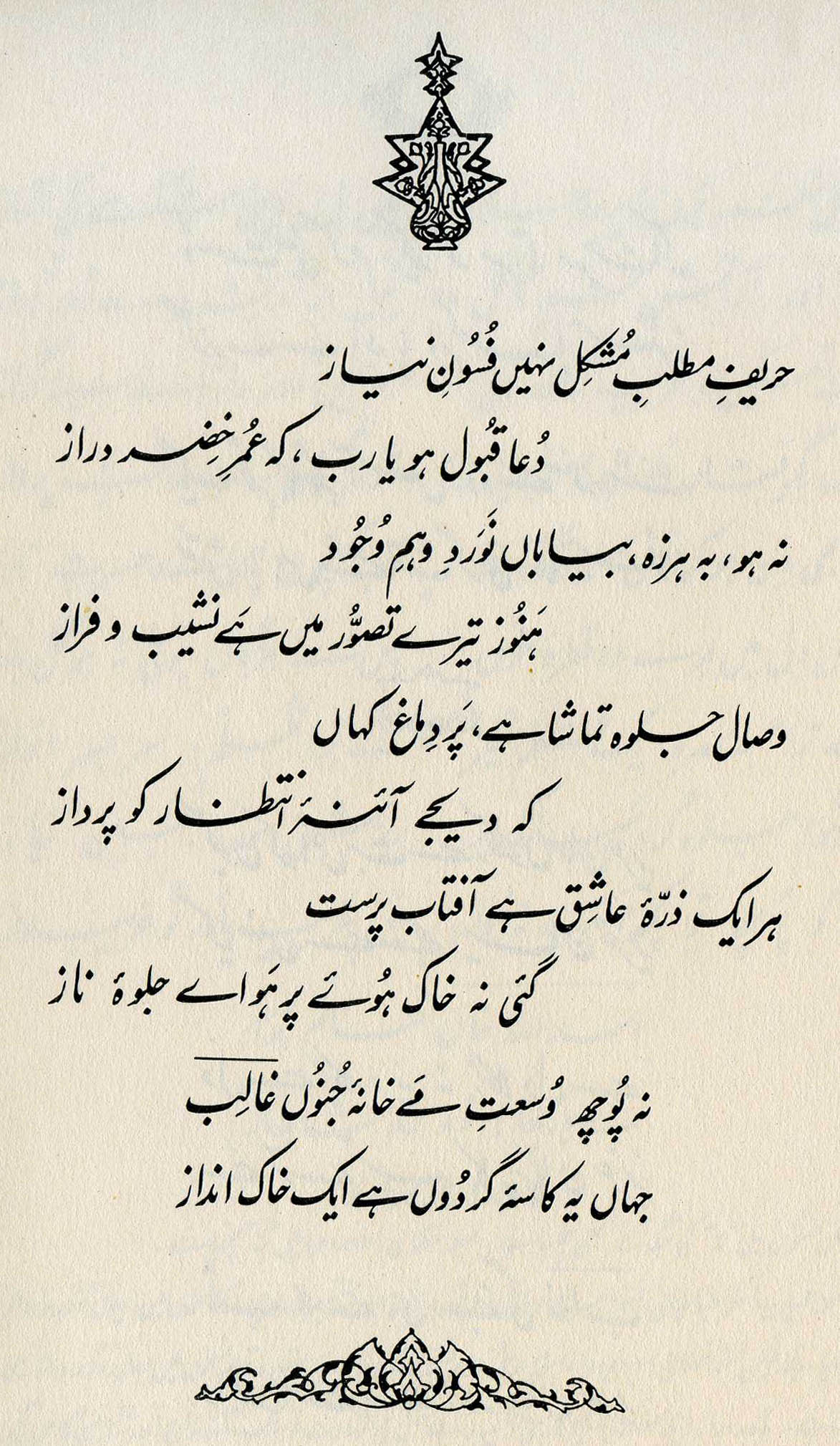
= test. = that gait that would overturn/confuse people's hearts, would enchant them, would be Doomsday-arousing and turmoil-creating.
The meaning is that the gaze is absorbed in strolling through the spectacle of the wonder/deceit of existence. The way the gaze wanders/strolls this way and that, coming and going, is precisely being 'mischief-gaited', because only/emphatically an absorbedness in a trustworthy spectacle of existence has made it indifferent and heedless about absolute/abstract existence.
And this relish for this very spectacle is the cause of our disgrace. Enough-- now halt the mischief-gaitedness of the gaze, and close the two-world door, which is still open. That is, avert your eyes from every direction.
== Zamin, p. 187
From my eyes I have shed many tears. I thought that there would be an effect on the beloved, but there was none. My attraction/feeling is being disgraced. Now the beloved's eye is doing 'mischief-gaitedness', it goes in every direction. The door of both worlds is open-- sometimes she looks at that one, sometimes at this one. As yet, she hasn't looked in my direction.
But in the Nuskhah-e Sherani, instead of there is [Gyan Chand's text has ]. On this reading, no scope for the effect of tears remains, and the meaning becomes somewhat convoluted. Probably this is the meaning: The beloved saw me; I thought that my wretched condition would have an effect on her, but it did not. The effect of vision is deserving of disgrace. The beloved's gaze is still wandering here and there, creating mischief. The field of the whole world is open to her-- where she would wish, she would create mischief.
There can also be a philosophical commentary. The meaning of can also be a shape or form. 'Oh my multiplicity-adorning insight, you are a shame and a disgrace. My gaze has created mischief, and is gadding about in both worlds. In reality, the two worlds do not even exist. They are the mischief of the erroneous gaze.' But this commentary doesn't please the inner self. In the verse, only/emphatically the affair of beauty and passion is learned.
== Gyan Chand, p. 214
For background see S. R. Faruqi's choices . This verse is NOT one of his choices; I have added it myself, to complete the ghazal. For more on Ghalib's unpublished verses, see the discussion in 4,8x .
This verse, most unusually, has no verbs at all. And of course since it's an 'A,B' verse, we can't establish a coherent causal or logicall sequence of the lines. It's anybody's guess who is doing what to whom, and why.
In the first line we learn that apparently somebody or something now/still confronts the shame (or honor) of disgrace. (On the potential multivalence of , see 3,5 ; on the public visibility suggested by , see 20,9 .) It might be the addressee, 'effect/sign of vision' (a strange personification which itself covers a wide range of possibilities-- see the definitions above) who is subject to disgrace, but it might not. Zamin thinks the 'vision' is that of the lover; Gyan Chand thinks it's that of the beloved. In a verse so abstract, it's hard to choose.
The second line doesn't at all resolve the question. The gaze is mischief-inclined, and the 'two-worlds door' is open! Is the 'gaze' the same as the 'vision', or different (see the partial overlap in their definitions)? If the gaze is the beloved's, she will no doubt wreak universal havoc. If the gaze is the lover's, he will act perhaps as a voyeur, perhaps as a futile fantasist, perhaps as a seeker of mystical insight. And what exactly is a 'two-worlds door'? For discussion and examples of constructions, see 18,2 .
Really in this verse the structure is annoyingly loose and vague; perhaps the 'two-worlds door' has been left too wide open. Compare 41,4 , a verse also full of open doors, but with a more compelling air of mystery.
graphics/opendoor.jpg