Verse 41816ilnahii;N rahaa
G3
1
facing toward the six directions, the door of the mirror is open
2
here, the distinction/discrimination of defective and perfect did not remain
'Six-sided, hexagonal; — a hexagon; a cube:'.
'(The six-faced mirror), The heart of Muhammad; the sleepers in the cave; the inhabitants of the invisible world; visions, revelations'. (Steingass p.133)
'Separation, distinction, discrimination (= ); discernment, judgment, discretion; holding oneself aloof; refusal; --good-breeding; ceremony; preëminence'.
| References | |
|---|---|
| Arshi, Imtiyaz Ali | Ghazal# 29 |
| Raza, Kalidas Gupta | 161-162 |
| Nuskhah-e-Hamidiyah | 76-78 |
| Asi, Abdul Bari | 70-71 |
| Gyan Chand | 110-111 |
| Hamid Ali Khan | Open Image |
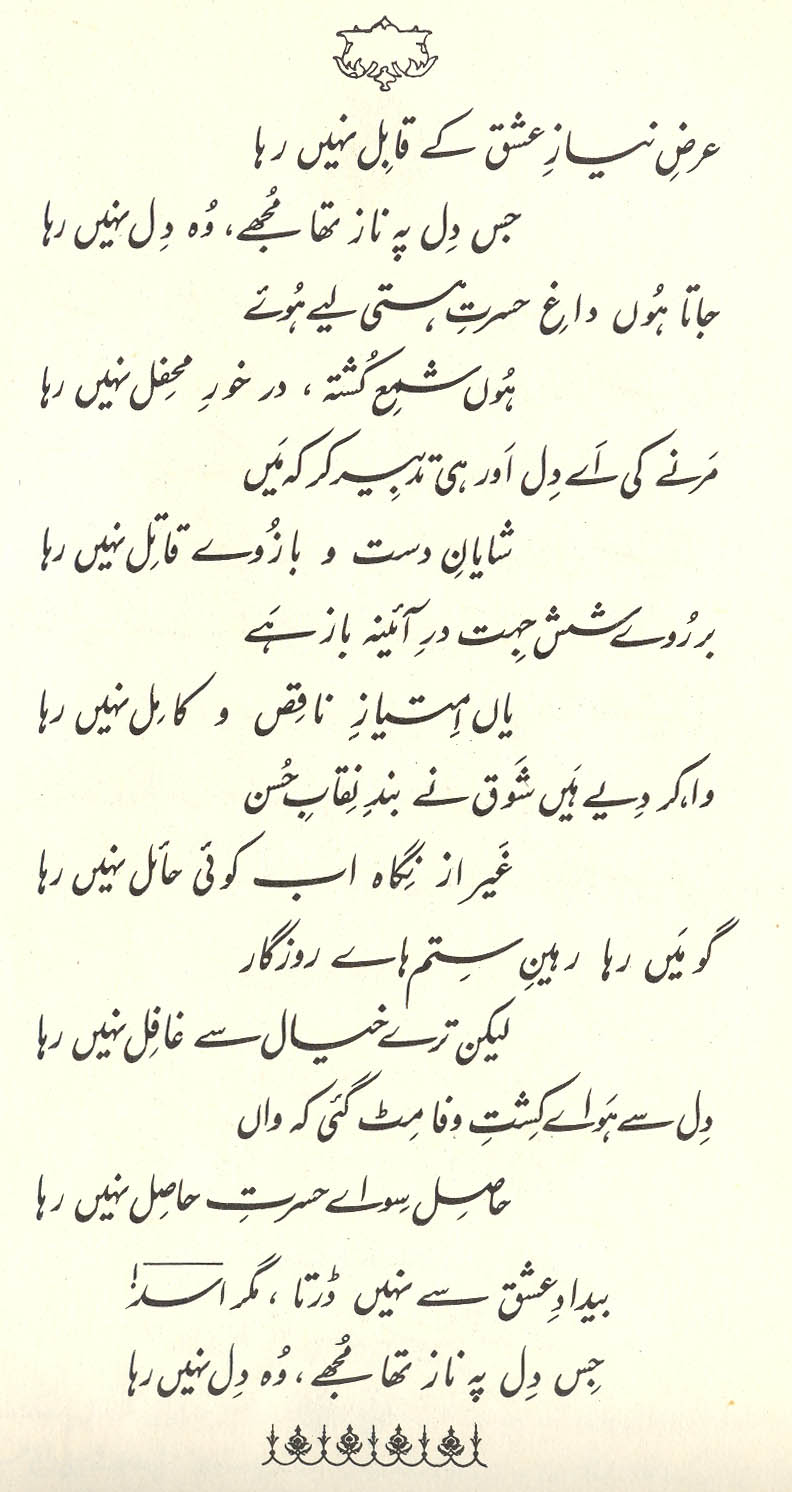
Before both defective and perfect, the six directions are present, and we are at a loss to understand them both. We are looking at both in that mirror, and are astonished that both have the same aspect. Here there's no difference between defective and perfect. A second interpretation is that the author would have called them 'facing toward six directions', and the meaning is that the way a mirror accepts reflections, and makes no distinctions, this is the same state as the image of the mystic knower's illumined heart. (38-39)
== Nazm page 38 ; Nazm page 39


Urdu text: Vajid 1902 {41}
'Facing toward the six directions'-- that is, for every individual. 'Here'-- that is, in the mirror-chamber. (41)
He says, the way a mirror accepts reflections, it makes no distinction as to whether it is the heart of a mystical knower or of a worldly person. This verse has been taken as divine truth [] or human conjecture[], both ways. If you want to take this verse toward divine truth, then the meaning will be that the heart of the mystical knower overcomes both states, good and bad. And if this verse is taken in a conjectural sense, then this meaning will emerge: that the people of the world do not perceive the difference between good and bad speech, as a result of which they cannot distinguish between defective and perfect. (77)
The six directions are east, west, south, north, down, and up....
The world and the things in the world are all before the eyes, and the astonished eye is amazed-- that is, all, perfect and defective, are unable to understand the mysteries of the world. No being is acquainted with any other being's secret. (95)
The most important word in the verse is 'here'. If this would be taken to mean 'in a mirror-chamber', then the question arises that in a mirror-chamber there are many mirrors, so why in the first line is there the mention of a single mirror? Furthermore, if this meaning is correct, then in the second line instead of there should have been , because this state of astonishment does not begin today, but has always existed.
If the mirror would be said to be a metaphor for the age/world, even then in the second line the perfect tense of the verb remains meaningless, because the age/world is always present (that is, since the world has existed, the age/time has existed). If it would be said that 'here, now, the distinction of defective and perfect is not present', then it must be accepted that the state did not exist previously, it has now come to exist.
If the 'mirror' is the heart of the mystic knower, then this verse no longer has any point at all; rather, it's a more or less meaningless idea that the door of the mirror is open in every direction, therefore no distinction has remained between defective and perfect. In this way the second line seems entirely unnecessary. In the door of the mirror being open in every direction and no distinction remaining between defective and perfect there's not even any subtlety, because a mirror is in any case unable to make a distinction between defective and perfect, whether its door would be open in six directions or in only one direction. And then, what is the need for 'here'? ....
In my opinion, this verse is the summarized story of a long mental and spiritual journey of the poet, or the speaker. The speaker's heart is like a mirror, which is one-sided-- that is, limited to unidirectionality. Since the mirror is polished on only one side, it can reflect things on only one side. This is the proof of its being limited and restricted in a sort of confinement. The speaker's mind too was limited like a one-sided mirror. Gradually and slowly progress is made in the mirror's power of reflection-- that is, awareness keeps increasing, so much so that there comes a stage when the door of the mirror of the heart opens for the six directions.
In other words, the speaker's mind (or heart) reaches the stage on its inner journey when the scene of the perfection of awareness presents itself. That is the stage where the distinction between defective and perfect is erased, and that perfect oneness is obtained that is beyond superficial distinctions.
When the mirror was one-sided, then it was defective. When it became six-directional, then it became perfect... Here no distinction any longer remains between defective and perfect, because whoever reaches that stage is perfect, although in reality he was defective.
The metaphor of 'door' for a mirror is common, but to bring in the word 'face' [] as wordplay for a mirror ('facing six directions') is Ghalib's special style. Whether meaning-based or verbal, if wordplay occurs to Ghalib (and it usually does occur), then he doesn't neglect it. This is the special trait of every great language-knower.
==(1989: 57-58) 2006: 73-75
ABOUT THE SIX DIRECTIONS: Whenever Ghalib mentions the 'six directions', he always seems to go spiralling off into some kind of cosmic abstraction. The literal meaning of is 'six-sided' (see the definition above). Ghalib uses it to refer to the 'six directions' (the usual four, plus up and down); the extension from four to six means that mystical interpretations can readily be invited. For more such complex uses of the 'six directions', see 12,6x , 128,1 , 152,4 , 155,4x , 228,2 , and 420x,6 .
What a total change from the first three verses! From extreme simplicity and starkness, to such a baroque, metaphysical complexity. Faruqi's explanation seems to make most sense of the verse. A mirror reflects anything that comes along-- any kind of thing, defective or perfect, from any direction. The searching heart of the mystical seeker, says Faruqi, no longer bothers with such distinctions, but transcends them. Perhaps they are all part of God's creation; perhaps they are nothing at all, and just don't signify. The word , literally 'here', usually implies either 'in the speaker's vicinity' or, more generally, 'in this world'.
But of course, any sense-making is on thin ice, and can never be other than haphazard or arbitrary-feeling. For the entities in the verse are excessively abstract-- a mirror, a door, the 'six directions', and someone or something located 'here' (about whom or which we have no information whatsoever).
And since the verse is a classic 'A,B' one, the relationship between the two lines is left entirely up to us to decide. Do the two lines describe the same situation? Does one of them describe a cause, and the other an effect (and if so, which way around)? Or do they describe two different situations-- which may be similar, or then again may be contrasted? As so often in Ghalib's verses, whatever answers we choose to give can be nothing but speculative, based largely as they must be on our own literary sensibilities or philosophical notions-- or, for that matter, the mood we're in at the time.
For surely a large part of the pleasure of the verse is actually a kind of mood -- a vague sense of quiescence, of radical passivity and acceptance, of mystical openness, of marveling at the whole of the cosmos.
Compare the less compelling 60,2 , in which the addressee is apparently rebuked for distinguishing between 'lowness and highness'.
Compare Mir 's brilliantly simple, faux-naïf rejection of such distinctions in M 694,3 .
graphics/mirror.jpg